
1 Beijing makes strategic gains during Merz’s China trip
Merz visits Beijing
German chancellor Friedrich Merz travelled to China for his first official visit from Feb. 25 to Feb. 26. According to news reports, Merz was joined by a large business delegation, including top executives from 30 German firms such as BMW, Volkswagen, and Siemens.
While in Beijing, Merz met with Chinese leader Xi Jinping and PRC premier Li Qiang. Li and Merz signed five agreements covering cooperation on climate change and green transition, the resumption of German pork exports (for the first time since being suspended in 2020 due to African swine fever), a protocol on poultry products (including chicken feet) exports, and sports exchanges in football and table tennis. Also, Xi informed Merz of a new PRC order to purchase up to 120 aircraft from Airbus. By comparison, Canada and the United Kingdom signed eight and 12 documents with China respectively when their heads of state visited Beijing this year. Germany’s agreements, however, offer more direct support to China’s real economy (Canada’s agreements mainly revolved around removing politically sensitive trade irritants while the UK’s agreements focused on financial and professional services).
Per official PRC media, both sides called for upholding the central role of the United Nations, opposing protectionism, and supporting multilateralism and free trade. Xi called on Germany to view China’s growth “in an objective and rational manner” and work with the PRC for “steady and sustained growth of the bilateral relationship.” Meanwhile, Merz said after his meeting with Xi that “we have had a considerable imbalance in the trade balance for about two years” and Germany is looking to reduce these imbalances, “which have arisen primarily from overcapacity in China.” Merz said that Germany’s trade dynamic with China is “unhealthy” and his government is “therefore addressing it and want to find ways to reduce this trade deficit.” However, Merz said at a business event attended by senior German and Chinese business leaders from the tech and auto sectors, “We want Chinese investment in Germany.” Merz also urged PRC leaders to “use their influence” to pressure Russia on ending the war in Ukraine.
Backdrop
Merz’s visit to China comes at a moment of geopolitical turbulence. Merz assumed office shortly after U.S. President Donald Trump rolled out sweeping global tariffs. Automobiles and related components — long a strong pillar of German exports — were particularly hard hit by Trump’s tariffs, with exports to the United States declining by 17.8 percent in 2025.
Concurrently, Germany is facing a “second China shock” with its trade deficit with China increasing by a third in 2025 to reach a record 89.3 billion euros. Germany’s exports to China also fell by 9.7 percent to 81.3 billion euros. The Merz government is under pressure to secure orders from the Chinese market to stabilize domestic manufacturing sentiment and shore up domestic support amid the rise of populist parties.
Speaking to the Bundestag in January 2026, Merz said that Germany “will have to learn the language of power politics” to be “taken seriously again” in a new world order that is being shaped by major powers.
Our take
1. The PRC and Germany appeared to be exercising practical caution with each other even as they advanced some economic interests. Xi Jinping opted to emphasize the “success story” of “mutual benefit and win-win outcomes” with Germany while urging Berlin to be “positive and pragmatic” in dealing with China. Meanwhile, Friedrich Merz raised the “unhealthy” trade dynamic between the two countries and urged the PRC to use its influence over Moscow to get Russia to end the conflict in Ukraine.
The paucity of deals and significant breakthroughs during Merz’s Beijing trip reflects ongoing geopolitical rivalry and domestic considerations on both sides. Concerns about the CCP threat in Germany and in the West more broadly, as well as the current trade imbalance in favor of the PRC, limits the sort of agreements that Merz can reach with China, including those that would deepen economic ties but would threaten security interests. That being said, Germany’s diplomatic toughness is materially constrained by economic dependence on China. Meanwhile, Xi and the CCP want to embed China deeply in global trade to deter decoupling, but do not want to be overly reliant on the West amid intensifying great power competition.
Merz would welcome the new Chinese order to purchase up to 120 Airbus SE commercial jets given its boost to the Germany economy. However, uncertainties remain between China’s procurement intentions and final implementation given Beijing’s track record in international trade negotiations.
2. Like Canada’s Mark Carney and Britain’s Keir Starmer, Friedrich Merz was partly looking to hedge against the U.S. and Donald Trump by strengthening Germany’s ties with the PRC. Trump’s maverick moves in his second term — imposing tariffs on allies, threatening to take Greenland, and criticism of Europe in his new National Security Strategy — appear to have convinced U.S. allies of the need for strategic autonomy from Washington and having economic diversity through maintaining strong economic relations with China instead of decoupling.
American allies hedging against the Trump administration will weaken the latter’s efforts to counter China and hand over strategic leverage to Beijing. In the case of Germany, Merz’s openness to Chinese investment (albeit framed around fairness) effectively provides an outlet for the PRC’s excess capacity. If Germany and the European Union do not synchronize strict tariffs with the United States, the effectiveness of Washington’s strategy of “containing” the CCP — if it is still being pursued (while the U.S. appeared to pursue a version of containment against the PRC, this is not one of the stated goals of the Trump NSS) — is at risk of being diluted. Moreover, Beijing will believe that the Western camp is not monolithic and can be divided with sufficient market incentives.
3. Despite the lack of deals and breakthroughs, Xi and the CCP would likely be satisfied with Merz’s China trip as they advanced several agendas.
First, the PRC-Germany economic ties have been reaffirmed and are now less likely to untangle in the face of U.S. pressure. This keeps China securely embedded in the global economy and helps the PRC neutralize Washington’s “containment” (particularly post-Trump).
Second, Merz’s statements upholding the UN and supporting multilateralism provided rhetorical ammunition for Beijing’s “multilateralism” narrative. Berlin’s alignment with Beijing’s position on the global order risks weakening international efforts to counter the CCP threat and could inspire other U.S. allies and nations to follow a similar course as they seek to navigate risks in major power competition.
Third, Beijing’s engagement with Berlin benefits its “divide and rule” strategy towards Europe. At a time when the European Commission in Brussels is advancing anti-subsidy investigations into electric vehicles, Beijing can offer preferential market access to German firms, incentivizing Berlin to adopt a more reserved stance within the EU toward such measures.
Four, the PRC-German agreements somewhat dilute Trump’s negotiating leverage ahead of the latter’s China trip at the end of March. Trump’s likely core demands include increased Chinese purchases of soybeans, Boeing aircraft, and energy products. However, by preemptively signaling aircraft purchases from Airbus and opening markets to countries like Canada and the UK, Beijing reduces the marginal value of the economic leverage in Trump’s hands.
4. The successive visits by Western politicians to China underscore the Western camp’s difficulty in sustaining unity on economic and strategic matters concerning the PRC over the long time.
Western politicians, constrained by short-term electoral cycles and domestic economic pressures such as employment and factory utilization, often lean toward transactional compromise when confronted with China’s vast market incentives and supply chain leverage. Beijing is able to exploit these pressures and interests to comprise the “values-based alliance” of Western nations and make asymmetrical geopolitical gains through bilateral negotiations.
The West needs a systemic approach that addresses Beijing’s governance model and narrative influence rather than engage in transactional reciprocity (aircraft orders, energy sales, etc.) if it is serious about gaining long-term strategic advantage over the PRC. As long as fundamental tensions persist between the CCP system and the Western-led order, short-term economic accommodations will not translate into durable security outcomes.
2 Analyzing the mass removal of NPC deputies and Xi’s ‘correct political performance’ campaign
Mass removal of NPC deputies
On Feb. 26, the Standing Committee of the 14th National People’s Congress concluded its 21st session in Beijing. The meeting pursued the following agenda items:
- The meeting adopted in principle the draft work report of the NPC Standing Committee.
- The NPC Standing Committee’s council of chairpersons recommended entrusting chairman Zhao Leji to deliver the Standing Committee’s work report to the upcoming fourth session of the 14th NPC.
- The meeting voted to adopt the report of the NPC Standing Committee’s credentials committee concerning the qualifications of certain deputies.
- The meeting approved a number of personnel appointments and removals.
- The meeting passed the draft agenda for the fourth session of the 14th NPC and the proposed list of the presidium and secretary-general, and decided to submit the drafts to the preparatory meeting of the fourth session for deliberation.
- The meeting approved the list of non-voting participants for the fourth session of the 14th NPC.
NPC personnel appointments and removals
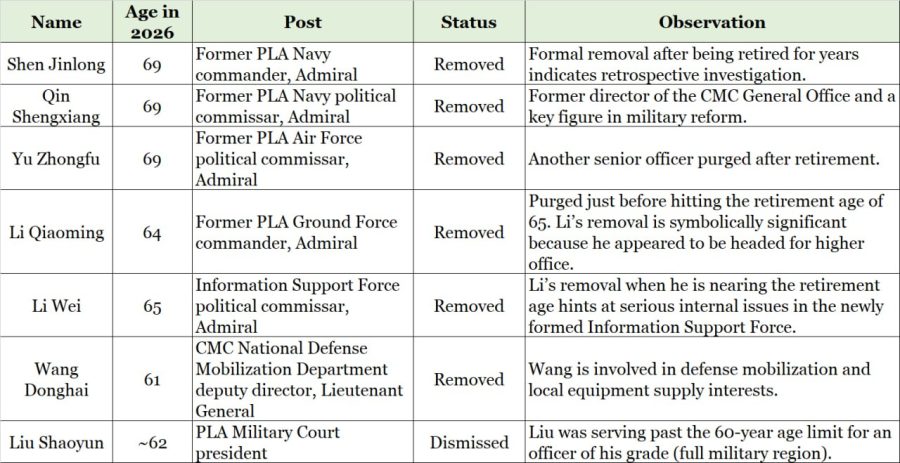
Military personnel removals
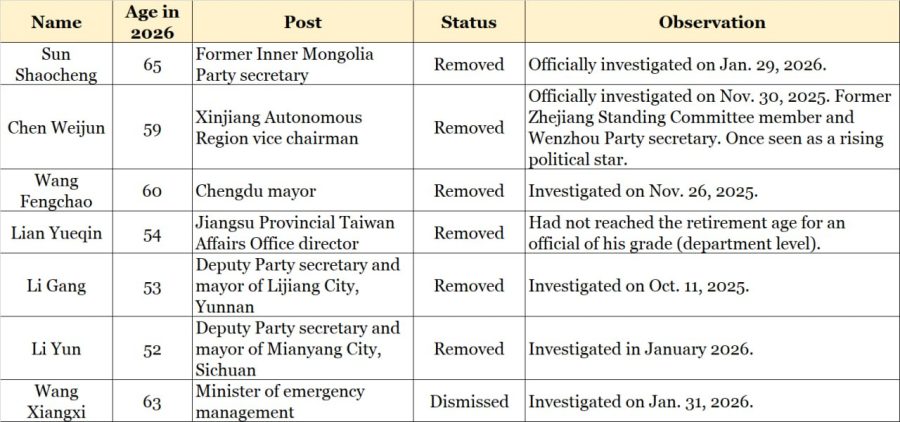
Local official removals
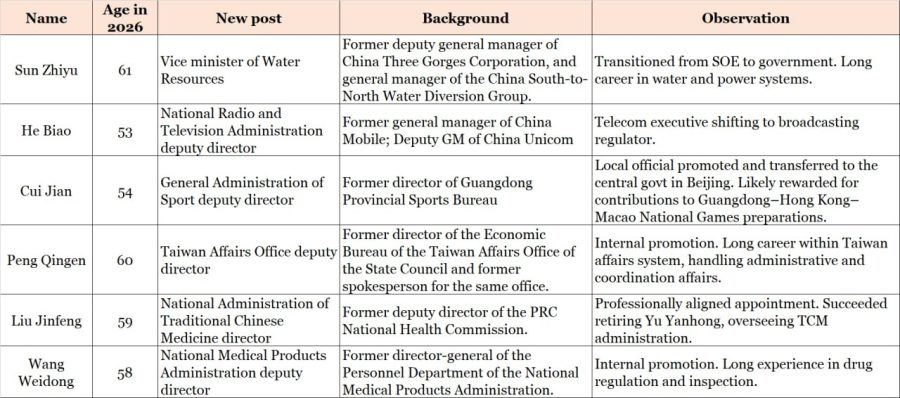
Newly appointed officials
Many of the new officials have solid professional backgrounds and were promoted from state-owned enterprises or powerful local departments.
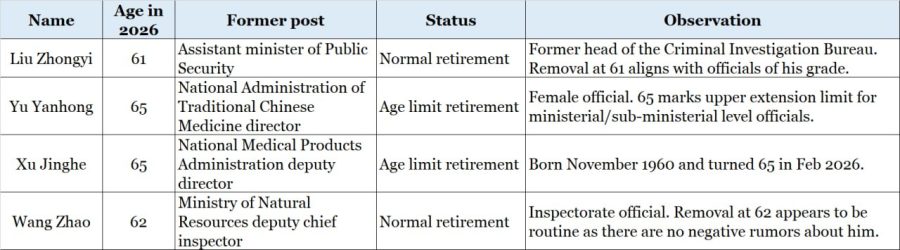
Retired officials
Political mobilization
Feb. 23
The Central Party Literature Press published and distributed nationwide a book titled “Selected Excerpts of Xi Jinping’s Discussions on Establishing and Practicing a Correct View of Political Performance” (edited by the Institute of Party History and Literature of the CCP Central Committee).
On the same day, the General Office of the Chinese Communist Party issued a notice on “launching a study and education campaign throughout the Party on establishing and practicing a correct view of political performance.” The campaign will focus on leading groups and leading cadres at the county and department level and above — especially principal officials/leading cadres (一把手) — and will begin after the 2026 Spring Festival holiday, concluding in principle by the end of July.
The Notice requires Party members and officials to thoroughly study General Secretary Xi’s important statements on establishing and practicing a correct view of political performance, as well as Party Central’s proposals for formulating the 15th Five-Year Plan for national economic and social development.
The Notice further emphasizes the need for officials to effectively prevent and rectify deviations in their performance evaluation mindset, and to resolutely and effectively implement major decisions and deployments of Party Central. Leading groups and their members at the county and department level and above are required to conduct in-depth self-examinations to identify problems related to their approach to political performance.
Feb. 24
The Central Leading Group for Party Building held a meeting to study and implement Xi’s important speeches and instructions on establishing and practicing a correct view of political performance, and to make arrangements for the related study and education campaign.
Cai Qi, a member of the Politburo Standing Committee and head of the Central Leading Group for Party Building, presided over the meeting and delivered remarks. Li Xi, a member of the Politburo Standing Committee and deputy head of the group, also attended the meeting and delivered remarks. Shi Taifeng, Li Shulei, and Mu Hong were present at the meeting.
Backdrop
The Xi Jinping leadership has been sustaining an intense purge of the People’s Liberation Army since mid-2023, targeting the PLA Rocket Force and the equipment procurement system in particular. The investigations reached a new peak in January 2026 with the purge of CMC vice chairman Zhang Youxia and chief of the joint staff department Liu Zhenli.
While the purges were underway, various political rumors concerning power shifts at the top of the CCP, including the “Xi losing power” narrative, were widely circulated overseas, most acutely in Chinese-speaking circles.
Meanwhile, the Central Commission for Discipline Inspection and the CCP Organization Department jointly issued “ten strict prohibitions” governing election discipline on Feb. 12. The prohibitions called for severely cracking down on behaviors such as factionalism and the forming of “small cliques.”
Our take
1. The proportion of officials who were “removed” (罷免) at the 21st session of the 14th NPC is high relative to those who retired due to age restrictions or resigned. Per norms in the CCP political system, the removal of an NPC deputy typically indicates that the individual has lost political credibility and is being formally investigated or subjected to severe Party disciplinary procedures.
The military system in particular is experiencing what can be described as a cross-service “comprehensive earthquake,” with senior officers from the Ground Force, Navy, Air Force, Rocket Force, and even the newly established Information Support Force being probed. The removal of several full generals who are already retired or holding sinecure positions (Shen Jinlong, Qin Shengxiang, Yu Zhongfu, etc.) are the latest signs of the sweeping purge that is underway in the PLA. More senior officers are likely to be caught up in the PLA purge given the broader reviews of generals following the downfall of two CMC vice chairs (Zhang Youxia and He Weidong) and three CMC members (Li Shangfu, Liu Zhenli, and Miao Hua) since 2023.
The military personnel whose NPC delegate status has been revoked represent only a portion of those who have been purged or will be investigated. Meanwhile, senior officials who are not implicated in alleged “anti-Xi” activities (“seriously trampled on and undermined the CMC Chairman Responsibility System,” etc.) could still face demotion and punishment on corruption-related grounds.
2. The removal of multiple PLA delegates from the NPC effectively refutes the rumors and arguments that Xi has “lost power” and Xi’s enemies are behind the purge. For one, the NPC — often described as a “rubber stamp” for Party Central’s decisions — would not be able to carry out removals of such a scale targeting both Xi-aligned and non-Xi-aligned generals had there been a genuine shift in the CCP’s power center. A power shift would most likely see the removal of mainly Xi-aligned individuals and Xi himself.
The NPC removals also follow established procedural patterns of political investigation. For senior officials, there is typically a six to nine month window between the initiation of investigation and the formal revocation of NPC delegate status. The recently announced removals reflect the phased disclosure of investigations conducted behind the scenes over the past six months. Technically, the revocation of delegate status is carried out by the local electoral units, with the NPC session providing procedural confirmation.
3. The “correct view of political performance” study campaign launched in spring 2026 carries only a superficial administrative function. In substance, it constitutes a “political health check” and loyalty test for the entire Party bureaucracy.
By redefining “political achievement” away from GDP growth and toward “deeply understanding the Two Establishes” and “upholding the Two Safeguards,” the Xi leadership has effectively stripped local officials of the ability to use economic performance as a bargaining chip in political advancement. Instead, political loyalty to Xi and the CCP has now become the overriding criteria for officials who aspire to hold higher office.
The simultaneous presence of Cai Qi and Li Xi (CCDI secretary) at the deployment meeting signals a high degree of linkage between ideological rectification and disciplinary review. Any official judged to have “deviations” in their view of political performance may face disciplinary action.
4. Xi Jinping’s ultimate objective behind the recent personnel turbulence and political indoctrination is likely to clear political obstacles ahead of the CCP’s 21st Party Congress in 2027 and pave the way for Xi to take a fourth term with minimal internal pushback.
The local leadership reshuffles in the second half of 2026 will serve as a prelude to the 21st Party Congress. Through the “ten strict prohibitions” on electoral discipline and assessments centered on the “correct view of political performance,” the Xi leadership aims to ensure that those entering provincial-level posts and the Central Committee are politically calibrated correctly and absolutely loyal to Xi.
Since no clear leadership succession echelon was established after the 20th Party Congress, ongoing political indoctrination compels existing officials to compete in displays of loyalty amid a perceived “power vacuum,” in exchange for career security beyond 2027. While Xi likely believes that the change in political assessment benchmarks will lead to a more loyal cadre and raise governing efficiency, it will more likely have a negligible or even adverse impact on the CCP’s governance as officials tailor their policies and reports (worsening the “good news” echo chamber and making it harder for Party Central to respond correctly to problems) with pleasing Xi in mind.
5. The recent personnel changes and political mobilization signal a shift in the CCP’s governing logic. Governance capacity and economic performance have receded to secondary status, while political loyalty has become the sole red line for official survival. This is not merely an anti-corruption campaign, but a political purge aimed at achieving a high degree of unity and consensus within the Party, government, and military in the lead up to the 21st Party Congress.




