
1 Wang Xing case draws attention to malign aspects of the BRI
The abduction of a minor Chinese actor in Myanmar in January has drawn attention to the proliferation of scam compounds along the PRC’s “Belt and Road Initiative” in Southeast Asia and the CCP’s role in those operations.
The Wang Xing case
Wang Xing, a 31-year-old Chinese actor, went missing on Jan. 3 in the northern Thailand city of Mae Sot. According to news reports, Wang had flown to Thailand expecting to be in a movie casting call, but was instead picked up at the airport in Bangkok, driven to Mae Sot, and moved to a scam compound in the town of Myawaddy in Myanmar. In an interview after being rescued, Wang said he only realized that he had been kidnapped after armed individuals forced him into a vehicle at a small river and took him into Myanmar.
Wang’s girlfriend Jia Jia contacted the Shanghai police less than an hour after losing contact with him. However, the police declined to file the case on the grounds that Wang was missing abroad and his girlfriend was not a direct relative. Jia Jia later contacted PRC consular offices in Thailand, but was told that they needed to confirm that Wang was in Thailand and his relatives had to file a report in Thailand before further action could be taken. Wang’s brothers also unsuccessfully attempted to report the case to the Shanghai authorities.
On Jan. 5, Jia Jia posted on social media that Wang Xing was missing and sought help for his case. Her posts were shared by some prominent Chinese celebrities and influential social media personalities, and a hashtag about how Wang was missing on the Thai-Myanmar border received more than half a billion engagements on Weibo. Subsequently, several actors who narrowly escaped being kidnapped reached out to Wang’s family and exposed the scam operation. The actors noted that the scam operation appeared to be highly familiar with dynamics in the mainland entertainment industry, provided deceptively professional “scripts” to those whom they were looking to kidnap, and offered pay comparable to legitimate productions.
On Jan. 6, Jia Jia arrived in Bangkok and filed a formal report with the PRC embassy in Thailand and the local police. The case attracted the attention of the Thai authorities due to its high profile nature. On Jan. 7, the Thai authorities said that they found Wang Xing in Myanmar and brought him back to Thailand, but did not reveal details of the operation. In subsequent press photos, Wang was spotted with a shaved head and looked traumatized. On Jan. 11, Wang returned to China.
***
Hong Kong media Sing Tao Daily reported that Wang Xing was allegedly held by a telecom-fraud syndicate in a scam compound called “Apollo Compound” in Myawaddy. Wang said that there were at least 50 other Chinese nationals with him in the building. Thai police reported that the mastermind behind “Apollo Compound,” a suspect from Guangdong, had been apprehended.
***
Overseas Chinese-language media outlet Kanzhongguo (Vision Times) reported on Jan. 16 that Wang Xing’s release was not due to a rescue operation by the Thai authorities or the PRC embassy in Thailand, but because the actual mastermind behind the scam operations got cold feet.
People familiar with the matter told Kanzhongguo that Wan Kuok-koi — a Macau businessman with triad connections whom the U.S. Treasury Department had blacklisted in 2020 for anti-corruption purposes — became alarmed that the Wang Xing case was being associated with his scam operations. Wan later found after an investigation that Wang had been abducted by his subordinates. To manage the fallout from the incident, Wan threw under the bus the person in charge of the scam compound that held Wang Xing and “handed” the latter over to the Thai authorities.
Case aftermath
‘Star Return Plan’
Following the Wang Xing kidnapping case and the exposure of scam operations in Myanmar, some efforts were made by individuals to organize rescue operations for others who are believed to have been abducted. Overseas Chinese-language media outlets reported that a woman surnamed Dai, who was a member of a mutual aid group for the families of those trapped in scam compounds in northern and eastern Myanmar, created an online document on Jan. 7 to compile information from over 100 group members who are seeking rescue help. Ms. Dai titled the online document “Star Return Plan” (星星回國計劃) and published it on the Chinese internet so that families of kidnapping victims can contribute to it. By Jan. 11, there were over 1,100 entries in the document.
On the evening of Jan. 11, the document had “forcibly stopped updating.” The document’s administrators then announced the migration and resumption of the project onto Google Docs. By Jan. 17, the “Star Return Plan” Google Doc had logged over 1,860 entries, with some entries including multiple victims. The document also showed that the majority of the cases had not been filed with the CCP authorities.
Tourism to Thailand impacted
The Wang Xing case affected Chinese tourism to Thailand. According to mainland media reports on Jan. 15, cancellations of flights from China to Thailand surged by 155 percent over the weekend of Jan. 11 and Jan. 12 per data from travel analytics company ForwardKeys. Thanet Supornsahasrungsi, head of the local tourism association in Chonburi province (where Pattaya, a well-known tourism destination, is located), said about 30 to 40 percent of Chinese tour groups had canceled hotel bookings.
Some Chinese and Hong Kong celebrities also canceled previously scheduled performances in Thailand.
Thai authorities to curb scam operations?
Mainland media reported on Jan. 14 that former Thai prime minister Thaksin Shinawatra remarked in a speech at a dinner event on Jan. 13 that the Thai government cabinet had discussed the issue of telecom fraud centers and made related resolutions. The resolutions include instructing regional electricity companies and major telecommunications firms to cease cooperation with their counterparts in neighboring countries to curb telecom fraud syndicates and drug production activities in border areas.
Chinese connection to SEA scam centers
The Wang Xing case drew attention to the fact that many of the masterminds behind the scam syndicates in Myanmar and other Southeast Asian regions are Chinese nationals. Some of these Chinese nationals and their groups have connections to the CCP, state-owned companies, the CCP’s overseas united front efforts, and Belt and Road Initiative projects.
In light of the Wang Xing case, the topic of scam compounds in Myanmar and elsewhere along BRI routes was widely reported on by overseas Chinese-language media and intensely discussed on social media. According to overseas Chinese-language media, those scam compounds were allegedly built by Chinese SOEs or Chinese-funded companies. Those SOEs or Chinese-funded companies also allegedly provided the scam compounds with finances, electricity, and telecommunication services. Some of the bosses behind scam syndicates were even targeted by CCP united front efforts, with some enjoying vice ministerial-level treatment and receiving coverage and praise in PRC state media.
On Jan. 30, 2024, the Chinese language edition of Deutsche Welle published an investigative report about scam compounds in Myanmar. The report noted that the mastermind behind the notorious “KK Compound” in Myanmar is Wang Yicheng, a Chinese businessman based in Thailand. Wang is also the vice chairman of the Asia-Pacific Economic Exchange Chamber of Commerce, a Bangkok-based organization that aims to promote Sino-Thai relations.
Deutsche Welle noted that some scam compounds are linked with the triad-connected Macau businessman Wan Kuok-koi. Jason Tower, the Myanmar program director at the U.S. Institute of Peace, told Deutsche Welle that Wan Kuok-koi is known to often quip, “I once fought hard for drug cartels, but now I fight hard for the Chinese Communist Party.”
In announcing sanctions against Wan in 2020, the U.S. Treasury Department noted that his World Hongmen History and Culture Association based in Cambodia had attempted to “paper over illegal criminal activities by framing their actions in terms of China’s Belt and Road Initiative, the China Dream, or other major initiatives of the CCP.” The U.S. Treasury also noted that the Chinese enterprises behind the World Hongmen History and Culture Association have several things in common, including their leadership having “links to criminal networks or actors involved in illicit activities in other parts of Southeast Asia” and them advertising themselves “online to be associated with Beijing’s BRI and flaunt connections with key Chinese government agencies.”
***
Hu Xijin, the former editor-in-chief of Global Times, published a commentary on the Wang Xing case on Jan. 11. In the commentary, Hu noted that despite the CCP authorities’ strict enforcement of a real name system for mobile phones, scam syndicates in northern Myanmar have managed to smuggle SIM cards across the border, register those cards, and integrate them into China’s domestic communication networks while masking their identities with virtual numbers. Hu added that telecom operators like China Mobile must provide a public explanation for this phenomenon.
In light of Hu’s commentary, Chinese netizens also raised several questions:
- Why do ordinary Chinese citizens have to register all their phone numbers under a real name, while scam operators can obtain mobile and landline numbers seemingly without limit for fraudulent purposes?
- How did scam syndicates access such accurate and detailed personal information about Chinese citizens?
- Why can scam syndicates successfully launder stolen funds, while ordinary Chinese citizens often have their bank accounts frozen or face numerous obstacles (including requiring various forms of proof) in withdrawing cash?
BRI backdrop
At the Third Plenum of the 18th Central Committee in 2013, Xi Jinping elevated the Belt and Road Initiative to a national strategy for expanding China’s influence abroad, exporting surplus industrial capacity, and extending financial reach. By the end of 2024, 155 countries had signed cooperation agreements with China under the BRI framework.
Our take
1. The Wang Xing incident and its associated developments are likely to deepen the Chinese people’s dissatisfaction with the CCP and its regime.
First, the CCP authorities came off as being unsympathetic to the plight of scam compound victims. The Shanghai authorities appeared to be unwilling to accept the report of Wang Xing going missing submitted by his relatives and girlfriend. Likewise, the PRC consular authorities in Thailand appeared to be unhelpful when the initial “missing person” report was made. While the Wang Xing case was later resolved relatively expediently, this was likely due to the fact that the case attracted a lot of attention and the CCP authorities were under pressure to deliver “results.” The CCP authorities continue to be under scrutiny over its willingness to help scam compound victims in light of the “Star Return Plan” and the effort to block the project in the mainland.
Second, the Wang Xing incident drew the public’s attention to the links between scam operations in Southeast Asia and the CCP. Discussions on Chinese message boards and social media indicate that many are coming to understand that the scam compounds came into existence with the help of the CCP through various organizations and projects. Chinese netizens also believe that these scam compounds would not survive without the CCP’s financial and infrastructural support. Others believe that the governments in the countries where the scam operations are being carried out did not take action to eradicate them partly because they were apprehensive about offending the CCP by taking out its proxies, and partly because the PRC elements were harming the Chinese people and not local citizens.
Third, many Chinese are realizing more of the CCP authorities’ double standards through the Wang Xing incident. Chinese netizens have called attention to how the CCP imposes strict controls on Chinese citizens and promotes nationalistic “wolf warrior” diplomacy, but somehow cannot deal aggressively with scammers abroad who are harming Chinese citizens and appear to have easy access to Chinese mobile numbers.
Finally, China’s economic downturn, which is closely tied to the failures of Xi Jinping’s policies and longstanding problems stemming from CCP rule, is a contributing factor as to why the scammers have a “market.” An increasing number of Chinese are becoming more desperate about their economic situation, and in their desperation would be more likely to fall for scams promising easy work and high pay. Meanwhile, the Xi leadership’s efforts to tighten control over foreign exchange and restrict outbound travel have led scam operations to pivot from luring Chinese individuals with gambling and money laundering schemes to telecom fraud and kidnapping.
2. The Wang Xing incident’s exposure of the connection between the CCP and the scam compounds in Myanmar and other countries in Southeast Asia could deepen foreign countries’ wariness of the PRC and make them more determined to push back against the CCP threat. In particular, foreign countries could become more concerned about the malignant byproducts of the Belt and Road Initiative and the darker aspects of the CCP’s attempt to expand its influence abroad.
The Xi leadership might not have explicitly ordered the creation and maintenance of the scam compounds abroad. But the CCP system and long-term proclivities of officials would naturally cause such schemes to sprout with the tacit approval of those within the regime. The CCP relies on or supports overseas Chinese communities and organizations abroad in working with foreign governments. In developing countries, several of these Chinese organizations could be involved in gray or criminal enterprises. Therefore, officials promoting the BRI or carrying out united front efforts who prioritize immediate and personal gains often end up directly or indirectly supporting criminal or grey-area schemes that some overseas Chinese organizations partake in, and overseas Chinese criminal syndicates gain an opportunity to align themselves with the CCP for protection.
Meanwhile, PRC intelligence and security agencies, as well as united front elements, are likely to work with overseas Chinese criminal syndicates to further their goals. Goals include corrupting foreign governments, hacking and other cyber crimes, espionage and infiltration work, and the suppression of dissidents, ethnic minorities, or anti-CCP individuals and movements abroad. Regarding the last point, Deutsche Welle reported in August 2021 that the PRC had allegedly set up “overseas black jails” in Dubai to abduct dissidents and Uyghurs, while French media exposed two cases in 2024 of PRC operatives attempting to forcibly repatriate dissidents and kidnap Uyghur political refugees in Paris.
Chinese nationals remain the primary victims of telecom fraud and “pig-butchering” operations run by CCP-linked individuals. However, such schemes affect Westerners and people from other parts of the world, and enslave hundreds of thousands of Southeast Asians. According to a 2023 United Nations report, at least 120,000 people in Myanmar and another 100,000 in Cambodia are believed to have been coerced into working for scam operations. The report added that the victims also come from mainland China, Hong Kong, Taiwan, South Asia, and even further afield from Africa and Latin America.
Meanwhile, John Griffin, a finance professor at the University of Texas at Austin, co-authored a paper on “pig-butchering” that noted that while there were “large inflows from potentially Chinese victims in 2020,” there appeared to be a “dramatic decrease in Chinese victims and a shift to U.S.-based victims” of scams after the CCP authorities banned cryptotrading in late 2021. Griffin estimated that “pig-butchering” scammers have stolen more than $75 billion from people around the world, of which $15 billion came from people in Western countries.
Greater recognition of malign aspects of the CCP’s BRI strategy could eventually court more pushback from the United States. At his confirmation hearing for Secretary of State on Jan. 15, Senator Marco Rubio said that while the U.S. welcomed the CCP into the global order and it took advantage of all its benefits, the Party also “ignored all its obligations and responsibilities.” Rubio continued, “Instead, they have lied, cheated, hacked and stolen their way to global superpower status, at our expense.”
2 CCP ‘hits’ its 2024 GDP growth target, but unlikely to flip negative investor sentiments
On Jan. 17, the PRC National Bureau of Statistics released China’s economic data for 2024.
Gross Domestic Product
- China’s GDP for 2024 grew by 5.0 percent year-on-year (at constant prices) to 134.9 trillion yuan.
Retail sales of consumer goods
- Total retail sales of consumer goods in December 2024 increased by 3.7 percent year-on-year to 4.52 trillion yuan.
- Retail sales of consumer goods excluding automobiles increased by 4.2 percent year-on-year to 3.95 trillion yuan.
- Total retail sales of consumer goods for the full year 2024 increased by 3.5 percent year-on-year to 48.79 trillion yuan.
- Retail sales of consumer goods excluding automobiles increased by 3.8 percent year-on-year to 43.76 trillion yuan.
National real estate market
- Real estate development investment nationwide decreased by 10.6 percent year-on-year in 2024 to 10.03 trillion yuan (calculated using a comparable caliber).
- Residential investment decreased by 10.5 percent year-on-year to 7.6 trillion yuan.
- New commercial housing sales areas in 2024 decreased by 12.9 percent year-on-year to 973.85 million square meters.
- Residential sales area decreased by 14.1 percent year-on-year to 814.5 million square meters.
- Sales revenue in 2024 decreased by 17.1 percent year-on-year to 9.68 trillion yuan.
- Residential sales revenue decreased by 17.6 percent year-on-year to 8.49 trillion yuan.
Fixed asset investment
- Fixed asset investment nationwide (excluding rural households) increased by 3.2 percent year-on-year to 51.44 trillion yuan (calculated using a comparable caliber).
- Private fixed asset investment decreased by 0.1 percent year-on-year to 25.76 trillion yuan.
Other data
- The total value of foreign trade increased by 5.0 percent year-on-year to 43.85 trillion yuan. Exports grew 7.1 percent year-on-year to 25.45 trillion yuan, while imports increased by 2.3 percent to 18.39 trillion yuan.
- The annual consumer price index increased by 0.2 percent from a year ago.
- China’s total population decreased by 1.39 million to 1.40828 billion by the end of 2024.
Our take
1. China’s lackluster economic performance in 2024 and a People’s Daily commentary in December 2024 noting that the PRC can accept annual growth of “a little to the left or a little to the right of 5 percent” led Wall Street and global banks to lower their China GDP forecasts for 2024.
However, we noted on several occasions that the CCP authorities will release figures showing that it achieved its annual growth target in 2024 regardless of the actual situation. For example, we wrote in the Oct. 21, 2024 newsletter: “We believe that the CCP authorities will find it very difficult to hit its ‘around 5 percent’ without creative data manipulation and taking measures to completely change the pessimism about China’s economic prospects both inside and outside the country. Regardless, the NBS will undoubtedly release data next year showing that it had met the growth target.”
2. The CCP’s own key economic figures from 2024 make it hard to believe that the Chinese economy really grew by 5 percent for the whole year. Exports aside, other key economic indicators logged growth of less than 5 percent. The real estate sector in particular saw double-digit declines; real estate constitutes a substantial share of the GDP.
Meanwhile, the Chinese economy continues to face deflationary pressures. The CPI rose by just 0.2 percent for the year, while the PPI fell by 2.2 percent. Additionally, growth in new renminbi loans and social financing decreased by 20.49 percent and 9.34 percent respectively in 2024 from a year ago.
3. Using a method employed by the CCP authorities to calculate real GDP growth, we estimate that China’s actual GDP growth for 2024 was 3.6 percent, or much lower than the official 5 percent.
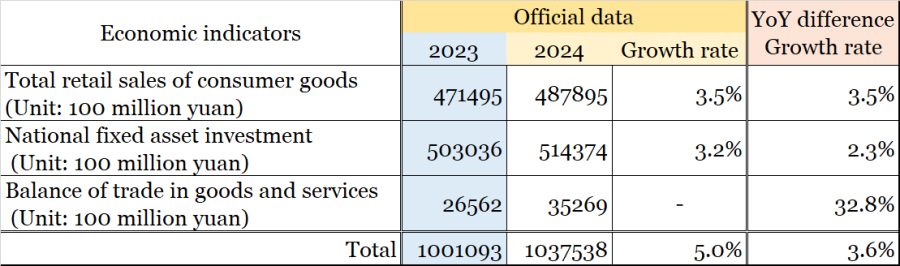 Source: National Bureau of Statistics and State Administration of Foreign Exchange
As the State Administration of Foreign Exchange has only released data for China’s trade in goods and services for the first 11 months of 2024, we assumed in the table above that the growth rate of China’s trade in goods and services for the full year matches the figure of the January-November period (32.8 percent).
4. Beijing may have “hit” its stated 2024 growth target, but foreign investors are unlikely to be convinced given longstanding and increasing skepticism about official data. As chief economist for Asia Pacific at Natixis Alicia Garcia-Herrero told Reuters, “Are investors around the world going to invest in China because they hit 5 percent? No. So it’s becoming an irrelevant target.”
We believe that foreign investors will approach investing in China with greater caution and pay greater attention to risk assessments as the economic situation deteriorates. Foreign pessimism about China is also likely to accelerate capital outflows and steel the resolve of foreign countries in addressing the CCP threat.




