
1 China’s industrial profits likely declined in Q1 2024, major state banks see falling profits, and more areas ease property restrictions
China industrial profits fall in Q1 2024
April 27
The PRC National Bureau of Statistics released China’s industrial profit data for the first quarter of 2024. According to the NBS’s calculations on a “comparable caliber,” total profits of industrial enterprises above designated size nationwide increased by 4.3 percent to reach 1.506 trillion yuan.
However, a comparison of the recent official data with the official data from previous years shows that China’s industrial profits for Q1 2024 shrank rather than grew in absolute terms.
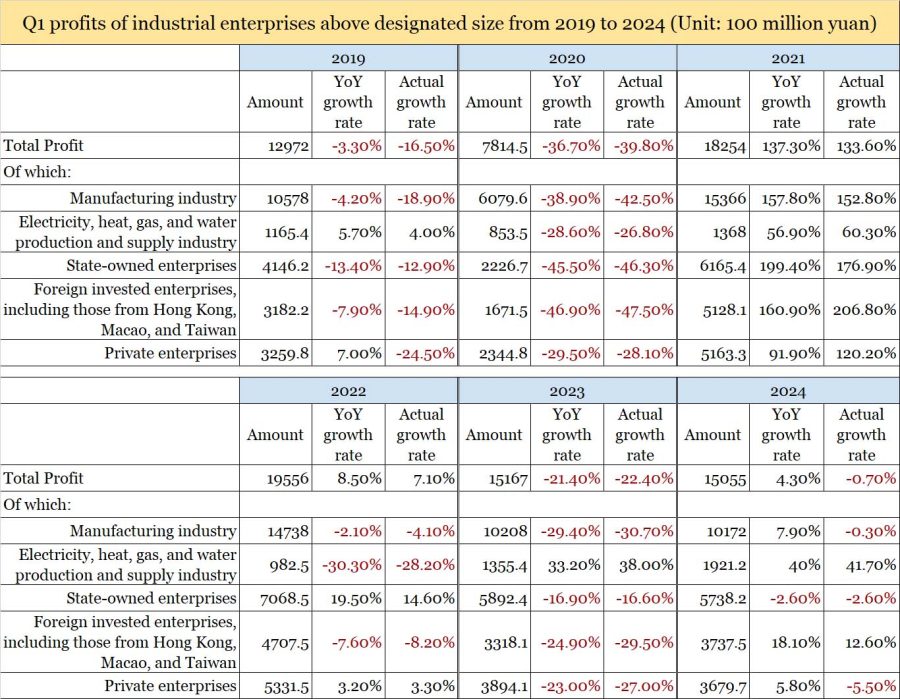
Table 1 (Source: National Bureau of Statistics)
China’s factory and services activity growth slows
April 30
The NBS announced that China’s manufacturing purchasing managers’ index (PMI) fell to 50.4 in April from 50.8 in March. With the exception of production, the sub-indexes of new orders (51.1), raw material inventories (48.1) and employment (48.0) slowed down when compared to the previous month. Also, with the exception of main raw material purchase price (54.0), other related PMI sub-indexes like new export orders (50.6), imports (48.1), purchasing quantity (50.5), factory prices (49.1), finished product inventories (47.3), and backlog orders (45.6) all eased off from a month ago.
Meanwhile, the services sub-index under the NBS non-manufacturing survey slowed sharply to 50.3 in April, compared with 52.4 in March.
Profits fall for six major state banks and CICC
April 27
The Bank of Communications announced profits of 24.99 billion yuan in the first quarter of 2024, an increase of 1.44 percent year-on-year. The bank’s net interest margin was 1.27 percent, compared with 1.28 percent at the end of 2023.
April 29
China International Capital Corporation announced a Q1 2024 revenue of 3.874 billion yuan, a decrease of 37.61 percent from a year ago. The company’s net profit attributable to its parent company decreased by 45.13 percent to reach 1.239 billion yuan.
April 30
1. China Construction Bank announced a net profit of 24.99 billion yuan in the first quarter of 2024, a decrease of 2.2 percent year-on-year. The bank’s net interest margin was 1.57 percent, compared with 1.7 percent at the end of 2023.
2. The Bank of China announced a net profit of 55.99 billion yuan in the first quarter of 2024, a decrease of 2.9 percent year-on-year. The bank’s net interest margin was 1.44 percent, compared with 1.59 percent at the end of 2023.
3. The Industrial and Commercial Bank of China announced a net profit of 87.65 billion yuan in the first quarter of 2024, a decrease of 2.78 percent year-on-year. The bank’s net interest margin was 1.48 percent, compared with 1.6 percent at the end of 2023.
4. The Postal Savings Bank of China announced a net profit of 25.81 billion yuan in the first quarter of 2024, a decrease of 1.73 percent year-on-year. The bank’s net interest margin was 1.92 percent, compared with 2.01 percent at the end of 2023.
5. The Agricultural Bank of China announced a net profit of 70.35 billion yuan in the first quarter of 2024, a decrease of 1.55 percent year-on-year. The bank’s net interest margin was 1.44 percent, compared with 1.6 percent at the end of 2023.
Real estate policies further relaxed in some areas
April 28
Mainland media reported that several major second-tier cities have recently lifted property restrictions and more cities are expected to do so in the future:
i) Incomplete data from Zhuge Data Research Center showed that 35 cities in China have relaxed property restrictions since 2023, with 22 of the 35 (including Hefei, Kunming, Suzhou, and Changsha) fully easing all restrictions. Also, the number of cities with property restrictions (excluding Hainan Province) had dropped to single digits. Data from China Index Research Institute also showed that only the core areas of cities (excluding Hainan) such as Beijing, Shanghai, Shenzhen, Guangzhou, Hangzhou, Tianjin, and Xi’an still retained property restrictions, with Hangzhou only having restrictions on the purchase of new houses.
ii) An increasing number of cities are gradually canceling the lower limit on interest rates for first-home mortgages. For instance, incomplete statistics from Zhuge showed that 12 cities, including Nanchang, Qingdao, Taizhou, and Fuzhou, have phased out the lower limit on commercial individual housing loan interest rates for first-time home buyers.
iii) Many places, including Luoyang, Yantai, Harbin, and Guangzhou, have adjusted their housing provident fund policies. Adjustments include raising the maximum amount that can be borrowed from the housing provident fund, supporting the withdrawal of housing provident funds for down payment, reducing the down payment ratio for housing provident fund loans, and canceling the conditions restricting housing provident fund loans in different places.
iv) Many cities are further relaxing household registration requirements. For example, Nanjing plans to ease requirements such that the purchase of property in the city directly leads to the home buyer obtaining household registration.
v) All prefecture-level and above cities in China have currently established urban real estate financing coordination mechanisms. As of March 31, 2024, 1,979 “white-listed” projects have collectively received bank credit totaling 469.03 billion yuan.
vi) Many regions are exploring policies for property trade-ins (以舊換新). Data from the China Index Research Institute found that more than 30 cities have expressed support for property trade-ins since 2023. Of those cities, Yancheng, Suzhou, Shenyang, and some other places are issuing subsidies for property trade-ins, while the local governments of Hai’an in Jiangsu Province, Xiangcheng District in Suzhou, Zhengzhou, Lianyungang, and some other places are directly purchasing old homes from individuals or developers.
vii) Liandu District in Zhejiang’s Lishui City issued plans to allocate 16 acres of residential land for individuals to build low-density projects (i.e. villas) which can be sold after completion.
April 30
The Beijing municipal housing and urban-rural development commission announced that families are allowed to buy one more home in non-core areas outside the fifth ring.
Our take
1. China’s industrial profits showing negative growth in absolute terms aligns with our earlier analysis and estimation that China’s GDP and fiscal revenue for the first quarter of 2024 also saw negative growth. In particular, the NBS’s official industrial profits growth was calculated on a “comparable caliber,” or a non-transparent tool that the CCP authorities use to “massage” figures and cover up economic decline.
If our assessment of the actual growth rate of China’s industrial profits is accurate, this means that the Chinese economy is still struggling to recover even a year after “zero-COVID” restrictions were lifted. The recent public controversy over the skyrocketing gas bills for residents also suggests that the high growth in the rate of profits for the electricity, heat, gas, and water production and supply industry could be due to increases in public utility prices and irregular charges more so than industries producing more to meet rising demand.
The official PMI data for April indicates a loss of economic momentum and poor growth prospects. While the manufacturing and services PMI indexes remain in the expansion zone, both performed worse than in March; this is worrisome given suspicions of data fabrication in China’s first-quarter economic growth data. Also, the PMI sub-indexes show that new orders were not as good in April as compared to the previous month and employment growth had contracted despite the expansion of production, which suggests that businesses are not optimistic about their prospects. Other PMI sub-indexes highlight China’s export slump in March, with a drop in imports and the procurement of raw materials (RMB depreciation could have led to increasing raw material prices and a contraction of the sub-index from the previous month). Finally, the drop in factory prices and finished product inventories suggests that companies are cutting prices in a bid to reduce inventory.
The various economic indicators pointing to negative growth for China in the first quarter of 2024 suggest that something is amiss. Some possible explanations include shrinking global demand for Chinese exports, the COVID-19 epidemic in China not having truly ended and the continuation of people being affected by pandemic-related illnesses, and China’s population having significantly decreased during the three pandemic years and after.
2. China’s property sector experiencing a “hard landing” is almost certainly a major factor hindering the recovery of the Chinese economy.
The CCP authorities have clearly taken various measures in an effort to turn around the real estate situation, including easing purchase restrictions, facilitating property trade-ins, promoting the “three major projects,” etc. However, the measures have not led to much improvement thus far. For one, the scale and funding for the real estate rescue appear to be lacking, partly because local governments are struggling with various financial and debt problems. Meanwhile, property prices are declining despite state-owned enterprises entering the market in an attempt to stabilize prices; over time, SOEs will have to bear the risk of falling prices.
3. The six major state banks and CICC seeing falling profits is a sign of financial contagion spreading from the real estate debt crisis, as well as a sign of rising risks in the financial sector as the Chinese economy deteriorates.
Some reasons for the decline in profits of the six major state banks include:
- Those banks have a portion of their assets invested in the real estate sector, local government bonds, and small and micro-enterprises (per the request of the CCP authorities) to generate profits on the interest difference between loans and fulfill political tasks. But the banks are now struggling to make profits from loans with declining real estate sales and the property sector slum, more property developers defaulting, a growing liquidity crisis, and a considerable number of companies facing debt extension risks.
- The CCP authorities required large state banks to provide liquidity to local governments and real estate companies facing debt risks in 2023, thus transferring risks to the banks and affecting their profitability.
- The CCP authorities demanded that banks lower interest rates on existing home loans, while a large number of home buyers started making early loan payments.
- Residents and businesses are reluctant to borrow, there is a lack of qualified borrowers, and funds are idling within the financial system.
The six major state banks account for over 40 percent of the total assets of China’s financial institutions. The falling profits and net interest margins of those banks suggest that risks are growing in the PRC financial system.
Net interest margin is a key indicator of a bank’s profitability and growth. Chinese commercial bank net interest margins have historically hovered above 2 percent, until the first quarter of 2022 when they fell to 1.91 percent. Since then, bank net interest markets have continued to decline, reaching a low of 1.73 percent in the third quarter of 2023 and dropping to a record low of 1.69 percent in the fourth quarter of 2023; the caution line is about 1.8 percent in China.
The six major state banks could find themselves with insufficient capital if their net profits and net interest margins continue to decline. This would affect their ability to lend and reduce their resilience to risk, which would in turn affect the resilience of the entire PRC financial system. And if the six major state banks are in trouble, the situations of small and medium-sized banks are likely to be comparatively worse.
Meanwhile, there are several possible reasons why CICC’s profits have significantly declined. As a member of the “national team,” CICC’s funds are stuck in the stock market and it cannot unwind its positions if stock prices do not rise. Also, CICC could be finding it hard to see returns on investment given the current poor economic environment. CICC could too be seeing a drop in revenue from intermediary services with fewer companies making initial public offerings and issuing bonds.
4. The Chinese economy’s deepening recession will seriously weaken its “economic shield” and leave the PRC more vulnerable to geopolitical risk. For instance, the U.S. and its allies could move more boldly to slap sanctions on China as the world becomes less reliant on or invested in the PRC. Beijing will also be even more limited in its ability to turn things around if the U.S. Federal Reserve does not cut interest rates this year.
The worsening economic situation in China will inevitably increase political risks for the Xi leadership and affect the stability of the CCP regime.
2 Politburo confirms Third Plenum to be held in July
Third Plenum date set
April 30
State mouthpiece Xinhua reported that a meeting of the CCP Politburo decided to convene the Third Plenum of the 20th Central Committee in July 2024.
The Politburo meeting also made the following points:
- The meeting said that “reform and opening up” are “important magic weapons for the Party and the people to catch up with the times.” Reform is necessary for safeguarding the regime, “responding to major risks and challenges, winning strategic initiative in increasingly fierce international competition, solving unique challenges facing the big Party, and building a stronger and more powerful Marxist Party.” The meeting also required that the entire Party “consciously prioritize reform more prominently” and “further comprehensively deepen reform around promoting Chinese-style modernization.”
- The meeting stressed that the further comprehensive deepening of reform must adhere to the political thoughts and theories of Marxism-Leninism, Xi Jinping, and his predecessors.
- The meeting praised the political achievements of the Xi leadership since the beginning of the year, including noting that the economy had achieved a “good start.” The meeting also acknowledged that the economy “still faces many challenges” despite having continued to “recover and improve,” including “insufficient effective demand, significant pressure on business operations, numerous risks and hidden dangers in key areas, inadequate smooth operation of domestic circulation, and a significant increase in the complexity, severity, and uncertainty of the external environment.”
- The meeting further requested that economic work should “seize the opportunity and avoid slackening after hard work” (“堅持乘勢而上,避免前緊後鬆”).
- The meeting called for the promotion of integrated development in the Yangtze River Delta.
The Politburo meeting made several key points on economic policy:
- Macro policy: Expand domestic demand and do a good job in implementing the large-scale equipment renewal and consumer goods replacement action plan.
- Fiscal policy: Ultra-long term special treasury bonds will be issued as soon as possible, and the issuance of local government special bonds to maintain the necessary intensity of fiscal expenditure will be sped up.
- Monetary policy: Flexibly use policy tools such as interest rates and bank reserve requirement ratios (RRR) to reduce overall social financing costs.
- Develop new productive forces according to local conditions.
- Strengthen the layout of national strategic science and technology capabilities and proactively plan for future industries.
- Deepen reform and opening up, and build a unified national market.
- Actively develop venture capital and strengthen “patient capital” (i.e. long-term investment).
- Actively expand export trade and increase efforts to attract and utilize foreign investment.
- Continuously prevent and resolve risks in key areas.
- Real estate: Continue to adhere to differentiated policies based on local conditions and ensure the delivery of housing. Coordinate and research policies and measures on “digesting” existing housing stock and optimize policy measures for new housing. Urgently establish a new model for real estate development.
- Local government debt: Ensure that high-risk provinces and cities truly reduce debt and maintain stable development.
- Promote the reform and risk reduction of small and medium-sized financial institutions.
- Promote green and low-carbon development.
- Safeguard and improve people’s livelihoods, prioritize employment, promote income growth for middle and low-income groups, and strengthen the social security system.
Jiang clan in trouble?
April 25
Yao Cheng, a former colonel of the People’s Liberation Army Navy who is currently based in the United States, posted on X (formerly Twitter) that it was rumored that Jiang Zemin’s son Jiang Mianheng and grandson Alvin Jiang Zhicheng were recently formally arrested.
Yao said it was rumored that Alvin Jiang was detained after he attended Jiang Zemin’s funeral in December 2022. Also, Jiang Mianheng was rumored to have joined the anti-Xi camp inside the military and was involved in a military coup, and is currently being investigated by the PLA. Both Jiang Mianheng and Alvin Jiang are said to be detained in the Laiguangying General Political Department Detention Center (a military detention facility) in Beijing’s Changping District.
***
Rumors circulated in December 2022 shortly after Jiang Zemin’s death that the military procuratorate of the Central Military Commission had arrested Alvin Jiang in Shanghai and that he was being detained in Qincheng Prison (a maximum security prison where political prisoners are usually held) in Beijing.
Our take
1. We previously analyzed that the Third Plenum of the 20th Central Committee was likely being delayed because the Xi leadership was struggling to come up with effective economic rescue policies. The Politburo’s recent announcement that the Third Plenum will be held in July, however, does not mean that Beijing has found an actual solution to its problems. Rather, the readout of the Politburo meeting suggests that the Xi leadership will likely continue with its tepid approach to economic management instead of implementing genuine reform and releasing bold stimulus.
The Xi leadership used propaganda techniques to hype up expectations for its upcoming economic policies and the Third Plenum. The official readout of the Politburo meeting describes “reform and opening up” as a “magic weapon,” or a significant political label which suggests that Beijing is placing great importance on economic reform and liberalization. However, “reform and opening up” under Xi Jinping has proved to be different in essence from that under Deng Xiaoping. We believe that by “deepening reform,” Xi is looking to further consolidate his authority, strengthen the Party’s leadership over the regime, as well as prioritize national security and the real economy over financialization and risky stimulus.
The various policies announced in the Politburo meeting readout indicate that Beijing is preparing to stick with what it has already done over the past year. For instance, the CCP authorities want to speed up bond issuance and keep up the intensity of fiscal expenditures to support investment; expand domestic demand through encouraging the trade-in of old goods for new; and wait for opportunities to cut interest rates. Part of the reason why the Xi leadership is waiting until July to convene the Third Plenum could be because it is hoping that the U.S. Federal Reserve makes at least one rate cut by then, which would allow the CCP authorities to go ahead with trimming its own rates.
The Politburo meeting also reveals that one of Beijing’s key economic focuses is softening the “hard landing” facing the real estate sector. The various measures taken by local governments suggest that the cities are looking to remove most property purchase restrictions, with core areas in first-tier cities being the exception. Meanwhile, the CCP authorities continue to rely on state-owned companies to help “digest” the existing housing inventory (such as purchasing property for use as affordable housing) and more vigorously promote the “new model for real estate development” (i.e. work on the “three major projects,” etc.).
The Politburo meeting’s call to develop “new productive forces,” enhance “national strategic science and technology capabilities,” and grow venture capital and “patient capital” reflects the challenges facing the PRC in courting funds and developing technology. For instance, many of the state-owned and private companies involved in the CCP’s chip “great leap forward” initiative ended up engaging in speculative trading of chip concepts in the capital market to generate quick profits and the massive funding for the initiative did not significantly advance China’s chip capabilities. The PRC is also finding it difficult to attract long-term investment in Chinese technology given the risks of doing so with the West’s tech restrictions on China, China lacking strong intellectual property protection, and the CCP’s financial and political elites tendency to exploit the capital market to enrich themselves (i.e. through short selling and various forms of financial fraud).
The Politburo meeting readout’s warning to PRC officials to “avoid slackening after hard work” this year suggests that the Xi leadership is aware that mistakes were made in economic management in 2023, and wants to avoid highlighting these lackluster results again. This is an indirect admission that things are not going as well for the Chinese economy as the official data seems to indicate, and that Beijing is expecting a rough ride in the second half of the year.
We believe that the economic policies and direction unveiled at the Politburo meeting and the confirmation of the Third Plenum date are unlikely to assuage foreigners of their concerns about how Beijing is managing the economy and China’s prospects. If anything, the Xi leadership’s call for the regime to develop technological capabilities (i.e. build up China’s ability to produce chip and critical technologies) and expand exports (i.e. dump excess capacity abroad) could alarm foreign investors and businesses who are concerned that the PRC’s policies could escalate tensions with the U.S. and its allies and expose them to greater geopolitical risks. Foreigners are also likely to be troubled by the domestic problems (“insufficient effective demand,” focus on clearing local government debt, promoting the risk reduction of small and medium-sized financial institutions, etc.) listed by the Politburo meeting.
2. The Third Plenum is likely to formally approve personnel changes to the Central Committee, be it adding full and alternate members or removing members who are being investigated. This means that former foreign minister Qin Gang and former defense minister could potentially be booted from the Central Committee at the Third Plenum and replacement members could be appointed.
How Xi Jinping resolves corruption issues in his camp will offer insight into the current state of his “quan wei” (authority and prestige) and the dynamics of CCP elite politics and factional struggle.
3. The political rumor that members of the Jiang clan are in trouble is not entirely new and has been circulated in various forms after the death of Jiang Zemin. At least two signs suggest that there is nothing more to the rumor at present. First, the Politburo meeting readout still lists Jiang’s “three represents” as one of the political thoughts and theories that the CCP must adhere to in “further comprehensively deepening reform.” Second, Yao Cheng’s description of Laiguangying General Political Department Detention Center being situated in Changping District is inaccurate; the detention center is located at the intersection of Laiguangying North Road and Shunhuang Road in Chaoyang District (adjacent to Changping District). While this discrepancy somewhat undermines the credibility of the rumor, it is possible that the source of the rumor internationally included the inaccuracy to throw off trackers.
However, it cannot be ruled out that the Xi leadership does indeed have Jiang Mianheng and Alvin Jiang under some form of control. The rumor being circulated about the pair could also be disinformation from the Xi camp aimed at political mobilization and other purposes. The rumor also aligns with what Chinese dissident and political pundit Yuan Hongbing earlier disclosed about Xi Jinping being undecided on whether to criticize Jiang Zemin. If the rumor is accurate or has a degree of authenticity (i.e. the Xi leadership could be stealthily probing the Jiang clan and has placed some members under informal control) to it, then it is possible that Xi currently has not made up his mind about whether to condemn Jiang and his “incorrect line” given the dire political implications the move would have for the regime and Xi’s personal belief that he can still safely weather the many crises plaguing the PRC without officially repudiating Jiang’s line. Xi might also believe that he presently lacks sufficient political strength to go ahead with the momentous decision to hold accountable a former CCP leader.




