
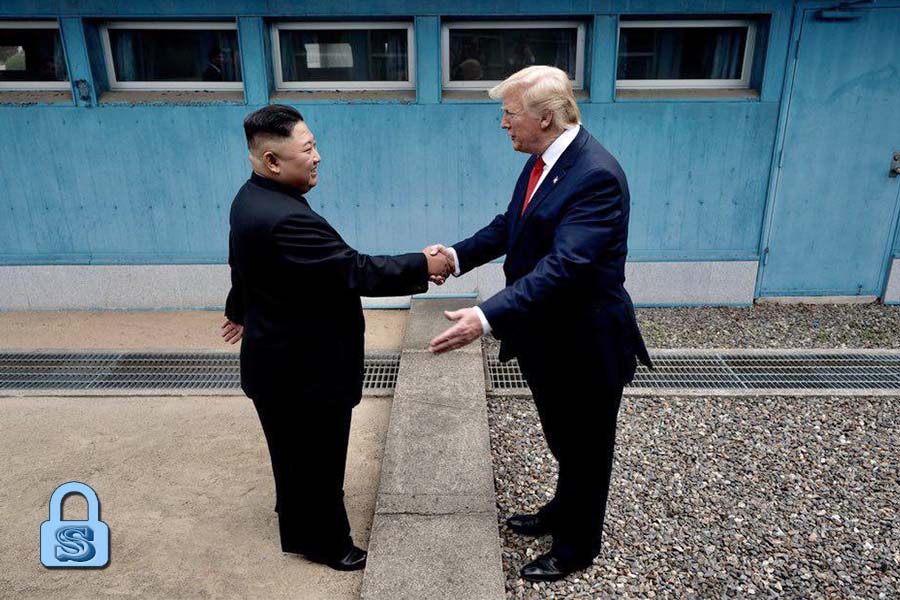
◎ The Trump-Kim DMZ meeting somewhat cancels out China’s diplomatic effort in Pyongyang before the G20 summit in Osaka.
On June 30, United States President Donald Trump and North Korean leader Kim Jong Un held a theatrical, impromptu meeting at the demilitarized zone that divides North and South Korea. At the DMZ, both leaders shook hands before Trump crossed into the North Korean side escorted by Kim. After another handshake and photos, both of them returned to the South Korean side and held an hour-long meeting inside the Freedom House at the DMZ with members of their nuclear teams. Following the meeting, Trump announced that the U.S. and North Korea would restart the denuclearization talks which had stalled after the second Trump-Kim summit in February.
While at the DMZ, Trump invited Kim to the White House and Kim said that Trump would be welcomed in Pyongyang. According to news reports, Kim said that their impromptu meeting signals that they can “meet any time” now. “I think meeting here, two countries that have a hostile past, we are showcasing to the world that we have a new present and we have a positive meeting going forward,” said Kim.
Trump said after the meeting: “We’re not looking for speed. We’re looking to get it right. We’re on a very good path. This was a terrific day.” U.S. Secretary of State Mike Pompeo told the media that “even in Hanoi, we made progress” and that the U.S. has a “jumping-off point” for denuclearization discussions “which will put us in a place where we can truly evaluate if there is any clear path forward. Having listened to Chairman Kim today, I think there is.”
On June 28, Trump invited Kim to meet at the DMZ via a tweet while he was attending the G20. During the meeting, Kim said that he was surprised by Trump’s invitation and accepted the offer on account of their “excellent relationship” and the significance of their meeting at the border. Earlier, the two leaders had exchanged personal letters, including one from Trump which Kim praised as “excellent” and offered to “seriously contemplate the interesting content” of the letter.
Our take:
1. After denuclearization talks appeared to stall following the second Trump-Kim summit and North Korea showed signs of “backsliding,” we wrote that “North Korea is more likely trying to play ‘hard to get’ to woo America back to the negotiation table” instead of reverting to form. The impromptu Trump-Xi meeting at the DMZ confirms our earlier analysis.
2. We believe that the Trump-Kim DMZ meeting somewhat cancels out Xi Jinping and the Chinese regime’s diplomatic effort in Pyongyang before the G20 summit in Osaka.
We wrote previously that the Chinese Communist Party could utilize “conventional and ‘unrestricted warfare’ strategies and tactics … to pull off a ‘Pearl Harbor’ against the U.S. and survive the ‘new cold war.’” One of these tactics is the engineering of foreign crises to divert America’s attention away from China, including working with North Korea to undermine the U.S. effort to denuclearize the Korean Peninsula.
From Xi’s perspective, making his first trip to North Korea before meeting Trump at the G20 signals to Party “hardliners” that he is preparing to take a tough stance with the United States. During his visit, Xi said that the relationship between the Chinese regime and North Korea is a “strategic choice made by both sides and won’t be shaken no matter how the international situation changes,” a tough message that would sit well with “hardliners” at home and guard Xi against criticism that he is preparing to “tamely surrender” to Trump in Osaka.
3. In a September 2018 article, we noted that “while North Korea would very likely seek ways to get the best out of both parties [China and the U.S.], it would ultimately pivot towards the U.S. because it has greater economic and political incentive to do so.”
Kim Jong Un is almost certainly tracking the impact of the Sino-U.S. trade war on both countries. We believe that Kim can see more clearly now that the Chinese regime will find it increasingly difficult to aid North Korea the longer the trade war drags on. Meanwhile, Kim would be aware that America has been doing well economically under Trump and is in a more robust position to absorb trade war pain. From an economic perspective, it makes more sense for Kim to throw in his lot with the U.S. over China at this stage.
Kim also has greater political incentive to work with Trump on denuclearization now. The 2020 U.S. presidential election looks closer from June 2019 as compared to February 2019, and Kim might not want to risk restarting denuclearization talks with a different U.S. president, especially one who is more “politically correct” than Trump. Also, Kim might be betting that his best chance for setting North Korea on the path of “reform and opening up” while preserving his rule is when Trump is president.
4. We believe that Kim Jong Un would have learned his lesson from the Vietnam summit and be less inclined to “backslide” or play games with the United States in the coming denuclearization talks. However, we maintain that “negotiations with the DPRK are bound to see ‘setbacks’ and ‘false steps” given the nature of the regime.”
What’s next:
1. U.S.-DPRK denuclearization negotiations could progress at a faster pace because both Kim and Trump have political incentives to achieve denuclearization. For Trump, securing peace on the Korean Peninsula and getting North Korea to start the denuclearization progress would be a boost for his reelection campaign and a “backup achievement” in case he cannot resolve Sino-U.S. issues by November 2020.
We believe that there could be a resolution to the North Korean denuclearization issue as soon as this year.
2. There is a chance that Kim and Trump could sign a declaration to end the Korean War and agree to sign a formal treaty to end the Korean War during a Trump-Kim summit in Washington. Whether or not China gets to be a signatory of a formal peace treaty would likely hinge on how the Sino-U.S. trade talks are progressing.
3. Per CCP characteristics, the Chinese regime will very likely try to play the North Korean card to gain an advantage in trade negotiations with America. While there could yet be more drama from North Korea, we believe that the drama would be kept to a minimal.
Get smart:
The U.S. needs to resolve Sino-U.S. problems to thoroughly resolve U.S.-DPRK issues. And the U.S. needs novel solutions to resolve Sino-U.S. problems in a peaceful, low-cost, but highly-impactful manner.

[wpdreams_rpp id=0]




