
1 China’s Jan-Feb 2026 fiscal data reveals hidden ‘reefs’ beneath the flood of exports
On March 19, the PRC Ministry of Finance released fiscal revenue and expenditure data for January–February 2026.
National general public budget revenue and expenditure
- The national general public budget revenue increased by 0.7 percent year-on-year to 4.4154 trillion yuan.
- Tax revenue increased by 0.1 percent to 3.6393 trillion yuan.
- Non-tax revenue increased by 3.4 percent to 776.1 billion yuan.
- Major tax categories:
- Domestic VAT increased by 4.7 percent to 1.5838 trillion yuan.
- Domestic consumption tax decreased by 6.2 percent to 382.7 billion yuan.
- Corporate income tax decreased by 3.9 percent to 875.9 billion yuan.
- Personal income tax decreased by 6.9 percent to 384.6 billion yuan.
- Import VAT and consumption tax increased by 12.9 percent to 296.3 billion yuan.
- Tariff revenue increased by 14.4 percent to 36.1 billion yuan.
- Export VAT and consumption tax rebates increased by 9.7 percent to 556.9 billion yuan.
- Securities transaction stamp duties increased by 110 percent to 49.9 billion yuan.
- The national general public budget expenditure increased by 3.6 percent year-on-year to 4.6706 trillion yuan.
- Major spending categories:
- Social security and employment increased by 8.6 percent to 927.9 billion yuan.
- Healthcare increased by 17.3 percent to 411.9 billion yuan.
- Debt interest payments increased by 22 percent to 191.4 billion yuan.
- Major spending categories:
National government fund budget revenue and expenditure
- The national government fund budget revenue decreased by 16 percent to 536.3 billion yuan.
- State-owned land-use rights transfer revenue decreased by 25.2 percent to 354.7 billion yuan.
- The national government fund budget expenditure increased by 16 percent to 1.3174 trillion yuan.
- Spending related to land-use rights transfers decreased by 1.9 percent to 641.8 billion yuan.
Our take
Entering the first quarter of 2026, China’s fiscal system is navigating the “deep water” phase of transitioning from a real estate-dependent model to a new development paradigm. Data from January and February reveals a complex set of characteristics: stagnant tax growth, expanding mandatory expenditures, an intensifying debt burden, and a deep slump in land-based finance.
While the export sector has demonstrated a powerful “technical compensation” effect, weak domestic demand and the rigid growth of local debt service costs have become the core shackles restricting fiscal flexibility.
1. China’s national tax revenue grew by just 0.1 percent year-on-year in the first two months of 2026, while non-tax revenue increased by 3.4 percent. The sluggishness in the tax-to-revenue ratio indicates that the recovery of profitability in the real economy remains slow.
i) The tax structure currently shows a pattern of “binary differentiation” (二元分化):
- Domestic VAT growth (up 4.7 percent) was mainly driven by recovery in industry and services, as well as a narrowing decline in the producer price index (PPI). Meanwhile, the strong growth in import VAT and consumption tax (up 12.9 percent), along with tariffs (up 14.4 percent), confirms stronger-than-expected performance in foreign trade.
- The decline in corporate income tax (down 3.9 percent) reflects continued pressure on corporate profit margins, as well as the impact of a higher base last year due to tax settlement adjustments.
- The significant drop in personal income tax (down 6.9 percent) is partly due to the “Spring Festival effect.” In 2025, an earlier Chinese New Year meant year-end bonus withholdings were concentrated in Jan-Feb 2025, creating a high base. In 2026, the festival occurred in mid-to-late February, meaning related tax data will likely be deferred to March. Another factor is the high base from 2025, during which tax authorities conducted an intensive campaign to collect taxes on individual overseas income; as that primary task concluded, 2026 figures show a comparative decrease.
ii) Securities transaction stamp duty surged by 110 percent year-on-year. This reflects highly active trading in China’s A-share market since the beginning of the year, with sustained growth in turnover. In an environment where real estate has lost its investment appeal, the capital market is becoming a critical outlet for absorbing social liquidity.
2. The national general public budget expenditure increased by 3.6 percent year-on-year in the first two months of 2026. Despite near-zero revenue growth, the fiscal stance remains expansionary.
i) Healthcare spending (up 17.3 percent) and social security and employment spending (up 8.6 percent) both saw significant year-on-year increases. This indicates that during the economic transition period, both central and local governments are prioritizing the strengthening of the social safety net to ease employment pressures and address the rigid social demands of an aging population.
ii) The most striking data point is the rapidly rising burden of debt interest payments, which surged by 22 percent year-on-year in Jan-Feb 2026. The growth rate of interest payments is more than six times that of total expenditure growth, clearly revealing that the “interest payment peak” from years of massive local government and sovereign debt issuance has arrived. Fiscal resources are increasingly being diverted from productive investment toward servicing existing debt, and this crowding-out effect will constrain fiscal policy flexibility over the long term.
3. The government fund budget is the primary source of funding for local infrastructure investment. Its core component — revenue from state-owned land-use rights transfers — suffered another major setback at the beginning of 2026.
i) In Jan-Feb 2026, local government fund revenue fell by 19.2 percent (450.1 billion yuan). Within this, revenue from land sales was only 354.7 billion yuan, a sharp 25.2 percent year-on-year decline, showing a state of continuous “stalling.” Although the 2026 budget draft had set a target for land revenue to remain at the same level as the previous year, the actual start has been extremely weak. Sales for the top 100 real estate developers dropped by approximately 30 percent in the first two months, leading to a collapse in land-acquisition appetite.
ii) While total government fund revenue fell by 16 percent (536.3 billion yuan), fund budget expenditure actually grew by 16 percent (1.31 trillion yuan). This massive funding gap relies primarily on the issuance of new local government special bonds (with a 2026 limit of 4.4 trillion yuan) and special treasury bonds. This reflects the government’s attempt to use central credit leverage to forcibly support infrastructure investment and prevent a chain-reaction collapse triggered by a real estate hard landing.
4. The PRC’s fiscal data for the first two months of 2026 depict an economy undergoing a process of “contraction and substitution.” Stable VAT and import-related taxes driven by foreign trade act as a “life support system” for current finances. However, the 25.2 percent drop in land revenue and the 22 percent increase in debt interest payments are simultaneously squeezing the fiscal space of local governments.
If the real estate market does not achieve substantive stabilization in the second or third quarters of 2026, China’s fiscal policy may need to break through the 4 percent deficit-to-GDP ratio, requiring an even larger expansion of the central government deficit to maintain overall economic and social stability.
2 Beijing’s quiet purge of defense experts hints at serious problems with Chinese weapons systems
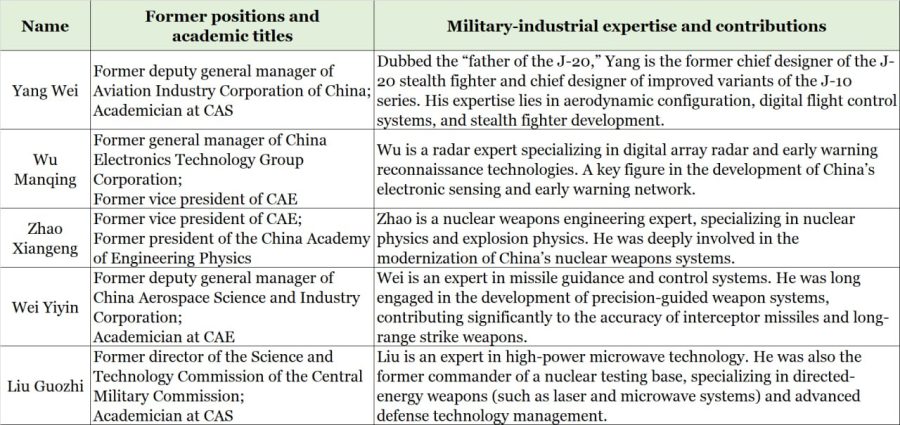
CAS, CAE quietly remove academicians
From around mid-March 2026, the Chinese Academy of Sciences (CAS) and the Chinese Academy of Engineering (CAE) quietly scrubbed the names and biographies of several top academicians from their official website. Those removals were described by external observers as an “earthquake in the academic community,” particularly as some of the scholars were once regarded as national strategic “assets” and “national treasures” in the defense science sector.
Other weapons experts recently removed from the NPC and CPPCC
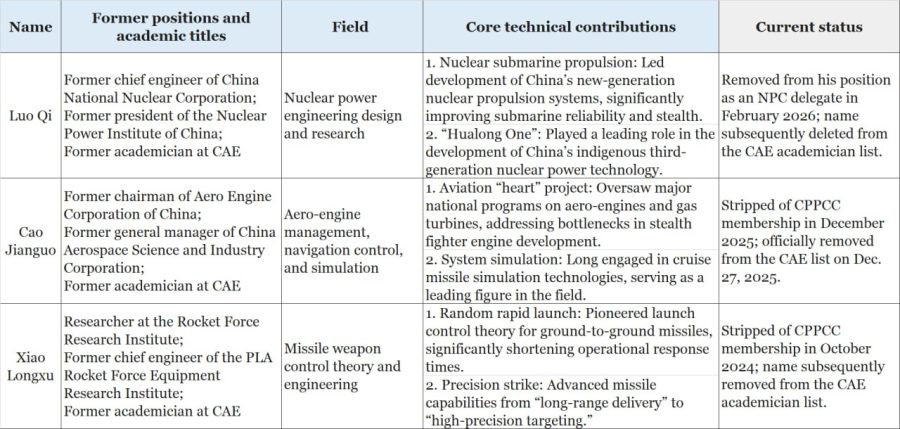
From late 2024 to early 2026, three prominent PRC military experts were successively stripped of their status as delegates to the National People’s Congress or members of the Chinese People’s Political Consultative Conference, and were subsequently removed from the list of academicians of the Chinese Academy of Engineering. These three individuals held “godfather-level” academic status and technical influence in China’s fields of nuclear power, ballistic missile control, and aero-engine development.
Chinese-made air defense systems show problems?
The PRC has been expanding its overseas arms sales in recent years, including to countries like Iran and Venezuela that have been involved in conflicts with the United States and its allies. The performance of Chinese-made air defense systems have come into question when the countries who bought those weapons did not fare well against strikes from the U.S. and Israel.
i) On June 22, 2025, the U.S. attacked three Iranian nuclear facilities in a military operation codenamed “Midnight Hammer.” The seven B-2 bombers involved in the mission did not encounter air defense resistance; chairman of the Joint Chiefs of Staff Dan Caine said, “Iran’s fighters did not fly, and it appears that Iran’s surface to air missile systems did not see us throughout the mission. We retained the element of surprise.” Iran uses domestically produced (i.e. Bavar 373), Russian-made (i.e. S-300, S-400), and Chinese-made (i.e. HQ-9B) air defense systems; it is unclear which systems were deployed and failed to counter the U.S. attack.
ii) On Jan. 3, 2026, the U.S. military launched Operation Absolute Resolve to capture Venezuelan president Nicolás Maduro and his wife Cilia Flores. Venezuela’s air defense network appeared to be unsuccessful in stopping the U.S. strike; President Donald Trump later claimed that the U.S. deployed a “discombobulator” that “made [enemy] equipment not work” during the mission. Some commentators have claimed that a key factor behind the successful U.S. operation was that the operators of the Venezuelan air defense network were earlier bought off and compromised; however, there does not appear to be tangible evidence of this.
The Venezuelan military previously purchased nine Chinese-made JY-27 anti-stealth radars. The radar is supposedly capable of detecting U.S. F-22 Raptors and F-35 Lightning II at distances of several hundred kilometers.
iii) On Feb. 28, 2026, the U.S. and Israel launched Operation Epic Fury in a bid to overthrow the Iranian regime. According to Indian media outlets, Iran’s Chinese-made HQ-9B air defense systems failed to record any successful interceptions. Meanwhile, overseas Chinese-language media claimed that at least three PRC radar technicians and seven drone technicians from DJI were killed in Iran during the U.S-Israeli strikes.
US IC revises threat estimate on PLA invasion of Taiwan
On March 18, the Office of the Director of National Intelligence released its annual threat assessment report. Per the report, the U.S. intelligence community believes that “Beijing probably will continue seeking to set the conditions for eventual unification with Taiwan short of conflict,” and “Chinese leaders do not currently plan to execute an invasion of Taiwan in 2027, nor do they have a fixed timeline for achieving unification.”
The report added that “Beijing almost certainly will consider a variety of factors in deciding whether and how to pursue military approaches to unification, including PLA readiness, the actions and politics of Taiwan, and whether or not the U.S. will militarily intervene on Taiwan’s behalf.” Also, “Chinese officials recognize that an amphibious invasion of Taiwan would be extremely challenging and carry a high risk of failure, especially in the event of U.S. intervention.”
Our take
1. The quiet removal of several experts and scientists linked to the PRC defense industry in March 2026 represents a devastating repudiation of China’s military R&D achievements over the past decade. Notably, those sidelined were involved in the development of core domain weapons and systems, including stealth fighters, missile guidance, nuclear submarines, nuclear weapons engineering, and radar sensing.
In the CCP regime, academicians are the top scientists or engineers who received the highest-honorary title in their respective field, as well as the executors of state will. The removal of the academicians listed above hint at their involvement in severe corruption, including data falsification and misallocation of research funds. The Xi Jinping leadership could have also concluded that the PLA’s so-called “new-type combat capabilities” that those academicians were responsible for were simply not up to scratch and caused the PRC to greatly lag behind its various military modernization milestones.
The fall of J-20 chief designer Yang Wei is particularly significant. The J-20 is the PLA’s fifth-generation fighter and was built to counter U.S. air superiority platforms like the F-22 and the F-35. But if Yang was sidelined because the Xi leadership found his data to be fraudulent, this would imply that the PRC’s plans for air superiority in the Taiwan Strait and the South China Sea rest largely on fragile assumptions and inaccurate simulations rather than actual capability.
If the academicians were indeed purged over work and performance issues, then Xi Jinping’s “self-revolution” movement is evolving from tackling mainly “administrative corruption” and issues of political loyalty (starting around 2023) to a “technical and performance reckoning” in 2026. Regardless, it is not a stretch by any means to infer performance problems on the part of those experts. Many of them were “beneficiaries” of “peacetime” conditions (at least for the PRC) during the Jiang Zemin-Hu Jintao era (1992 to 2012), and were likely accustomed to providing unproven technical indicators to Beijing in exchange for endless R&D budgets.
2. While it is impossible to state conclusively from publicly available information, there is a possibility that the recent purge of so-called “national treasure-level” defense experts and scientists is linked to the potential underperformance of Chinese weapon systems in external conflicts between 2025 and 2026. Despite having either Chinese-made air defense missiles or radar, Venezuela was unable to prevent the capture of its leader Nicolás Maduro and his wife, and Iran has not had much success (if any) in downing U.S. or Israeli aircraft.
If Venezuela had Y-27 anti-stealth radars up and running when Operation Absolute Resolve was underway but they failed to provide effective early warning, this means that the PRC/PLA would be “blind, deaf, and mute” in actual combat. This represents a major reputational blow to the PRC defense industry, which had touted the JY-27 as China’s primary tool for countering U.S. fifth-generation aircraft.
Meanwhile, if reports from overseas Chinese-language media are accurate and the PRC had radar technicians and drone technicians on the Iranian frontlines, this would suggest that Beijing had provided operational support and tactical guidance for its HQ-9B air defense system to Tehran. And if the Chinese technical personnel on-site were not able to make the system function effectively, then this points to serious design and technological flaws, as well as the unstated implication of severe corruption in the defense industry.
3. The underperformance of Chinese weapons in actual combat — if that is indeed the case in Iran and Venezuela — cannot be explained solely by technological inferiority. A deeper cause lies in long-term institutional corruption, hidden during peacetime behind “impressive” data and high export volumes.
Within the PRC’s military procurement system, there exists a vicious cycle of “deceiving superiors and concealing problems below.” During the Jiang-Hu era, relatively stable Sino-U.S. relations and aligned economic interests created an implicit understanding between the military leadership and defense enterprises: since war was unlikely, weapons only needed to meet performance standards in exercises and simulations. Because defense research institutions and evaluating experts often belonged to the same system, testing data were frequently embellished. For example, radar detection ranges might be measured in controlled, low-interference environments. This would set up Chinese-made radar systems for failure under complex, real-world electronic warfare conditions.
Another likely factor contributing to the underperformance of Chinese-made defense systems is diversion of a significant portion of China’s military R&D funding toward “greasing palms” and building academic power networks. Notably, many of the recently removed academicians previously held senior executive roles in defense conglomerates, controlling vast procurement and contracting resources.
There is reason to believe that Beijing’s purge of senior defense experts is an extension of the sweeping military purge initiated by Xi Jinping in 2023. Initially focused on the PLA Rocket Force and the CMC Equipment Development Department, the investigations expanded to implicate numerous senior officers and defense industry executives. The ongoing removal of defense experts suggests a strong possibility that Xi discovered problems far more severe than mere bribery among generals, namely, serious setbacks to his military modernization program due to subpar equipment and weaponry. Previously, Bloomberg News reported that corruption in the PLA resulted in missiles that were “filled with water instead of fuel” and that vast fields of missile silos in western China had lids that “don’t function in a way that would allow the missiles to launch effectively,” citing U.S. intelligence assessments. The investigations into figures such as Yang Wei and nuclear submarine expert Luo Qi suggest that the PLA’s most prized “Assassin’s Mace” weaponry is likely compromised by corruption and data falsification.
The technical limitations of compromised military equipment and weaponry would throw a spanner in the works of Beijing’s major war plans. For instance, a J-20 fighter whose performance does not live up to its chief designer Yang Wei’s claims would deprive the PLA of projected air superiority in scenarios involving conflict in the Taiwan Strait. Without air superiority, serviceable stealth detection, and effective air defense coverage, the PLA’s large amphibious fleet could become vulnerable targets for U.S. anti-ship missiles. The discovery of such problems would force PLA to completely reassess and redo its plans for conflict in the Taiwan Strait and other major contingencies, consuming valuable time and resources that could be better spent on advancing military modernization.
4. The PRC defense expert purge could see multiple core R&D projects facing a leadership vacuum and confusion over technical directions over the next three to five years. A culture of evasion — summarized as “doing nothing to avoid trouble” (不做事就不出事) — could take root among officials across the military-industrial R&D chain.
China’s defense exports could also lose credibility in “Global South” markets as the performance of Chinese-made weapons and military equipment come under scrutiny in Iran and elsewhere. This could prompt partner countries to reassess their strategic relationships with Beijing.
5. The ODNI’s assessment of Beijing’s plans for taking Taiwan in 2027 and its preference for non-kinetic solutions are in line with our earlier assessments (see here, here, and here). To briefly recap, we pointed out that Xi Jinping’s top priorities are resolving economic and political issues on the mainland, while launching an invasion of Taiwan would significantly increase his personal political risk.
We also debunked claims by the “Xi losing power” camp that he is purging those who resist an invasion of Taiwan (in 2027 or otherwise); it is much more likely that Xi is attempting to root out the systemic corruption in the PLA that is/has been sabotaging his military modernization (and in turn, Xi’s efforts to bolster regime security amid turbulent times for the PRC) objectives.




