
1 Implications of Wei Fenghe and Li Shangfu’s sentencing for the PLA
Two former defense ministers sentenced
On May 7, PRC state mouthpiece Xinhua reported that a military court had found former defense ministers Wei Fenghe and Li Shangfu guilty of corruption. They were both sentenced to death with a two-year reprieve, deprived of political rights for life, and had all their personal property confiscated. Xinhua added that their sentence would be commuted to life imprisonment without the possibility of commutation or parole after their reprieve period.
PLA Daily commentary
On May 8, the PLA Daily published a frontpage commentary on the suspended death sentences of Wei Fenghe and Li Shangfu. Titled “Persist in Punishing Every Instance of Corruption and Greed” (堅持有腐必反、有貪必肅), the article was intended to shape public opinion about the development.
The article stated that the verdicts against Wei and Li demonstrated the firm determination and unwavering resolve of Party Central and the Central Military Commission to punish corruption.
The article then harshly condemned the two former defense ministers, accusing them of having “betrayed the trust and heavy responsibilities entrusted by Party Central and the CMC,” and of having “seriously polluted the political ecology of the armed forces.” It further claimed that Wei and Li had caused “enormous damage” to the CCP’s cause, national defense, military construction, and the image of senior leadership cadres, describing the nature of their offenses as “extremely serious,” with “exceptionally vile influence” and “particularly grave harm.” The article added that their punishment was “entirely self-inflicted.”
The article also issued a warning: “No matter who they are, regardless of how high their position or how great their power, all are equal before Party discipline and state law. Any corruption will never be tolerated. For those who disregard fear and violate the law, every case will be investigated no matter how many people are involved or how deep the connections run. There are no ‘red books and iron coupons’ (丹書鐵券, i.e. no ‘get-out-of-jail-free’ card) and no ‘iron-cap princes’ (鐵帽子王, or those who are above the law).”
In its conclusion, the article called on the entire military to “implement the CMC Chairman Responsibility System, and always remain loyal to, support, safeguard, and defend the core leadership.”
Backdrop
Following the exposure of severe corruption in the rocket force and equipment development system in mid-2023, the Xi Jinping leadership has subjected the People’s Liberation Army to its largest and most far-reaching purge in recent years. The purge has led to the downfall of many generals and has left the Central Military Commission with just one member (vice chairman Zhang Shengmin) aside from chairman Xi.
Our take
1. The sentencing of Wei Fenghe and Li Shangfu marks the first time in PLA history that two former defense ministers were simultaneously handed capital punishment (albeit commuted to life imprisonment). It is extremely rare for senior military officers to receive capital punishment in the PRC. Gu Junshan, a former lieutenant general and deputy director of the PLA General Logistics Department, was the last senior military officer to receive a suspended death sentence (2015), while former CMC vice chairman Guo Boxiong (sentenced in 2016) and former CMC member Fang Fenghui (sentenced in 2019) received life imprisonment. The harsher sentences of Wei and Li reflect the Xi leadership’s fury and dissatisfaction with the current crop of military elites.
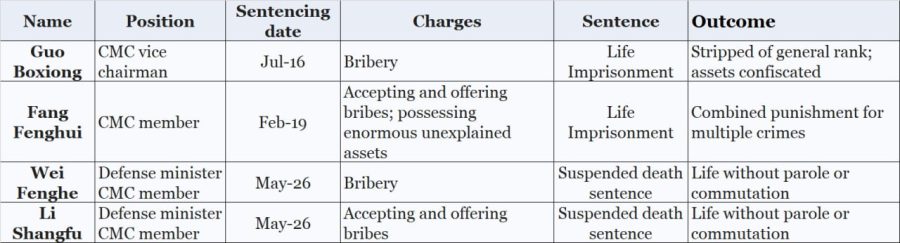
Those who receive a suspended death sentence in the CCP regime are effectively sidelined from social and political life. Beijing likely believes that Wei and Li are deserving of such punishment because their economic corruption and other offenses had damaged the “political ecology” of the PLA and its combat readiness. Also, the use of phrases such as “collapse of belief” and “causing enormous harm” to describe Wei and Li’s actions and behavior in previous official statements implied that they had somehow seriously undermined Xi’s military modernization agenda (“strong military”) even as they outwardly professed loyalty and diligence.
2. The sentencing of Wei Fenghe and Li Shangfu represents only the visible portion of a much broader upheaval within the PLA power structure. A review of updated data from early 2026 shows that the PLA has experienced the most extensive personnel purge in its history since 2022.
As of May 2026, the total number of senior officers investigated, removed, or missing has reportedly exceeded 100. The purge appears to be highly targeted instead of random. A list (see below) of theater-command-level senior officers personally promoted by Xi Jinping at the CCP’s 20th Party Congress in late 2022 shows that only three full generals appear to have “survived” politically. Most of the others have either been formally investigated or have been absent from major public events for extended periods, suggesting possible investigations, forced retirement, or undisclosed disciplinary measures.
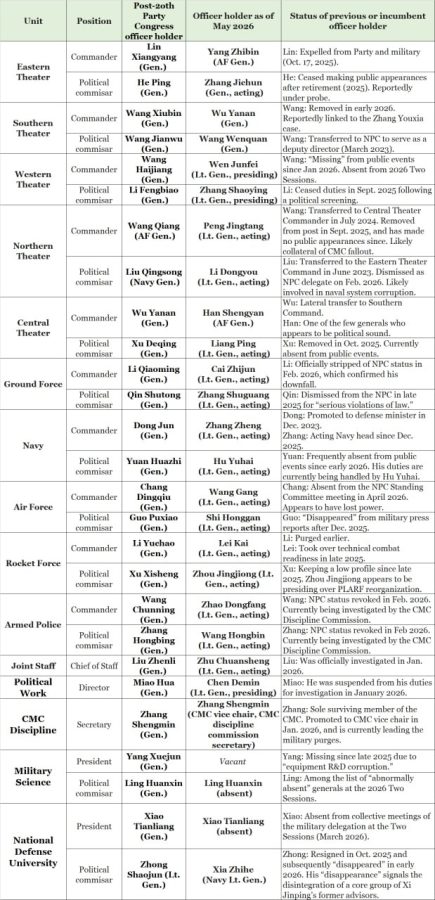
Per the data above, 61 percent of the purged officers came from operational command backgrounds. This suggests that Xi is systematically removing military figures who, despite possessing professional expertise, may have harbored reservations about Xi’s “strong military” agenda or may have manipulated readiness data while maintaining outward political compliance.
Xi’s dismembering of the current military establishment suggests that he is very displeased by the severe level of corruption in the PLA, as well as the military establishment’s likely inability to meet various military modernization benchmarks and objectives (including the military’s 2027 centenary targets and Taiwan contingency preparedness targets).
3. Li Shangfu and Wei Fenghe likely received harsh punishments because their actions and behavior seriously impacted regime security. For instance, severe corruption in the PLA Rocket Force (where Wei was a former commander) would have substantially degraded the PRC’s strategic nuclear deterrence and regional denial capabilities. Xi would have been immensely furious to learn that a branch that he regards as a core pillar of “national power” in actuality had limited operational credibility.
Beijing’s retrospective rectification campaign targeting the PLA Equipment Development Department (EDD) in July 2023 focused specifically on procurement irregularities dating back to 2017. This implies that a significant portion of the strategic weapon systems deployed over the previous seven years — including PLARF assets — may have incorporated components that failed to meet military specifications. In this context, Li Shangfu, who previously headed the EDD, and Wei Fenghe, the inaugural commander of the PLARF, are viewed as bearing direct responsibility for failings in their respective departments during this critical modernization period.
The PLA Daily commentary on the sentencing of Wei and Li also reinforces the conclusion that their actions had been disastrous for the military and the CCP regime. In particular, the two men’s doings were characterized as “enormously damaging, extremely serious in nature, exceptionally vile in influence, and caused particularly grave harm” (極大損害,性質極其嚴重,影響極為惡劣,危害特別巨大).
4. The corruption associated with Wei Fenghe and Li Shangfu reportedly extended beyond the PLA itself into China’s broader defense-industrial system. Economic data from 2024–2025 suggest that the resulting political shockwave contributed to partial paralysis within segments of the military-industrial supply chain. Norinco Group, a major Chinese producer of military equipment and ordnance, reportedly saw revenue fall by 31 percent in 2024 as the PLA and defense sector was hit with purges. In contrast, the global arms industry expanded by approximately 5.9 percent in 2024 due to the wars in Ukraine and the Middle East.
Research by the Stockholm International Peace Research Institute indicated that delayed and cancelled contracts were a major driver behind the PRC’s impacted military-industrial supply chain. As the CMC’s disciplinary apparatus investigated issues inherited from the Wei and Li era, numerous projects under development were subjected to renewed technical reviews and audits. This reportedly delayed critical programs — including hypersonic weapons subsystems and next-generation aircraft engines — by an estimated three to five years.
The decline in industrial output exposes a deeper structural vulnerability in the PRC. The PLA’s military modernization was not built upon healthy industrial competition, but rather upon a highly monopolized system deeply dependent on political patronage. Once procurement decision-makers such as Li Shangfu were officially designated as criminals, the legitimacy and operational coherence of the entire system became effectively frozen. This instability significantly undermines the PLA’s prospects of achieving its intended “informatization” and “intelligentization” transformation goals before 2027.
5. One likely major reason behind the exceptionally severe sentencing of Wei Fenghe and Li Shangfu is that the corruption-driven purge sweeping the PLA from 2023 to 2026 has, in effect, delayed Xi Jinping’s 2027 centenary military modernization objectives by at least five to ten years. One of the core benchmarks of the 2027 goal was the development of sufficient joint operational capability, likely including those required to conduct a successful campaign against Taiwan.
i) The greatest loss caused by the military purge lies in the “human factor,” namely, the emergence of leadership vacuums and experience “breaks” within the PLA. Among the more than 100 senior officers removed or investigated were numerous commanders with frontline operational experience or long-term responsibility for combat training exercises.
The frequent turnover of theater-command leadership inevitably disrupted institutional coordination within joint operations centers, particularly regarding data-sharing and inter-service cooperation. To fill the resulting vacuum, many officers rapidly promoted during 2024–2025 were selected primarily for “political reliability” rather than tactical competence. This fostered a bureaucratic culture focused less on operational initiative than on avoiding political mistakes, a phenomenon that could negatively impact the PLA’s battlefield adaptability and competency.
The extraordinarily high attrition rate in the military is reflected by the fact that only three of the theater-command-level officers personally promoted by Xi Jinping at the 20th Party Congress are considered politically “sound” (Wu Yanan, Dong Jun, and Zhang Shengmin). This suggests that Xi’s personnel selection mechanisms to ensure the selection of “trustworthy” cadres have not held up well in the face of intractable systemic corruption, and the PLA is currently paying the price as the pool of “capable” personnel dries up.
Likewise, the PLA Daily commentary on the sentencing of Wei Fenghe and Li Shangfu suggests that the military purges have not yet fully concluded. The article said that the CCP authorities would “investigate every case no matter how many people are involved, and dig as deep as necessary wherever connections extend.” It even invoked phrases that were once associated with the Xi leadership’s targeting of Zeng Qinghong, the former Politburo Standing Committee member and current de facto head of the Jiang Zemin faction (no “red books and iron coupons” and no “iron-cap princes”).
ii) Corruption within the PLA has severely undermined the CCP’s doctrine of “political army-building.” In response to the collapse of confidence within the military elite, Beijing is adopting increasingly extreme and almost Orwellian propaganda measures to eliminate lingering “political contamination.”
In February 2026, external observers noted that the official website of the PLA Daily had extensively deleted or restricted access to reports and search functions covering periods prior to 2026. It is possible that the PLA undertook the censorship to scrub out the so-called “residual poison” of purged high-ranking officials from the public record. Notably, figures such as Wei Fenghe, Li Shangfu, and Zhang Youxia — all previously regarded as Xi Jinping loyalists within the military — had made many public loyalty declarations and policy statements before their political downfall.
It is also possible that Beijing is further limiting publicly available information on the PLA to prevent external analysts from discerning purge patterns and other military developments to sieve out potential weaknesses during a crucial rectification period.
6. The suspended death sentences handed to Wei Fenghe and Li Shangfu symbolize the end of an era, namely, the era shaped under Jiang Zemin in which loyalty within the military was often maintained through tolerated corruption, allowing modernization and systemic graft to coexist. Xi Jinping is attempting to use harsh punishment and large-scale purges to create a military that is both “politically pure” and combat-capable. Ironically, however, the pursuit of “absolute loyalty” could end up eroding the very combat effectiveness he seeks to strengthen.
The fate of more than 100 senior officers — whether already sentenced like Wei and Li, or still under investigation and likely to spend the remainder of their lives in prison — reflects the broader tragedy of elite politics within the CCP system. Their downfall reveals a deeper structural problem — when corruption becomes the lubricant that sustains institutional operation, any attempt to remove that lubricant through uncompromising force risks causing severe internal friction and even partial systemic breakdown.
The current upheaval in the PLA will impact its efficacy and result in major strategic vacuums in the short term. Beijing could be forced to temper aggressive operations and behavior until it regains confidence in the PLA’s upper echelons and the military’s combat readiness and capabilities. Yet it is risky to downplay what the PLA may still be capable of even as it is swept up by the political rectification campaign. The PLA could potentially become even more dangerous in the mid to long-term should the rectification campaign produce a new senior military leadership cadre that is more capable of implementing and fulfilling Xi’s “strong military” agenda.
2 Assessing the US-China state of play before the Xi-Trump meeting in Beijing
Trump’s Beijing trip and expectations
Barring unforeseen circumstances, United States President Donald Trump will travel to Beijing to meet Chinese leader Xi Jinping from May 14 to May 15. According to news reports, Trump has invited the chief executives of various big U.S. companies — including Nvidia, Qualcomm, Apple, Exxon, Boeing, Blackstone, Citigroup, and Visa — to accompany him on the China trip. U.S. officials told Reuters that Trump and Xi are set to discuss Iran, Taiwan, artificial intelligence, and nuclear weapons, as well as announce purchases related to Boeing airplanes, American agriculture, and energy.
Expectations are low for a breakthrough agreement at the upcoming Trump-Xi summit. Observers believe that smaller deals could be announced, including more Chinese purchases of U.S. agricultural products and possibly the sale of more Boeing jets to China. Also, Trump could press Xi to help out with the Iran situation, while Xi could raise the issue of Taiwan and U.S. technology restrictions with Trump.
State of the Sino-US ‘détente’
Sino-U.S. relations were on the rocks at the start of Trump’s second term following the escalation of the trade war with dueling tariffs. Rocky relations, however, transformed into a “détente” of sorts after Xi and Trump had a relatively friendly face-to-face meeting in Busan at the sidelines of the Asia-Pacific Economic Cooperation meeting in October 2025.
Since Busan, the PRC and the U.S. have each taken actions that directly or indirectly affected each other:
US measures
1. Pax Silica (December 2025): The Trump administration announced “Pax Silica,” a flagship artificial intelligence and supply-chain security initiative, with eleven nation-state signatories. The initiative aims to build a secure, resilient, and innovation-driven technology ecosystem among “trusted” allies and partners, as well as reduce “coercive dependencies” (mainly on China) in critical tech supply chains. It focuses on the entire technology supply chain, from critical minerals and energy to advanced manufacturing, semiconductors, AI infrastructure, and logistics.
2. The Venezuela intervention (Jan. 3, 2026): Under “Operation Absolute Resolve,” the U.S. captured Nicolás Maduro. The move impacted the PRC’s regional energy interests. For one, the U.S. froze all Venezuelan state assets, including those committed to debt-repayment to Beijing, which means that billions in Chinese loans are at risk of being wiped out. The sale of Venezuelan oil in dollars at market prices instead of heavily discounted prices settled in yuan or oil-for-loan repayments also hurts Beijing’s energy interests. Also, the PRC’s long-time influence operations and investments in the region are at risk depending on how Washington decides to act.
3. Critical minerals proclamation (Jan. 15, 2026): Trump signed a national security proclamation declaring U.S. reliance on Chinese-processed minerals a “national emergency.” It established a 180-day window for allies to decouple from Chinese supply chains, threatening 100 percent tariffs on any mineral products containing Chinese-refined content by July 2026.
4. “Economic Fury” campaign (April–May 2026): In response to the Iran war and Tehran’s blockade of the Strait of Hormuz, the U.S. Treasury launched a maximum-pressure campaign that affected some PRC interests:
- Teapot refinery sanctions (April 28): Blacklisted five major Chinese “teapot” refineries in Shandong for processing Iranian crude.
- Designation of Qingdao Oil (May 1): Sanctioned the Qingdao Haiye Oil Terminal for allegedly facilitating “toll payments” to the IRGC for passage through the Strait of Hormuz.
5. De Minimis tariff hike: The U.S. implemented a 90 percent tariff on all “de minimis” imports (packages under $800), effective May 2. This affects Chinese e-commerce giants like Temu and Shein, which had previously bypassed trade war tariffs using this loophole.
PRC measures
1. “Heavy” rare earth restrictions (Jan. 6, 2026): China suspended certain rare earth controls at Busan, but restrictions targeting military-related entities and defense contractors were not lifted. Concurrently, Beijing strengthened export controls on dual-use items destined for Japan (including heavy rare earths and high-performance magnets), indirectly affecting segments of the U.S. defense supply chain that are deeply integrated with Japanese firms.
2. Supply chain and counter-jurisdiction regulations (April 2026):
- Industrial security decree (April 7): Made it a crime for MNCs to conduct ESG audits or “supply chain investigations” in China. This effectively blocked Western companies from complying with U.S. forced-labor laws (UFLPA).
- Extraterritorial jurisdiction regulations (April 13): Created a legal mechanism to sue U.S. companies in Chinese courts if they comply with U.S. sanctions against Chinese entities.
3. Solar technology export ban (around April 15, 2025): Beijing reportedly held preliminary consultations with solar panel manufacturing equipment suppliers (including firms such as Suzhou Maxwell Technologies) regarding possible restrictions on exports of next-generation solar cell manufacturing equipment (N-type/TOPCon) to the United States.
4. The “blocking order” (May 2, 2026): In a historic first, the PRC issued a formal blocking order against the U.S. “Economic Fury” sanctions. It prohibited Chinese banks and companies from recognizing U.S. sanctions on Iranian oil, creating a “compliance deadlock” for global financial institutions.
However, a May 7 Bloomberg News report claimed that the National Financial Regulatory Administration issued a verbal directive asking Chinese banks to review their exposure and business dealings with firms including the sanctioned Hengli Petrochemical (Dalian) Refinery Co., and not to extend new yuan-denominated credit to those companies, citing people familiar with the matter. The directive came before the May 1 Labour Day holiday period in China and the Commerce Ministry’s May 2 instructions for companies to disregard U.S. sanctions.
Our take
1. Sino-U.S. relations remain tense despite the Busan “détente” as both sides gird up for long-term great power competition. While the Trump administration relaxed America’s stance on the sale of mid-tier advanced chips (specifically, the NVIDIA H200) to China in early 2026, it continues to promote U.S. interests by shoring up supply chains and critical minerals, as well as (intentionally or otherwise) “roll back” CCP hegemonic actions (such as in Venezuela) abroad. The Xi leadership has also moved to restrict U.S. access to critical minerals and “green” technologies, as well as refuse to comply with American sanctions over Iran.
Both sides, however, have few reasons to rock the boat in Beijing. Xi would prefer to keep the status quo, or even see an improvement in the bilateral relationship, to keep exports (currently the sole “healthy” driver of the Chinese economy) flowing to the U.S. amid difficult economic conditions at home. Trump also has an interest in sustaining the supply of cheap Chinese goods as domestic economic conditions worsen (due to the Iran war and other long-term issues) ahead of the crucial mid-term elections in November.
Neither Beijing nor Washington has an incentive to be provocative and inflame disputes with the other at this point. The U.S. already has its hands full with conflicts in Ukraine and the Middle East, as well as a rapidly dwindling munitions stockpile (a CSIS report warned that within the first 16 days of the Iran conflict, the U.S. military consumed nearly 40 percent of its THAAD interceptor inventory and almost 50 percent of Patriot PAC-3 stockpiles). Meanwhile, Xi has been subjecting the PLA to a massive purge and rectification campaign, and can ill-afford to test the combat readiness of the troops at a time when the military leadership ranks have been decimated.
That being said, both sides are likely to push the other to give ground, or at least make statements expressing displeasure, on their respective issues of concern. Xi is likely to restate the PRC’s “sovereignty” over Taiwan and reject efforts to back “Taiwan independence.” Xi could also urge Trump to abandon its “law of the jungle” behavior in international politics and bring the conflict in Iran to a close. Further, Xi could request that Trump roll back technology controls (such as those on chipmaking equipment and China’s access to advanced semiconductors) and not take future retaliatory trade actions. Meanwhile, Trump could urge Xi to have China purchase more products from America, crack down on the export of drugs, regulate the export of overcapacity, curb cyberespionage and hacking, raise various human rights issues (including releasing Apple Daily boss Jimmy Lai), and cease its support of Russia in the Ukraine war and the sale of weapons to Iran.
Ultimately, both Xi and Trump could extract cosmetic “concessions” from each other, but no breakthrough deal. The devil will be in the details with the “concessions.” For instance, the PRC belatedly fulfilled its purchase of 12 million metric tons of U.S. soybeans as agreed in Busan in October 2025 and is falling behind this year’s commitment. Also, promises by Trump to sell more mid-tier advanced chips to China could face obstruction from Congress as China hawks in both parties look to shore up U.S. technological security and advantage, and rein in the White House’s “largess.”
2. Xi and Trump will have several more opportunities this year to meet in person and perhaps reach agreements that they might not be able to in Beijing. Xi is due to reciprocate Trump’s visit with a trip to Washington D.C. in late 2026. Also, Trump could travel to Shenzhen for the APEC meeting in November, and Xi could go to Miami in December for the G20 meeting. With at least three potential face-to-face meetings on the cards, both Trump and Xi are under less pressure to exit their meet-up in Beijing with something definitive.




