
1 Why cross-border brokerages are the latest target in the CCP’s drive for financial control
Beijing cracks down on cross-border brokerage firms
On May 22, 2026, the China Securities Regulatory Commission (CSRC), together with eight other government departments and with the approval of the PRC State Council, announced plans to impose severe penalties on three well-known, internet-based cross-border brokerage firms — Futu Securities, Tiger Brokers, and Longbridge Securities. This regulatory crackdown triggered strong shockwaves across financial markets, with the U.S.-listed parent companies of two of the firms seeing their share prices plunge by more than 30 percent in pre-market and early trading.
According to the official determination issued by the CSRC and local regulatory authorities, Tiger Brokers, Futu Securities, and Longbridge Securities had conducted cross-border securities business targeting mainland Chinese investors without obtaining approval from the CSRC. Their activities were therefore classified as “illegal securities operations.”
In this round of penalties, Chinese regulators adopted a dual punishment mechanism involving both the confiscation of all illegal gains and the imposition of massive fines, placing extremely high administrative costs on the two leading brokerage firms and their management teams:
- Futu Holdings announced that its relevant domestic and overseas entities were facing proposed fines totaling about 1.85 billion yuan, while its founder and CEO Li Hua personally faced a proposed fine of 1.25 million yuan.
- A specific subsidiary of Tiger Brokers was fined a total of approximately 308.1 million yuan by the Beijing Securities Regulatory Bureau, while illegal gains amounting to 103.1 million yuan were confiscated, bringing the total penalties and confiscations to 411.2 million yuan. Its chairman and CEO Wu Tianhua was personally fined 1.25 million yuan.
For existing mainland Chinese investors, regulators introduced a clearly defined “disconnection and liquidation” plan, establishing a two-year transition period for concentrated rectification. During this transition period, offshore institutions will be prohibited from illegally providing mainland investors with services such as purchasing securities or transferring additional funds into accounts. Only one-way sell transactions and outbound fund withdrawals will be permitted. After the transition period ends, offshore institutions must completely shut down their websites, trading apps, and supporting servers within mainland China.
Regulators said that as retail investors gradually liquidate their U.S. or Hong Kong stock holdings over the next 24 months, the resulting U.S. dollar or Hong Kong dollar proceeds will no longer be allowed to be reinvested offshore. Under the strict supervision of mainland Chinese banks, most of these funds will effectively be forced to return through official banking channels back into the mainland financial system.
Hong Kong Monetary Authority coordinates with Beijing’s measures
On the same day as Beijing’s cross-border brokerage crackdown, the Hong Kong Monetary Authority issued a regulatory circular to all authorized institutions (banks) registered in Hong Kong requiring that they implement three additional supervisory measures targeting mainland Chinese individual investment accounts:
- Retrospective investigation and closure of fraudulent accounts: Any accounts opened since January 2023 using suspicious or forged documentation, including falsified identity documents, must be identified and shut down.
- Closure of dormant zero-balance accounts: Any “zombie accounts” that, as of May 22, 2026, hold zero asset balances and have recorded no customer transactions within the previous 12 months must be closed.
- Mandatory declaration of fund sources for new accounts: When opening new accounts, mainland Chinese investors must submit written declarations confirming that all investment and settlement funds originate from lawful sources outside mainland China.
These measures apply exclusively to individual investment accounts, including investment functions embedded within integrated banking accounts. They do not apply to corporate or institutional accounts, nor do they affect ordinary savings accounts, loans, or other non-investment banking services.
Impact of the crackdown on cross-border brokerages
The overall impact of Beijing’s liquidation campaign targeting cross-border brokerage firms could involve between HK$200 billion and HK$250 billion in Hong Kong-based assets, according to assessments by financial institutions such as CITIC Securities.
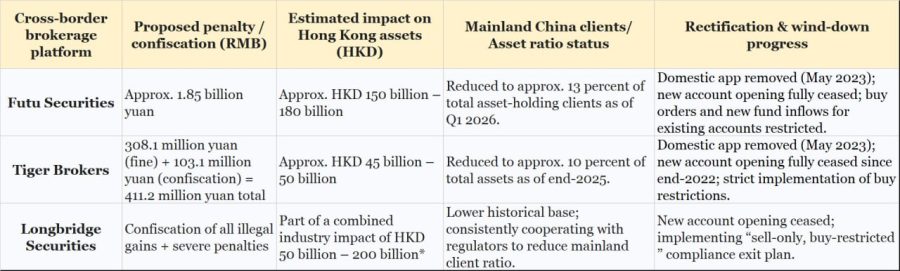
*Note: Combined impact across these three and other affected brokerages is estimated by market analysts (e.g., CITIC Securities) at up to HKD 250 billion, with the aforementioned platforms constituting the primary share.
Our take
Beijing’s crackdown on cross-border brokerages is not a routine compliance or regulatory matter within the financial industry. Rather, it represents a financial defensive campaign undertaken by the CCP authorities amid multiple mounting pressures, including a worsening shortage of investable assets within the mainland real economy, contracting credit conditions, historically significant capital outflows under the capital account, and intensifying geopolitical pressures overseas.
1. The deeper macroeconomic driver behind Beijing’s cross-border brokerage crackdown is the threat that uncontrolled capital outflows pose to the renminbi exchange rate and China’s foreign exchange reserves.
About $1 trillion of so-called hot money exited China in 2025, according to an index compiled by Bloomberg Intelligence, the biggest outflow since the data began in 2006. Overseas Chinese language media noted funds have been flowing out through various non-compliant channels, underground banking networks, and cross-border brokerage platforms.
Conventional international financial theory holds that currency appreciation is usually accompanied by capital inflows. In China’s unique macroeconomic environment, however, temporary appreciation of the RMB has instead become the ideal window for accelerating massive capital flight. This reflects the highly rational arbitrage and hedging logic of market participants.
First, when the RMB temporarily strengthens due to heavy official intervention or short-term foreign exchange settlement flows — for example, rebounding from 7.3 yuan per U.S. dollar to 6.9 yuan — the cost of converting yuan into dollars falls significantly. For mainland high-net-worth individuals and corporations, this effectively means that purchasing U.S. dollar assets becomes “discounted.” Every rebound in the RMB’s value rapidly stimulates the desire of existing domestic wealth holders to convert their assets into dollars and move capital abroad.
Second, market expectations of long-term depreciation exhibit a strong “front-running” characteristic. Amid escalating global geopolitical conflicts and growing expectations of renewed Trump-era tariff policies, Chinese financial traders broadly anticipate structural depreciation pressure on the RMB over the medium to long term. As a result, investors interpret any short-term RMB strength maintained through central bank controls as “unsustainable temporary prosperity,” and use such windows to accelerate capital flight.
In this process, China’s manufacturing export sector plays a “dual-track” role. China’s manufacturing industry now accounts for roughly 32 percent of global manufacturing output and maintains world-leading advantages in key industrial sectors such as shipbuilding, automobiles, and new energy technologies. The value-added level of its exports has also risen significantly. China recorded a massive trade surplus of about $1.2 trillion in 2025, which became a crucial “macro-level blood bank” supporting the RMB exchange rate and preventing an immediate collapse in foreign exchange reserves.
However, the enormous trade surplus itself also conceals and intensifies capital outflows. Export firms, benefiting from significant pricing power and overseas operational flexibility, often use methods such as over-reporting imports and under-reporting exports to retain profits abroad, or directly convert offshore foreign exchange earnings into U.S. equities, U.S. Treasury bonds, or overseas real estate. Thus, the larger the trade surplus becomes, the more dollar-denominated assets private firms and foreign-funded enterprises accumulate overseas. In an environment of weak domestic investment confidence, these funds naturally acquire the ability to pursue arbitrage opportunities directly in foreign markets.
2. After gray-channel pathways for the exit of funds such as cross-border brokerages were thoroughly crushed, the enormous volume of capital forcibly trapped inside China did not flow into the A-share market to support technological innovation as policymakers had intended. Instead, it flooded into the long-term government bond market, worsening domestic deflationary pressures and the “financial circulation without real economic activity” problem.
On May 25, the PRC Ministry of Finance completed the first reopening auction of the 2026 book-entry fixed-interest 10-year government bond issue. The actual reopened issuance totaled 90 billion yuan, with a coupon rate of 1.72 percent, while the winning price of 99.98 yuan translated into an annualized yield of only 1.73 percent — an extremely low historical level. Two days later on May 27, the yield on 10-year government bonds in the open market fell to a historic low of 1.7216 percent.
The sharp decline of 10-year government bond yields directly reflects the severe shortage of investable assets and weak financing demand within the real economy. After accounting for potential inflation or structural currency depreciation, the real return on a 1.7216 percent annual yield is effectively close to zero. Yet financial institutions and private capital continue to scramble to buy such bonds aggressively. This demonstrates that within China, neither private-sector business expansion nor middle-class activities such as home purchases or entrepreneurship are capable of generating investment returns higher than 1.73 percent with controllable risk.
At this stage, China’s banking system increasingly displays classic “liquidity trap” characteristics. By the end of April 2026, China’s broad money supply (M2) had reached 353.04 trillion yuan. Facing collective anxieties over healthcare, pensions, and property depreciation, mainland households have chosen proactive balance-sheet contraction and defensive saving behavior. During the first four months of the year alone, RMB deposits surged by 14 trillion yuan.
Banks are therefore sitting on enormous deposits but cannot find safe borrowers. To avoid leaving funds idle, they have been forced to allocate capital at virtually any cost into the only major safe-haven asset backed by sovereign credit, namely, Chinese government bonds. This strange coexistence of “massive monetary expansion alongside real-economy deflation” was fully reflected in China’s April 2026 financial and total social financing data. Core credit indicators were extremely weak:
- The increment of total social financing (TSF) collapsed sharply, with April TSF growth amounting to only 620 billion yuan, the lowest level in nearly two years.
- Total new RMB loans turned negative for the first time, with net new loans shrinking by 10 billion yuan in April. In other words, Chinese banks collectively recovered more money than they lent out, indicating that the entire economy is trapped in an aggressive “repayment and deleveraging” cycle.
Against the backdrop of a massive 1.25 trillion yuan contraction in real-economy credit (excluding bill financing), the central bank and commercial banks resorted to “bill financing volume inflation” in order to meet politically mandated targets of “supporting the real economy.” As a result, bill financing surged by 1.24 trillion yuan in April alone.
The common method used for this “bill-financing inflation” involves banks coordinating with familiar state-owned enterprises (SOEs) and central SOEs, encouraging them to issue short-term commercial bills at near-zero rediscount rates, after which the banks discount the bills themselves. The 1.24 trillion yuan simply circulates once between financial institutions and SOE accounts, transforming into “social financing growth” on statistical reports, while not a single yuan actually flows into factory production lines or creates any real jobs.
This practice of using bill financing to conceal deflationary pressure is quietly accumulating massive “Silicon Valley Bank-style” systemic risks beneath the surface. Commercial banks’ net interest margins are being squeezed from both sides. On one hand, they must bear the interest costs of massive household fixed-term deposits; on the other hand, their asset portfolios are increasingly forced into ultra-long-term government bonds yielding less than 1.73 percent.
If future macroeconomic policy is forced to shift due to external pressures, such as a resurgence of inflation, rising interest rates could trigger an epic collapse in the prices of these ultra-long-duration low-yield government bonds. This could potentially unleash a severe liquidity crisis across China’s financial institutions.
3. Beijing’s implementation of the “Comprehensive Rectification Plan for Illegal Cross-Border Securities, Futures, and Fund Operations” means that the mainland access channels of internet brokerages such as Futu, Tiger Brokers, and Longbridge have been completely shut down. Put another way, the “gray era” in which mainland Chinese residents could directly open and operate U.S. stock trading accounts has officially come to an end.
Administrative barriers, however, cannot eliminate the public’s strong demand to hedge against currency depreciation and allocate assets overseas. After both compliant and semi-compliant channels were blocked, overseas investment pathways for mainland capital have become increasingly polarized between “institutionalized” and “black-market” methods. At present, mainland Chinese capital retains only three major legal channels for investing in U.S. equities:
- QDII funds and public mutual fund products: This is now the only fully compliant channel available to ordinary investors seeking overseas asset exposure. However, due to surging demand for offshore allocation, QDII foreign exchange quotas for public funds have become extremely tight. Many ETFs linked to U.S. stock indices are frequently forced to suspend large subscriptions or impose purchase limits.
- Greater Bay Area “Cross-Boundary Wealth Management Connect 2.0”: Mainland residents within the Greater Bay Area may use the “Southbound Connect” program to purchase qualified wealth management products distributed by Hong Kong banks, with funds operating under a “closed-loop remittance” system. However, the program has strict geographic limitations, and individual investment quotas are capped at 3 million yuan.
- Private equity and trust products offered by licensed financial institutions: High-net-worth individuals may subscribe to QDLP/QDIE (Qualified Domestic Limited Partner/Qualified Domestic Investment Enterprise) private funds. However, these channels typically require minimum investments ranging from millions to tens of millions of RMB, creating extremely high entry barriers.
Against the backdrop of tight quotas and limited access to official channels, middle-class and wealthy investors with strong hedging demand are increasingly likely to turn toward more concealed and riskier black-market channels:
- Using offshore digital bank cards linked to international brokerage platforms: Investors open overseas accounts through digital banks with relatively relaxed policies toward mainland residents (such as Wise and similar platforms), then wire funds abroad under pretexts such as education or travel expenses before ultimately depositing the funds into major international brokers such as Interactive Brokers.
- Using cryptocurrency (including stablecoins like USDT) as an intermediary transfer mechanism: Investors purchase stablecoins such as USDT through over-the-counter (OTC) crypto markets inside China using WeChat Pay, Alipay, or RMB bank cards. The crypto assets are then transferred to offshore virtual bank cards supporting crypto deposits, or directly exchanged for foreign currency cash through offline C2C exchange shops in places such as Hong Kong or Singapore, thereby bypassing China’s real-time foreign exchange monitoring systems.
- Using underground banking “mirror transfer” operations: Clients transfer RMB domestically into mainland nominee accounts designated by underground banks. After confirming receipt, the underground bank’s offshore branch deposits equivalent amounts of U.S. dollars or Hong Kong dollars directly into the client’s designated overseas bank account. Because the funds technically do not cross borders in a formal transaction, this system is extremely difficult for regulators on either side to monitor in real time.
The CCP authorities’ comprehensive suppression of semi-compliant channels such as Futu and Tiger Brokers will likely force cross-border capital flows underground rather than eliminate the real demand for capital flight. Objectively, this may substantially stimulate the expansion of deep underground financial networks. For investors, this means their overseas asset allocation efforts may increasingly face destructive risks such as fraud by illicit operators, judicial account freezes resulting from mainland police “card-cutting” crackdowns, and offshore banks rejecting or closing accounts under anti-money laundering reviews.
4. The joint penalties imposed by the CSRC and eight government departments against cross-border brokerages are not merely a securities regulatory event. Instead, they signal that China’s macroeconomic policy has entered a “high-wall defensive phase.”
At the macro-policy level, these regulatory measures will generate both positive and negative effects, though the long-term negative structural consequences are likely to outweigh the short-term positive effects.
Positive effects (Short-term defensive impact)
- A defensive barrier in the foreign exchange protection campaign: Amid the severe situation of approximately $1.04 trillion in capital outflows during 2025, cutting off convenient cross-border securities investment channels does physically slow the pace of retail capital flight, buying time for authorities to stabilize the RMB exchange rate and protect foreign exchange reserves.
- Forcibly retaining liquidity within the domestic banking system: Restrictions placed on existing offshore assets during the two-year transition period are expected to force around HK$250 billion in Hong Kong-based assets to flow back into the mainland after liquidation. Objectively, this provides a temporary liquidity buffer for mainland banks that are facing mounting local government debt and property-sector debt risks.
Negative effects (long-term structural damage)
- Increasing the domestic “financial clogging” problem and systemic bad-debt risks: Trillions of yuan trapped behind regulatory barriers, combined with weak confidence in both the real economy and China’s A-share market, are likely to accelerate demand for government bonds, driving long-term yields even lower. This severely compresses commercial bank net interest margins. If macroeconomic interest rates eventually rise, it could trigger a collective “Silicon Valley Bank-style” liquidity crisis.
- Freezing private-sector confidence: The severe punishments and the expansion of global tax transparency mechanisms such as CRS 2.0 send a signal that overseas asset allocation carries extremely high risks for private property holders. This may push domestic private capital into complete “lying flat” behavior (refusing to invest, hire, or consume), thereby accelerating China’s descent into a balance-sheet recession.
- Structural weakening of Hong Kong’s offshore financial center role: The “sell-only, buy-restricted” treatment applied to as much as HK$250 billion of Hong Kong-based assets over the next two years will likely impose sustained selling pressure on an already fragile Hong Kong stock market. It also further raises the financial separation wall between Hong Kong and mainland China.
Overall, this analysis argues that Beijing has committed a macroeconomic error of “treating symptoms rather than root causes.” The fundamental drivers behind the trillion-dollar capital outflows and the collapse of government bond yields to 1.73 percent lie in structural issues associated with Xi Jinping’s “Party leads everything” governance model. Structural issues include a systemic shortage of investable assets, the collapse of the land-finance model, and declining confidence in the security of private property rights.
Without deep structural reforms that rebuild confidence among private capital and high-net-worth groups, Beijing’s reliance on administrative crackdowns and financial barriers will not transform trapped capital into fuel for economic recovery. Instead, the trapped liquidity may simply circulate internally, push interest rates lower, and intensify deflationary anxiety. In essence, this crackdown exchanges the long-term fragility of China’s domestic financial system for short-term stability in headline foreign exchange figures.




