
1 CCP uses Middle East crisis to ‘weaponize’ China’s manufacturing capacity
CCP steps up basic research
On April 30, Xi Jinping attended and delivered a keynote speech at a symposium on strengthening basic research held in Shanghai. Per state media reports, PRC vice premier Ding Xuexiang chaired the meeting and CCP General Office director Cai Qi was present. Other notable attendees included Politburo members Yin Li, Shi Taifeng, Liu Guozhong, Zhang Guoqing, and Huang Kunming, along with officials from central and state organs, military representatives, provincial leaders, and participants from universities, research institutions, national laboratories, enterprises, and the scientific community.
After listening to remarks from science and technology officials and experts, Xi emphasized that basic research constitutes the “source” of the entire scientific system, the “central hub” for all technological problems, and the foundation for building a “science and technology powerhouse.”
Xi stated that a new round of technological revolution and industrial transformation is accelerating, with global competition increasingly concentrated in frontier basic research. He added that the importance of original and disruptive innovation is becoming more prominent. Xi then called on scientific personnel to “seize opportunities and respond to challenges,” and to continuously achieve “new results.”
Xi further stressed the need to strengthen overall coordination and top-level design in basic research, optimize systemic layout, and adhere to the “Four Orientations” (四個面向; i.e. toward global scientific frontiers, the main economic battlefield, major national needs, and people’s health). He also highlighted the importance of enterprise-led integration of “industry–academia–research–application,” aiming to establish a full-chain pathway from basic research to commercialization.
Xi additionally addressed issues related to talent development, institutional support mechanisms, and international cooperation in basic research.
Meeting chair Ding Xuexiang noted that Xi’s speech was “strategic, comprehensive, and highly instructive,” providing clear direction and fundamental guidance for advancing basic research.
***
The CCP’s 15th Five-Year Plan (2026 to 2030) proposes maintaining a strategic focus on the real economy, with the manufacturing sector’s value-added share of GDP expected to remain broadly stable (above 28 percent). Policy emphasis is placed on three directions, namely, intelligentization, green transformation, and industrial integration.
Within this framework, the development of “new quality productive forces” is positioned as the core engine of manufacturing upgrading. Authorities emphasize fostering new industries, business models, and growth drivers through breakthroughs in technology, innovative allocation of production factors, and deep industrial transformation.
Concurrently, Beijing continues to prioritize supply chain security. Through a “whole-of-nation” approach, it seeks to concentrate resources on overcoming bottlenecks in areas such as advanced semiconductor manufacturing, high-end industrial software, critical materials, and precision components, while strengthening control over key nodes in industrial and supply chains to mitigate the risk of external disruptions and sanctions.
PRC restricts exports of strategic commodities
Since the outbreak of the U.S.–Iran conflict in February 2026 and the subsequent crisis in the Strait of Hormuz, global energy, chemicals, and defense supply chains have entered an unprecedented period of disruption. Against this backdrop, China — as the world’s most important supplier of upstream and midstream industrial inputs — has intensively implemented a series of export restrictions on strategic commodities.
Regulatory framework
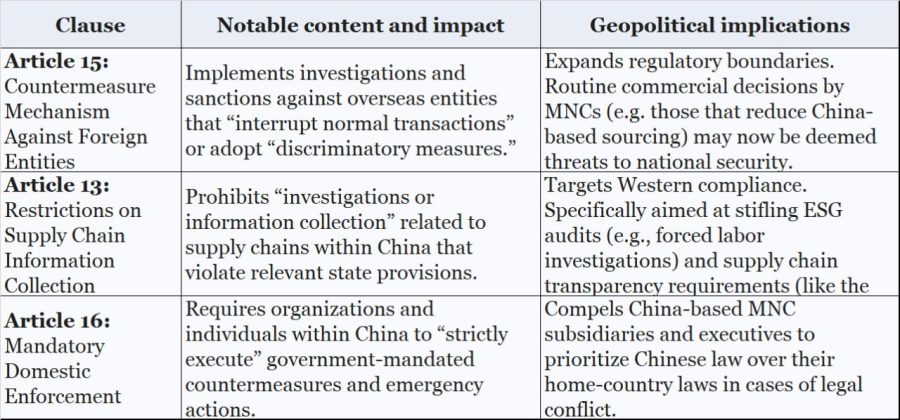
On April 7, the PRC State Council issued regulations on industrial and supply chain security (工業和供應鏈安全條例). The Regulations came into immediate effect on the day of issuance without any transition period.
The Regulations formally establish a supply chain regulatory system centered on “national security,” integrating export controls, counter-sanctions provisions, and industrial data protection into a unified enforcement framework. The legislation also establishes a central coordination mechanism involving 15 government bodies, including the Ministry of Commerce, the Ministry of Industry and Information Technology, and the Cyberspace Administration, tasked with comprehensive oversight of global supply chain activities.
The Regulation comprises 18 articles, with key provisions as follows:
- Establishment of a “critical sectors list”
- The state will formulate and dynamically adjust a list of critical sectors covering core raw materials, key technologies, high-end equipment, and essential products related to economic security, national defense, and public welfare. Items on the list will receive prioritized support to ensure continuity in production and circulation.
- Monitoring, early warning, and emergency management
- A system for monitoring and early warning of supply chain risks will be established to continuously assess the stability of supply channels.
- In the event of major security threats to critical sectors (e.g., foreign embargoes or sudden disruptions), the State Council may implement emergency dispatch and other extraordinary measures to maintain social stability.
- Countermeasures and extraterritorial application
- The regulation explicitly defines retaliatory mechanisms against “improper extraterritorial jurisdiction” and “trade discrimination”:
- Foreign entities that impose discriminatory restrictions or disrupt normal trade may be placed on a “malicious entities list.”
- Retaliatory mechanisms include restricting or banning imports and exports of related products and technologies, imposing special levies, freezing domestic assets, and restricting entry and transactions.
- The regulation explicitly defines retaliatory mechanisms against “improper extraterritorial jurisdiction” and “trade discrimination”:
- Integration and diversification
- Enterprises are encouraged to diversify supply channels to reduce dependence on single external sources.
- The regulation also supports private capital participation in key technology R&D and promotes digital and intelligent upgrades to enhance supply chain controllability.
Export restrictions
March 12
Reuters reported that the PRC’s National Development and Reform Commission ordered Chinese refineries to immediately halt exports of refined oil products for March, in response to potential domestic fuel shortages triggered by the Middle East conflict.
March 19
China imposed comprehensive export restrictions on phosphate fertilizers (e.g., MAP and DAP), extending the suspension of export licenses through August 2026. Urea export quotas were also reduced by approximately 30 percent.
Official narratives framed these measures as necessary to safeguard agricultural output under the “1.8 billion mu arable land red line” and to stabilize domestic food prices. However, analysis of international trade flows suggests that the measures carry a distinctly discriminatory character.
May 1
China announced sweeping restrictions on exports of smelting by-product sulfuric acid. Except for a limited number of specialized categories (e.g., electronic-grade acid), mainstream exports have effectively come to a halt.
The official rationale cited the need to ensure domestic fertilizer production and support spring planting, as well as to address disruptions in sulfur imports. Globally, around 33 percent of sulfur supply originates from the Middle East and depends on transit through the Strait of Hormuz. The regional crisis caused sulfur prices to surge by more than 65 percent in March 2026.
Broader geopolitical context
The ongoing conflict in the Middle East has severely disrupted global energy supplies. U.S.–Israel coalition airstrikes have targeted key Iranian infrastructure, including desalination facilities on Qeshm Island, Kharg Island, and the South Pars gas field, with the aim of crippling missile production and nuclear development capabilities. In response, Iran adopted an extreme form of asymmetric retaliation by effectively blocking the Strait of Hormuz, one of the world’s most critical chokepoint for energy and bulk commodities. The blockage of the Strait has transformed the regional conflict into a global economic crisis.
The crisis in the Strait of Hormuze has disrupted around one-third of global shipping, particularly affecting flows of energy and basic industrial chemicals. For Western industries reliant on Middle Eastern inputs, the impact extends beyond rising costs to outright production stoppages. According to revised projections by the International Monetary Fund in April 2026, global GDP growth has been downgraded from 3.3 percent to 3.1 percent, with surging energy prices identified as the primary driver of inflation.
Our take
1. Xi Jinping’s speech in Shanghai essentially elevates basic research to a national security issue. This emphasis reflects the CCP’s strategic recalibration against the backdrop of acute global political and economic turbulence in 2026 and earlier. Recognizing the vulnerability of traditional industrial supply chains to external sanctions, Beijing is shifting toward establishing defensive and countervailing capabilities at the level of fundamental scientific principles and core technologies.
As the core innovation hub of the Yangtze River Delta, Shanghai has been assigned the role of a primary source of original innovation within the 15th Five-Year Plan. Scientific resources are increasingly being aligned with national strategic priorities, particularly with respect to enhancing resilience under conditions of extreme external pressure.
Publicly available data indicates a sustained increase in China’s investment in basic research. By 2025, such spending had approached 280 billion yuan, accounting for more than 7 percent of total R&D expenditure. This reallocation of funding complements the material control measures implemented by Beijing in response to the shocks of the U.S.–Iran conflict in 2026.
Within the current five-year plan framework, the concept of “new quality productive forces” extends beyond an economic growth paradigm to function as a tool of geopolitical competition. Its core logic lies in restructuring traditional, emerging, and future industries into an integrated system, thereby establishing full-spectrum control across the innovation chain, or from “0 to 1” breakthroughs to “10 to N” industrial scaling.
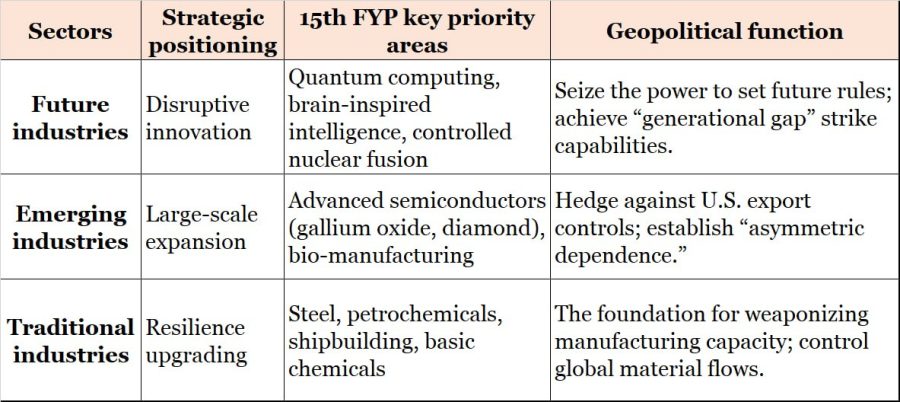
The draft outline of the 15th Five-Year Plan identifies 28 major projects focused on these “new quality productive forces.” These initiatives aim to address technological bottlenecks through the integrated advancement of education, science and technology, and talent development. In practice, however, such “integration” often translates into a compression of academic autonomy. Intellectual resources are systematically redirected toward priority areas linked to military–civil fusion and supply chain competition, reinforcing the state’s capacity to deploy technological development as a strategic instrument in an increasingly fragmented global order.
2. The PRC has been acting the part of the “responsible stakeholder” and major power following the outbreak of the U.S.-Iran war. This act falls apart on closer examination of Beijing’s recent moves. Notably, the CCP’s measures restricting the export of strategic commodities suggests that it has adopted a calibrated strategy centered on the “weaponization” of manufacturing capacity
i) The blockade of the Strait of Hormuz has disrupted roughly one-fifth of global oil shipments and one-quarter of liquefied natural gas maritime trade, while also destabilizing the global sulfur supply system, which accounts for approximately one-third of global production.
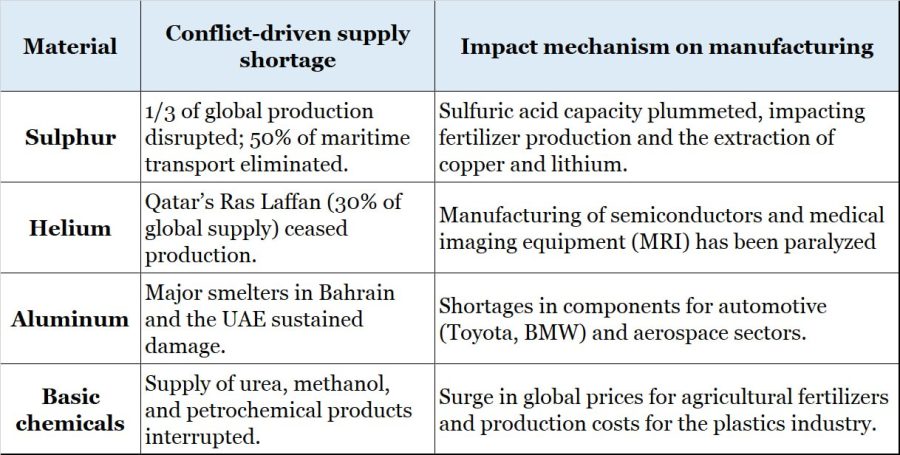
The war is not only consuming energy resources, but also depleting inventories within advanced manufacturing supply chains. This exposes structural vulnerabilities in the U.S. defense industrial base. Continuous ballistic missile launches by Iran and its proxies have driven interceptor missile consumption — such as Patriot missile system and THAAD — far beyond replenishment capacity. This attritional dynamic highlights the deep dependence of U.S. defense manufacturing on critical raw materials and precision components, many of which are sourced from or controlled by China.
ii) At this critical juncture, Beijing has curtailed exports of essential industrial inputs. This appears to be an attempt by the CCP to leverage supply constraints as a geopolitical instrument to pressure other countries into decoupling from the U.S. or maintaining neutrality. This effectively constitutes the “weaponization” of China’s industrial scale.
A prominent example is the PRC’s comprehensive restriction on sulfuric acid exports. The war-induced disruption of Middle Eastern sulfur supply has already driven global sulfuric acid prices up by around 50 to 100 percent. As the world’s largest producer of sulfuric acid — accounting for approximately 45 percent of Asia’s exports — Beijing’s restrictions are estimated to create an annual global supply shortfall of around 2.8 million tonnes.
Sulfuric acid, often referred to as the “mother of industry,” is a critical input for extracting metals such as copper, nickel, and cobalt, as well as for phosphate fertilizer production. The most affected countries include Chile (the world’s largest copper producer), India, Morocco, and the Democratic Republic of the Congo.
Around 37 percent of Chile’s imported sulfuric acid originates from China. By March 2026, China’s sulfuric acid exports to Chile had effectively fallen to zero.
Analysis by Morgan Stanley indicates that up to 1.1 million tonnes of Chile’s refined copper output — around 20 percent of total production — faces suspension risk due to insufficient sulfuric acid supply. This has directly driven up global copper prices and disrupted downstream industries, including clean energy sectors in Western economies such as electric vehicle manufacturing.
iii) The PRC has sought to position itself as a “responsible stakeholder,” a “rational actor” in global governance, and a source of “stability and certainty” in a turbulent world even as it criticizes the U.S. and Israel for abiding by the “law of the jungle.” However, Beijing’s external messaging contrasts with its actions to exert tangible pressure on global supply chains.
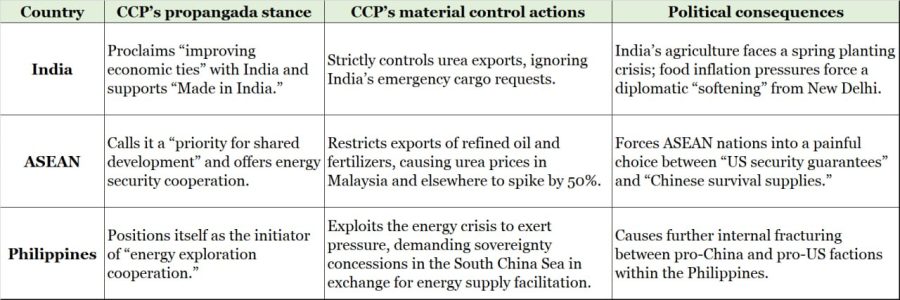
Official mainland media have framed sulfuric acid and fertilizer export restrictions as necessary to “prioritize domestic supply” and “stabilize domestic food costs.” From an analytical standpoint, this narrative obscures the CCP’s underlying strategy of leveraging scale advantages to engineer global shortages and extract geopolitical rents through supply chain control.
3. The CCP’s “weaponization” of its formidable manufacturing capacity amid turmoil in the Middle East is reminiscent of its earlier leveraging of medical supplies production during the early period of the COVID-19 pandemic. In considering the CCP’s past behavior, several trends can be inferred:
i) The CCP could leverage its “overcapacity” into a form of “strategic deterrence.” While the West previously viewed China’s overcapacity as a symptom of structural economic imbalance, the trajectory of the 15th Five-Year Plan suggests that the creation of excess capital serves could be a deliberate attempt to create a strategic reserve. This is in line with our earlier analysis that the CCP is pursuing non-kinetic expansion.
By massively expanding production and exporting at scale, China can undermine industrial bases in other economies, while simultaneously acquiring the capacity — within a “hybrid warfare” context — to disrupt more than 20 percent of global supply in key industrial inputs (e.g., sulfuric acid, steel, rare earths). The coercive effect of such leverage could approach that of nuclear deterrence, potentially discouraging Western powers from initiating secondary sanctions in flashpoints such as the South China Sea or the Taiwan Strait due to fears of “industrial strangulation.”
ii) Xi Jinping’s remarks at the meeting on strengthening basic research emphasized “original innovation capabilities.” This suggests that the CCP’s future “weaponization” efforts will extend beyond control over material volumes to encompass dominance in technological standards. Foundational research may serve as a new layer of export control. For example, through patent positioning in ultra-wide bandgap semiconductors such as gallium oxide during the 15th Five-Year Plan period, China could, by around 2028, establish a digital infrastructure standard independent of Western equipment. At that stage, the “weaponization of manufacturing capacity” would evolve into the “weaponization of techno-industrial systems.”
iii) The CCP is leveraging supply shortages induced by the U.S.–Iran war to promote its “Global Security Initiative” across Africa, Latin America, and the Middle East. Beijing may seek to construct a regional order anchored in “material supply commitments” where countries that align with China’s positions in international forums or refrain from hosting U.S. military bases would gain access to stable supplies of fertilizers, fuel, and basic chemicals. This would effectively constitute a commodity-backed international arrangement centered on Chinese industrial capacity, analogous to a “material Bretton Woods system.”
iv) The symposium on basic research represents, in essence, a mobilization for geoeconomic expansion. The CCP has capitalized on the geopolitical shock of the U.S.–Iran war to convert its accumulated industrial infrastructure into a tool of supply-chain coercion. By systematically strengthening basic research, the PRC aims to control the “central node” of technological systems, while export restrictions on sulfuric acid, rare earths, and fertilizers serve as operational testing of this capability. The strategic risk lies in its asymmetric nature: leveraging the openness of global trade, China can dominate mid- and upstream “lifeline industries” while advanced economies concentrate on frontier technologies such as AI.
Looking ahead, international competition is likely to shift from a primary focus on military capability or financial dominance toward a contest over “industrial resilience” and “control of material supply chains.” Absent the reconstruction of independent systems in basic chemicals, critical mineral processing, and strategic reserves, advanced economies may face acute vulnerability in future geopolitical crises. In such a scenario, the CCP is positioned to exert systemic pressure on the global industrial order by activating the “central hub” referenced in the Shanghai speech and monopolizing crucial production capacity.




