
1 Purge of former Wang Qishan aide reflects evolution of Xi’s anti-corruption campaign
Wang Qishan’s former secretary purged
On April 21, the PRC State Council announced a new round of personnel appointments and removals. A notable development was the removal of Zhou Liang, a deputy director of the National Financial Regulatory Administration and former secretary of Wang Qishan, Xi Jinping’s ally and first anti-corruption chief.
Zhou Liang was officially placed under investigation last month according to a March 24 announcement on the website of the Central Commission for Discipline Inspection and the National Supervisory Commission. He was the 16th centrally managed cadre (i.e. officials under the purview of the Central Organization Department) to be publicly purged in 2026.
***
According to publicly available biographical information, Zhou Liang was born in October 1971 in Yongzhou City, Hunan Province. Zhou holds a master’s degree in economics and was a secretary to Wang Qishan when the latter served in various roles for over 20 years starting in 1997.
- Guangdong period: When Wang was vice governor of Guangdong Province, Zhou worked in his general office.
- State Commission for Restructuring the Economic System and Hainan period: Zhou subsequently followed Wang to positions in the State Commission for Restructuring the Economic System and later the Hainan Provincial Party Committee.
- Beijing period: During Wang’s tenure as mayor of Beijing Municipality, Zhou served as his secretary. Prominent real estate developer Ren Zhiqiang mentioned in his memoir that he had contacted Wang through Zhou.
- CCDI period: After Wang took charge of the discipline inspection system, Zhou transferred to the CCDI, serving as deputy secretary-general and executive deputy head of the CCDI’s organization department. In 2015, Zhou was promoted to head of the CCDI’s organization department (vice-ministerial rank).
In 2017, Zhou Liang transitioned into financial regulation and became a key senior official within the financial system:
- November 2017: Appointed vice chairman of the China Banking Regulatory Commission (the youngest at the time).
- May 2018: Following regulatory restructuring, became vice chairman of the newly established China Banking and Insurance Regulatory Commission (CBIRC).
- May 2023: After further Party and state institutional reforms, the CBIRC evolved to become the National Financial Regulatory Administration. Zhou continued to serve as deputy director at the National Financial Regulatory Administration and ranked first among the deputies. He also concurrently served as Party secretary and part-time vice chairman of the National Committee of the China Financial Trade Union.
Zhou Liang was also a delegate to the 19th Party Congress, a member of the 19th Central Commission for Discipline Inspection, and a member of the presidium of the 18th Executive Committee of the All-China Federation of Trade Unions.
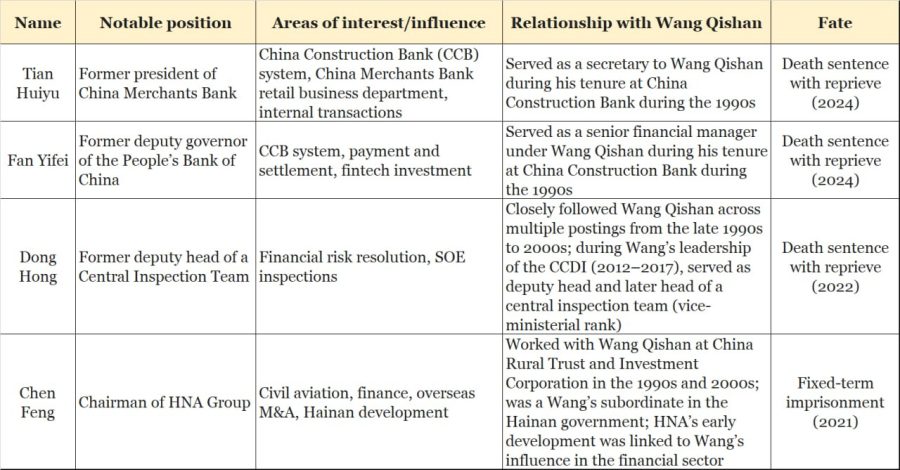
Former associates of Wang Qishan’s who were purged
Other former Secretaries of senior CCP leaders purged under Xi
Wang Wenhua, former secretary to Li Ruihuan
On Dec. 18, 2025, Wang Wenhua — the former deputy Party secretary of Qingdao City, director of the Qingdao municipal People’s Congress Standing Committee, and Party group secretary (vice-ministerial level) — was placed under investigation eight years after retirement. Wang had long served as confidential secretary to Li Ruihuan, former member of the Politburo Standing Committee and chairman of the Chinese People’s Political Consultative Conference.
Tian Xuebin, former secretary to Wen Jiabao
On Jan. 5, 2026, the anti-corruption authorities announced that Tian Xuebin — former secretary to PRC premier Wen Jiabao, former deputy director of the State Council Research Office, and former vice minister of water resources — was under investigation. He was the first vice-ministerial-level official investigated in 2026.On Feb. 6, Tian’s membership in the National Committee of the Chinese People’s Political Consultative Conference was revoked.
Between 1992 and 2008, Tian Xuebin served as a secretary within the General Office of the Central Committee and the General Office of the State Council. During this period, he served as Wen Jiabao’s secretary when the latter was premier (2003 to 2013).
Our take
1. The purge of Zhou Liang and other former aides to top CCP officials reflects the latest evolution of Xi Jinping’s anti-corruption campaign. With the weakening of actual factional influences in the regime, the campaign has shifted from one that was primarily biased against Xi’s enemies and somewhat “protective” of elite interests associated with Xi to take on a more “egalitarian” streak aimed at all who have undermined Xi’s policy agendas regardless of factional alignment or elite protectors.
Take the case of Zhou Liang. Before the 20th Party Congress, Xi relied on Wang Qishan and his network for both expertise and political loyalty in purging the Jiang Zemin faction and other “anti-Xi” elements. This led to Beijing “tolerating” potentially corrupt elements like Zhou and allowing them to ensure the enforcement of the anti-corruption campaign. In turn, the campaign enabled Xi to centralize power and transition the CCP regime away from the “collective leadership” model.
After Xi consolidated power to a high degree at the 20th Party Congress and he had largely sidelined most factional influences, the anti-corruption campaign was allowed to function in a “purer,” unfiltered form. Corrupt elements like Zhou Liang are no longer allowed to control or oversee critical authority and resources (in this case, finance), likely due to fears that they could sabotage Xi’s policies to avert regime collapse and facilitate the PRC’s ascension to become a “great power.” The removal of such elements is the logical outcome of the anti-corruption campaign’s evolution.
More broadly, the removal of aides of former high-ranking officials like Zhou Liang, Tian Xuebin, and Wang Wenhua signals that the anti-corruption campaign no longer takes the “protection” of their respective political patrons into account. This reflects Xi Jinping’s elevated “quan wei” and power in the CCP post-20th Party Congress, as well as the reduced capacity of Party elites to challenge or interfere with the Xi leadership. Those purges also reflect Beijing’s effort to push ahead with government priorities and bolster political security ahead of the 21st Party Congress in 2027.
2. Extending beyond Zhou Liang, the investigations into figures linked to Wang Qishan’s financial network — such as Tian Huiyu (former China Merchants Bank president) and Fan Yifei (former central bank deputy governor) — suggest that the Xi leadership is taking corruption in the financial sector very seriously given its connection with regime security. Beijing appears to be looking to dismantle entrenched “white glove” networks that have long facilitated the transfer of state resources to elite-linked interests.
- Rent-seeking and allocation distortions: Officials used regulatory authority to channel credit and conceal risks for selected entities, including large conglomerates.
- Indicative data:
- Tian Huiyu: Accused of bribery and illicit gains exceeding 500 million yuan.
- Dong Hong: Accused of bribery totaling 463 million yuan.
- Fan Yifei: Accused of financial misconduct exceeding 300 million yuan.
The corruption accusations against the purged officials are unlikely isolated incidents and point to systemic collusion between financial capital and bureaucratic power. From the case of CMB’s Tian Huiyu to that of Zhou Liang at the National Financial Regulatory Administration, it appears that a self-circulating system of vested interests has formed within the financial regulatory apparatus. Zhou held the power to interpret banking compliance as a senior regulator, which potentially enabled him to legitimize irregular lending or exercise discretion in risk resolution. Such mechanisms facilitated asset transfers through financial channels, contributing to wealth inequality and hidden local debt burdens ultimately borne by the central government. Thus, the removal of figures like Zhou represents an effort by Beijing to reassert state control over financial resources and reclaim them from elite-linked networks.
The Zhou Liang case also marks the anti-corruption campaign’s effort to take financial regulation into “deep-water territory.” Zhou, once responsible for cadre evaluation within the discipline system, could have leveraged his institutional knowledge to evade oversight, illustrating a classic “regulator-turned-insider” dynamic. This underscores the structural nature of corruption, which cannot be resolved solely through personnel changes.
4. In sum, the Zhou Liang case should not be interpreted simply as a personal rupture between Xi Jinping and Wang Qishan. Rather, it reflects the evolution of Xi’s anti-corruption effort as he looks to weaken the economic and political foundations of elite networks and establish a more controlled and insulated political environment ahead of the 21st Party Congress.
As long as the Xi leadership continues to follow its current governing logic — prioritization of political loyalty, ensuring central control over financial resources, and shoring up regime security — it is likely that the purge of aides of former senior officials and financial sector “white gloves” will persist through 2027.




