
1 Beijing issues industrial and supply chain security regulations with an eye on future geopolitical conflicts
On April 7, the PRC State Council issued regulations on the security of industrial and supply chains (國務院關於產業鏈供應鏈安全的規定). The Regulations aim to prevent risks to China’s industrial and supply chain security, enhance their resilience and security levels, and safeguard economic and social stability as well as national security.
The Regulations consist of 18 articles. Below is a summary of key points:
Core objectives and principles
- Legal basis: The Regulations are formulated in accordance with the National Security Law, Foreign Relations Law, Anti-Foreign Sanctions Law, and Foreign Trade Law.
- Guiding principle: Implement the “holistic national security concept” (總體國家安全觀), balance development and security, and improve the resilience and security of industrial and supply chains while advancing opening-up to a greater degree.
Governance system and division of responsibilities
- Coordination mechanism: The state will establish and improve a comprehensive working mechanism for industrial and supply chain security.
- Departmental responsibilities: Multiple State Council departments — including foreign affairs, NDRC, MIIT, public security, state security, and commerce — will carry out duties according to their respective mandates, with strengthened coordination.
- Local responsibilities: Provincial-level governments are responsible for relevant security work within their jurisdictions.
Early warning and risk prevention mechanisms
- Key sectors list: The state will implement a dynamic list system for key sectors to ensure stable supply of raw materials, technologies, equipment, and products.
- Risk monitoring and early warning: A monitoring and early warning system will be established to assess the stability of supply channels and issue timely alerts.
- Information sharing: Promote information-sharing platforms in key sectors while strictly ensuring data security.
Resilience enhancement and emergency response
- Reserves and R&D: Build both physical and capacity reserves, and increase investment in the R&D of core technologies and products.
- Emergency measures: When security is threatened, the State Council may take emergency actions such as centralized allocation, mobilization of reserves, and organizing production and transportation.
Legal defense and countermeasures
- Security investigations: Relevant departments may conduct security investigations into discriminatory restrictions imposed by foreign countries, regions, or organizations.
- Countermeasures
- Against foreign entities: Measures may include import/export bans, investment restrictions, entry bans on personnel, and placement on countermeasure lists.
- Against parties disrupting transactions: Foreign organizations or individuals that violate market principles and disrupt normal trade may face restrictions on transactions or revocation of eligibility to remain in China.
- Domestic compliance: Organizations and individuals within China must comply with national countermeasures. Violators may be barred from government procurement, restricted in trade, or prohibited from leaving the country.
Social participation and support
- Funding and technology: Encourage social capital to invest in breakthroughs in core technologies and promote the commercialization of scientific achievements.
- Professional services: Encourage legal and notarial institutions to provide services to help individuals and organizations respond to supply chain risks.
Xi Jinping’s ‘Holistic National Security Concept’
The “holistic national security concept” proposed by Xi Jinping is a core strategic framework guiding the CCP’s current national security policy. It emphasizes a “comprehensive security” approach, breaking away from the traditional focus on military and diplomatic security and extending national security into multiple dimensions such as the economy, society, and technology.
The “holistic national security concept” can be broken down into the “five key elements” and “five relationships”:
‘Five key elements’ (the structural logic of national security)
- People’s security as the ultimate goal: Security exists to safeguard people’s livelihoods.
- Political security as the foundation: Prioritization of regime security and institutional security (i.e., the CCP’s leadership).
- Economic security as the basis: Strong economic capacity underpins national security.
- Military, technological, cultural, and social security as safeguards: These serve as supporting pillars of national security.
- International security as support: Emphasizes engagement with the international community and shared security.
‘Five relationships’ (the dialectical approach to security issues)
- Balancing external security and internal security.
- Balancing territorial security and citizen security.
- Balancing traditional and non-traditional security.
- Balancing development and security.
- Balancing national security and common/global security.
With the evolution of “holistic national security concept,” its scope has expanded from an initial 11 domains to around 20 today, including political, military, territorial, economic, financial, cultural, social, technological, cybersecurity, food, ecological, resource, nuclear, overseas interests, space, deep sea, polar, biological, artificial intelligence, and data security.
Key “holistic national security concept” milestones since Xi Jinping took office include:
- April 15, 2014: Xi first proposed the “holistic national security concept” at the inaugural meeting of the Central National Security Commission.
- July 1, 2015: The Standing Committee of the National People’s Congress institutionalized the concept with the passage of the new National Security Law.
- October 2017: The 19th Party Congress incorporated the concept into the Party Constitution.
- June 2020: The Hong Kong National Security Law was enacted. This was seen as a major application of the concept in a specific region.
- December 2020: During a Politburo study session, Xi further outlined the “Ten Upholds” for national security work:
- Uphold the Party’s absolute leadership over national security.
- Uphold a national security path with Chinese characteristics.
- Uphold people’s security as the goal.
- Uphold political security as the top priority.
- Uphold coordination between development and security.
- Uphold prioritization of risk prevention and mitigation.
- Uphold the promotion of common/global security.
- Uphold modernization of national security systems and capabilities.
- Uphold the strengthening of national security personnel.
- Uphold the comprehensive improvement of the legal system for national security.
- October 2022: The 20th Party Congress report included, for the first time, a dedicated section on “national security,” emphasizing modernization of security systems and the coordination of development and security.
- April 2024: In marking the 10th anniversary of the concept, the CCP authorities launched large-scale propaganda campaigns highlighting its strategic role amid “profound global changes.”
2025–2026 (current): The focus of security policy is shifting further toward “new domains and new forms,” particularly in areas such as AI security, cross-border data flows, and supply chain resilience.
Our take
1. The State Council’s regulations on the security of industrial and supply chains is the CCP’s response to increasing global economic fragmentation and intensifying geopolitical tensions. The Regulations essentially shift the “holistic national security concept” from policy guidance to a more systematized, law-based framework. In doing so, it represents a new milestone in Xi Jinping’s prioritization of national security and its institutionalization through legal mechanisms.
The Regulations are not merely a tool of industrial regulation. Rather, it is an important document that translates Xi’s “holistic national security concept” into the underlying logic of economic governance at the onset of the 15th Five-Year Plan period. Through the Regulations, Beijing is looking to curb industrial and supply chain risks, enhance systemic resilience, and safeguard the CCP regime’s “survival foundation” amid worsening external circumstances.
A review of the Regulations suggests that Beijing is drawing lessons from technological decoupling between the U.S. and China, the sanctions regime that has emerged from the Russia-Ukraine war, and various negative external factors triggered by the U.S.-Iran conflict to redefine “regime security” in the PRC context. The CCP leadership likely believes that safeguarding traditional territorial security and implementing propaganda are no longer sufficient to sustain the Party’s ruling legitimacy in the 21st century, particularly if it wants to become a modern “great power.” Therefore, the CCP is looking to control the entire industrial chain — from basic raw materials to high-end core technologies — to ensure that its rule is not undermined by material shortages or technological paralysis amid turbulent international struggles.
2. The Regulations represent an extension of Xi’s “holistic national security concept” into the industrial domain. Article 2 of the document explicitly states that industrial and supply chain security must adhere to this concept and coordinate development with security. In practice, this “coordination” reflects a trade-off in which security takes precedence over efficiency. The CCP’s logic is that if economic development cannot support national security, or if development paths are externally constrained, then such development itself becomes a source of insecurity.
Within Xi’s framework, political security is placed at the highest level. Political security for Beijing means safeguarding the Party’s leadership and the socialist system with Chinese characteristics. Diverging from the past, the current security outlook emphasizes that “people’s security is the goal, while political security is the foundation.” This implies that the regime must possess the capability to maintain basic social functions under extreme conditions and prevent a sharp decline in living standards from triggering social unrest. Therefore, ensuring the security of industrial and supply chains becomes a vital factor in preventing social instability resulting from external “extreme pressure” (sanctions or blockades).
The Regulations show that Xi Jinping’s earlier concept of “bottom-line thinking” (first proposed in 2019) has now evolved into a mode of “extreme scenario management.” In the logic of the CCP’s materialist dialectics, the “bottom line” represents the boundary where a qualitative change occurs; once breached, it leads to uncontrollable disaster. In the context of industrial policy, the regime is required not only to anticipate favorable outcomes, but also to make strategic plans based on worst-case scenarios.
“Extreme scenario management” manifests in the Regulations through mechanisms such as the “key sectors list system” and the “risk monitoring and early warning system.” This indicates that the CCP is moving regime security beyond simply preventing industrial infiltration to achieving comprehensive control over critical choke points in global value chains. The new “bottom-line” under this rubric is ensuring that China’s domestic infrastructure, military industry, and basic people’s livelihoods do not collapse under extreme external pressure or comprehensive embargoes.
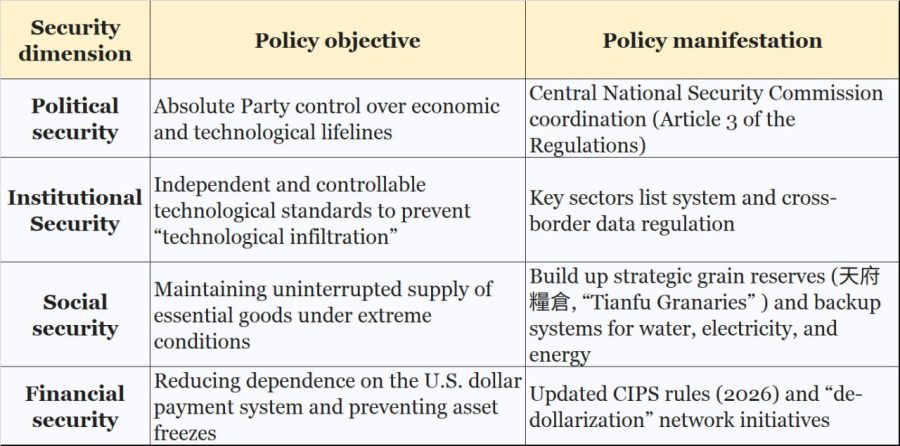
3. Article 7 of the Regulations notes that the state will formulate a list of key sectors to ensure the stable production and circulation of critical raw materials, technologies, equipment, and products. Although the full list has not been officially disclosed, it is possible to identify several industries regarded as the “lifelines of the regime” based on the 2026 outline of the 15th Five-Year Plan and local budget arrangements.
i) Beijing is likely to focus on semiconductor investment and production as part of its push for “new quality productive forces.” Already, the Sichuan local government has accelerated projects such as BYD Semiconductor and BOE’s 8.6-generation flexible display production line, with total investments exceeding 85 billion yuan. The CCP’s objective is the establishment of a “closed loop” for core electronic components and an easing of the PRC’s reliance on external chips; from the CCP’s perspective, heavy reliance on “foreign” technology in building national defense systems and AI governance structures is akin to constructing a fortress on sand.
ii) The U.S.-Iran conflict’s triggering of global energy shocks would have reinforced the CCP’s concerns about energy self-sufficiency. To that end, Beijing would look to invest and develop more energy-generation capabilities, as well as better manage what it currently has.
As a strategic inland region, Sichuan’s installed hydropower capacity exceeded 100 million kilowatts in 2026, the highest in the country. This means that the province is the last line of electricity supply for the regime in the event of external oil and gas disruptions. Also, projects such as the “Diversion of Water from the Yalong to the Min River” (benefiting 34 million people) and the “Six Horizontal, Six Vertical” modern water network reflect the CCP’s view of water resource allocation as a critical tool for maintaining social stability and strategic depth.
iii) Food security is another area that Beijing is likely to prioritize. The 15th Five-Year Plan aims to stabilize grain output at around 1.4 trillion jin (about 700 million metric tons). And while China’s per capita grain availability reached 508.9 kilograms in 2025 — well above the safety threshold — the CCP is still looking to build up strategic grain reserves (“Tianfu Granaries”) and maintain strict farmland protection red lines in 2026.
Beijing has also been exploring unified land-use management systems for farmland, forests, and orchards to prevent excessive industrial encroachment on agricultural resources.
iv) Beijing also considers the “Xinchuang” (information technology application innovation) sector and cybersecurity industries critical to maintaining the regime’s lifelines. During his 2026 inspection of the Beijing National Xinchuang Park, Xi Jinping emphasized the urgency of advancing IT innovation within the modern industrial system.
Beyond being a driver of economic growth, the CCP views the “Xinchuang” sector as the core of “digital sovereignty”; Beijing wants to ensure that its government communications and social governance data are protected from foreign surveillance or paralysis.
4. The Regulations’ emphasis on industrial and supply chain security reflects the CCP’s preparation for worst-case external scenarios. Based on policy signals from early 2026, Beijing perceives potential threats to regime stability across three escalating levels of external deterioration.
The first level is technological isolation and the normalization of “chokepoint” constraints. For instance, U.S. sanctions on China have expanded from defense industries to AI, biotechnology, and sensitive data. The CCP views the forced divestment of TikTok’s U.S. operations in 2025 as an outright expropriation of Chinese firms’ overseas rights. While such developments may slow industrial upgrading, the CCP currently appears to believe that China’s large domestic market and “whole-of-nation” mobilization capacity are sufficient to absorb the impact without fundamentally threatening regime stability.
The second level is the external financial “nuclear options” and the disconnection of China from international payment systems. The exclusion of Russia from the SWIFT system during the Russia–Ukraine war represented one of the CCP’s greatest fears. If China were completely cut off from the U.S. dollar system in a future extreme event, the regime’s import-export trade could collapse almost instantly and seriously endanger the CCP. As a defense response to financial “nuclear options,” the CCP upgraded the CIPS system in 2026, including expanded support for foreign currency payments and lower access thresholds. Beijing appears to have assessed that it needs to step up the internationalization of the renminbi and establishment of autonomous payment networks to avoid financial collapse and inflation (which would in turn directly erode middle-class support for the regime) following an extreme event.
The third level is extreme scenarios of energy and food embargoes. For one, global security risks have intensified amid the cascading effects of the 2026 U.S.–Iran conflict. And for China, the greatest threat from instability in the Persian Gulf lies in energy shortages stemming from the bombing of critical infrastructure or prolonged blockades of critical waterways (Strait of Hormuz and the Bab el-Mandeb Strait). The CCP likely fears the triggering of widespread industrial shutdowns and a return to rationing systems in the event of sustained energy and food shortages, which would in turn undermine its narrative of “common prosperity” under “Chinese-style modernization” and threaten its political legitimacy.
5. The CCP has been progressive laying out its industrial and supply chain security strategy for several years in the lead up to the introduction of the Regulations. Notably, the Central Economic Work Conference in December 2025 introduced the concept of “strengthening the construction of national strategic hinterlands.” What the Conference meant by this would be revealed in the industrial layouts of regions such as Sichuan, Chongqing, and Shaanxi.
i) Sichuan has been designated as a “strategic hinterland for China’s development” due to its enclosed basin topography and abundant natural resources. At a glance, this designation appears to parallel the CCP’s construction of “Third Front” national defense industries deeper inland in the 1960s. However, Beijing’s current priorities are less about reviving a defense program or relocating low-end industries, but the creation of backup capacity for critical industries.
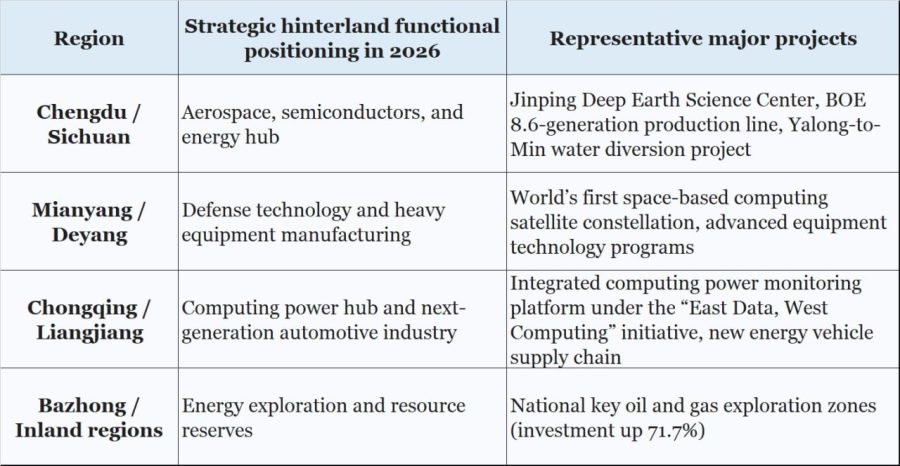
ii) One of the central lessons that the CCP appears to be drawing from the 2026 U.S.-Iran conflict is that supply chains become more vulnerable the longer they stretch. Therefore, Beijing is emphasizing localized supply chains in its industrial layouts. In Sichuan, sectors such as integrated circuits, new displays, and electric vehicles are improving their “nearby supporting capacity,” with the aim of building a “strategic internal circulation system” capable of operating independently even if coastal ports are blockaded.
The CCP is likely looking to “trade space for time” by having its industrial layouts situated deeper inland. By establishing backup production lines and strategic reserves in inland regions, Beijing seeks to maintain long-term resilience in the event of technological blockades or physical disruptions to industries situated on the coast. Sichuan’s key project investments have exceeded 1 trillion yuan thus far in 2026, with over 80 percent of funding allocated to infrastructure and industrial projects. Through these moves, the CCP is essentially conducting an “economic arms race” in peacetime.
6. Beijing has established an administrative mechanism led by the State Council to implement the Regulations, with local governments bearing primary responsibility. While the CCP’s “whole-of-nation” system allows for maximum resource mobilization, it also produces significant side effects.
The CCP authoritarian system has demonstrated operational effectiveness to an extent per its fiscal and industrial practices in 2026:
- Rapid capitalization and infrastructure rollout: In Sichuan, all 285 newly launched projects under the national list of 102 major engineering initiatives have commenced. The enforcement of this strategic deployment is something that Western democratic systems will struggle to replicate.
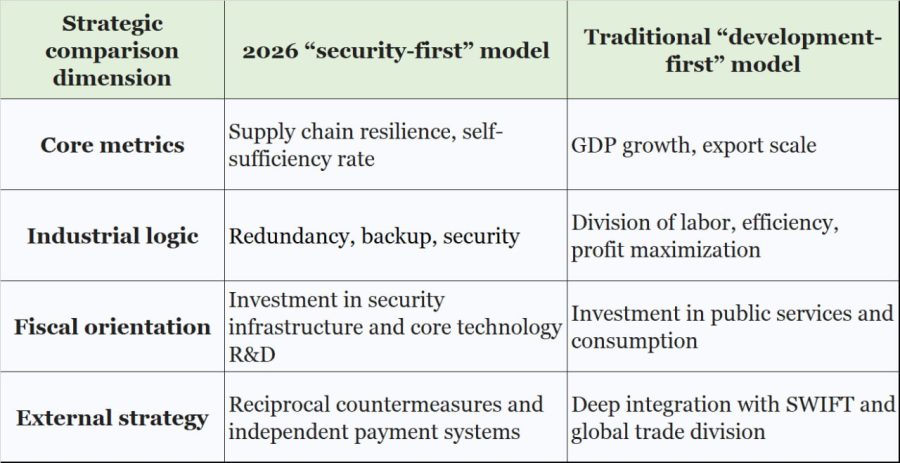
- Targeted policy and financial support: With a planned deficit ratio of around 4 percent and an expanded deficit scale of 5.89 trillion yuan, fiscal resources are being prioritized toward “security” rather than purely toward consumption or social welfare.
- Legalized enforcement mechanisms: The Regulations provide a legal basis for countermeasures against actors who are deemed to have harmed regime security. Organizations or individuals that fail to cooperate with security investigations may face legal penalties, ensuring compliance with state objectives.
This security-first model, however, also carries structural risks:
- Fiscal sustainability crisis: Local governments face massive debt ceilings for both general and special-purpose bonds. While central debt swaps have eased short-term pressure, local revenue growth targets remain low (around 2 percent to 4 percent), creating a severe mismatch between fiscal income and expenditure. Heavy asset investments driven by “security” priorities have long payback periods and may become permanent fiscal burdens.
- Distortion of market competition (“involution”): The “involution-style” competition highlighted in government reports reflects local governments blindly duplicating investments in key industries under the pressure of security evaluations. This leads to overcapacity, frequent price interventions, and damage to healthy market dynamics.
- Rising institutional costs of openness: Although the Regulations emphasize “high-level opening-up,” mechanisms such as security reviews, cross-border data controls, and mandatory countermeasures significantly increase compliance costs and operational uncertainty for foreign firms. To external observers, this “security fortress” may be robust, but is increasingly closed off.
7. The promulgation of the Regulations marks a significant milestone in the evolution of the CCP’s regime security outlook. Beijing is no longer satisfied with passive defense. Instead, by proactively restructuring industrial layouts, upgrading cross-border payment systems, and institutionalizing countermeasures through legislation, it is attempting to construct an economic system that is “immune to external influence.”
Xi Jinping’s “bottom-line thinking” has, by 2026, evolved into a comprehensive wartime contingency framework. The relocation of industry to strategic hinterlands and the localization of critical industries represent what the CCP sees as rational choices following assessments of extreme external risk scenarios. Although this “security-first” approach imposes heavy fiscal burdens and causes market distortions, in the CCP’s political calculus, such economic costs are considered acceptable when weighed against the risk of regime collapse.
The critical challenge for the CCP is whether the model of using institutional power to hedge against technological containment can achieve a genuine breakthrough in total factor productivity during the 15th Five-Year Plan period. If industrial layouts post-Regulations lead to the accumulation of excess capacity without genuine innovation, then this seemingly “robust” security chain is in danger of snapping from within from internal fiscal exhaustion. Conversely, if the PRC can use this “strategic buffer” period to achieve a leap in “new quality productive forces,” it could potentially lay the foundation to reshape the global rules of great-power competition.




