
1 Beijing met its 2025 GDP growth target, but only if data inconsistencies are overlooked
On Jan. 19, the PRC’s National Bureau of Statistics released some key economic data for China in 2025. Noteworthy data includes:
Macroeconomy and GDP
- China’s GDP in 2025 grew 5.0 percent to reach approximately 140.2 trillion yuan, meeting Beijing’s annual target.
- Growth eased from 5.4 percent in Q1, declining quarter by quarter to 4.5 percent in Q4.
- Contribution to growth:
- For the full year, final consumption expenditure, gross capital formation, and net exports of goods and services contributed 52.0 percent, 15.3 percent, and 32.7 percent respectively to growth.
- In Q4, the respective contributions were 52.9 percent, 16.0 percent, and 31.1 percent.
- Equipment manufacturing (up 9.2 percent) and high-tech manufacturing (up 9.4 percent) significantly outperformed overall industrial growth.
Consumer market
- Total retail sales of consumer goods rose 3.7 percent year-on-year to 50.12 trillion yuan.
- December retail sales grew only 0.9 percent year-on-year to 4.51 trillion yuan and fell 0.12 percent month-on-month, indicating soft consumption momentum at year-end.
- Nationwide online retail sales increased 8.6 percent to 13.09 trillion yuan, with online sales of physical goods accounting for 26.1 percent of total consumption.
Real estate market
- Real estate development investment fell 17.2 percent to 8.28 trillion yuan in 2025.
- New commercial housing:
- Sales area declined 8.7 percent to 881 million square meters.
- Sales value fell 12.6 percent to 8.39 trillion yuan.
- In December, housing prices across 70 major cities generally declined month on month. Second-hand home prices in first-tier cities fell 7.0 percent year-on-year, with Beijing down 8.5 percent. Shanghai was among the few cities where prices of new homes rose year-on-year (up 4.8 percent).
Investment
- Full-year investment declined 3.8 percent to 48.52 trillion yuan, mainly due to the drag from real estate. Excluding property, manufacturing investment edged up 0.6 percent.
Prices and demographics
- Consumer prices were flat year-on-year for 2025 as a whole. The CPI rose 0.8 percent year-on-year in December.
- By end-2025, China’s population stood at 1.405 billion, a drop of 3.39 million people from the previous year.
- People aged 60 and above accounted for 23.0 percent of the population.
- The urbanization rate rose to 67.89 percent.
***
On the same day, NBS director Kang Yi also held a press conference to go over key economic indicators.
Kang described the foundations of China’s economy in 2025 as “stable, with multiple strengths, strong resilience, and significant potential.” Looking ahead to 2026, he said that the long-term conditions and fundamental trend supporting economic improvement have not changed, nor has the overall trajectory of high-quality development. Kang further stressed that China has the foundation and conditions to ensure that economic performance is stable and improving.
Our take
In 2025, the Chinese economy exhibited a distinct “macro-data temperature gap,” or a phenomenon where the achievement of official GDP targets relied primarily on adjustments to statistical methods, the passive expansion of net exports driven by price competition, and a statistical increase in inventories. In contrast, the real economy — particularly household consumption and private investment — remained in a zone of deep contraction.
1. On the surface, China’s official macroeconomic data for 2025 projects an image of stability and resilience. Beneath this veneer, however, performance across economic sectors was highly uneven and almost fractured, highlighting the limited quality and authenticity of the reported recovery.
The official full-year GDP growth of 5.0 percent “precisely” met the CCP authorities’ politically and economically significant target of “around 5 percent” set at the start of 2025. The figure was clearly intended to signal that the Chinese economy remained resilient despite the property downturn and lingering post-pandemic “scarring” effects. We previously analyzed that “the CCP’s 2025 growth target of 5 percent is increasingly out of reach in actual terms, although Beijing will almost certainly ‘massage’ the data to hit its goal.”
Yet a far more fragile and internally inconsistent picture emerges once the headline number is broken down. From a quarterly perspective, growth momentum showed a clear “high start, low finish” trend. GDP growth reached 5.4 percent in Q1, supported by early-year policy stimulus and a low base effect. Growth in the second and third quarters hovered around 5 percent, before slipping to 4.5 percent in Q4. This stepwise deceleration points to weak endogenous growth drivers and a rapid dissipation of policy stimulus effects.
Economic performance across different sectors reveals striking divergences and contradictions:
- Industrial value added above designated size: Up 5.9 percent year-on-year, exceeding expectations. Driven largely by export-oriented manufacturing (notably the “new three” of electric vehicles, lithium-ion batteries, and photovoltaics) and inventory accumulation.
- Retail sales of consumer goods: Up 3.7 percent year-on-year, significantly below GDP growth and nominal income growth. This confirms a structural downgrading of consumption.
- Fixed-asset investment: Down 3.8 percent year-on-year, an extremely unusual contraction and one of the rare instances of annual negative growth since the start of reform and opening. This was largely due to the real estate downturn.
- Real estate development investment: Down 17.2 percent year-on-year, a far steeper decline than anticipated. This indicates that policy support measures (such as project “whitelists” and inventory buybacks) have had a limited impact.
- Exports (US dollar terms): Up 5.5 percent year-on-year, an inverse growth outcome against the backdrop of slowing global demand. This reflects Beijing’s aggressive “price-for-volume” strategy.
- Consumer price index: Flat at 0.0 percent year-on-year, confirming entrenched deflation. Core CPI posted only a marginal increase, while overall price stagnation underscores extremely weak domestic demand.
- Producer price index: Down 2.6 percent year-on-year. This signals prolonged industrial deflation, severe compression of corporate profit margins, and a consequent loss of investment appetite.
The above data anomalies sit uneasily with basic macroeconomic principles. Under normal conditions, industrial output, electricity consumption, logistics activity, investment, and consumption tend to move in broadly consistent directions. Instead, the official data reveal sharp directional divergences:
- Output – price divergence: Industrial value added rose 5.9 percent, yet PPI fell 2.6 percent. Firms are producing more but selling at lower prices, eroding margins. This phenomenon of “growing volumes without growing revenues” explains why headline macro data appear acceptable while corporate sentiment remains deeply pessimistic.
- Investment – capital formation divergence: Fixed-asset investment contracted by 3.8 percent, yet gross capital formation still made a positive contribution to GDP growth in official accounting. If investments truly fell, then GDP growth should have been much weaker unless other components or statistical adjustments were inflated (see point 2 below). This indicates that Beijing almost certainly reached into its statistical “black box” to produce the 5.0 percent GDP figure for 2025.
- Money supply – inflation divergence: Broad money (M2) growth remained elevated, while CPI stagnated and PPI stayed negative. This points to a breakdown in monetary policy transmission, resulting in a “liquidity trap” where capital idles within the financial system and inventories rather than circulating through consumption and investment.
2. The GDP figures released by the CCP authorities are primarily the result of production-side accounting. Against a backdrop of severe overcapacity and elevated inventories, the 5 percent GDP growth rate is clearly inflated. A calculation of growth using the expenditure approach — the three drivers of final consumption expenditure, gross capital formation, and net exports of goods and services — produces a very different picture.
i) China’s final consumption expenditure accounted for 52 percent of GDP growth in 2025 according to the National Bureau of Statistics, contributing roughly 2.6 percentage points to GDP growth. While this appears to support the narrative of China’s transition toward a consumption-driven economy, a closer examination shows that this higher contribution rate mainly reflects an adjustment in shares of investment and net exports rather than a robust rebound in consumption.
Structural weakness in retail data
Full-year growth in total retail sales of consumer goods was 3.7 percent, the lowest rate on record except for 2020 and 2022. More importantly, consumption experienced sharp down-trading and polarization:
- Collapse in durable goods consumption: Categories closely tied to the property cycle saw steep declines. In December, household appliances and audiovisual equipment plunged 18.7 percent, building and decoration materials fell 11.8 percent, and furniture declined 2.2 percent. This invalidates claims that property-support policies have meaningfully stimulated downstream industries and highlights extreme caution toward big-ticket purchases.
- Stalling auto consumption: Once a key growth engine, auto consumption recorded an average 5.0 percent decline across the year. While new-energy vehicle output surged, the overall drop in auto sales value reveals that the collapse of the internal-combustion vehicle market has outpaced EV substitution, with intense price wars further compressing revenues.
- Necessities and the “lipstick effect”: Growth was concentrated in food and cooking oil (up 3.9 percent), communications equipment (up 20.9 percent, largely driven by new product cycles from domestic brands such as Huawei), and gold and jewelry (up 5.9 percent) with safe-haven characteristics. This pattern — “eat enough, use smartphones, buy gold” (吃飽、玩手機、買黃金) — is classic defensive consumption behavior during periods of heightened economic uncertainty.
Service consumption: volume up, prices down
The CCP authorities have emphasized the recovery of service consumption such as tourism and catering. Indeed, domestic tourism revenue and trips rebounded in 2025, and railway passenger volume reached a record 4.59 billion trips. However, catering revenue grew only 2.2 percent in December, and major cities experienced waves of restaurant closures, with sector financing plunging 93 percent. This indicates that while people are still going out, average spending per visit (ticket size) has fallen sharply, signaling a shift toward cheaper consumption.
Income and employment are the root cause
China’s weak consumption fundamentally stems from deteriorating income expectations and household balance sheets:
- Youth unemployment: Excluding students, the unemployment rate for ages 16–24 stayed between 14.5 percent and 15.8 percent for two months in the year, exceeded 16 percent in most other months, and peaked at 18.9 percent in August. This means a large share of new labor entrants failed to become effective consumption drivers.
- Reversal of the housing wealth effect: Real estate accounts for roughly 70 percent of household wealth in China. Persistent declines in home prices have damaged household balance sheets, generating a strong negative wealth effect that suppresses middle-class consumption. In 2025, medium- and long-term household loans (mainly mortgages) rose by only 1.28 trillion yuan, just 21 percent of the 6.08 trillion yuan increase at the 2021 property peak. Meanwhile, the savings rate remained elevated at 43.4 percent, showing households prefer holding cash rather than spending.
In short, the 52 percent contribution of consumption to GDP growth was a passive increase caused by the collapse in investment. The real consumption market is characterized by minimal volume growth, structural downgrading, and price deflation, and is incapable of serving as the core engine for sustaining 5 percent growth.
ii) The component that most clearly exposes the inflation of GDP figures is gross capital formation. Fixed-asset investment fell 3.8 percent for the year, a highly unusual annual contraction since the start of the “reform and opening up” period. Yet in GDP accounting, gross capital formation still contributed 0.8 percentage points to growth.
While closely related, fixed-asset investment and gross capital formation differ by definition:
- Gross capital formation is gross fixed capital formation plus changes in inventories.
- Fixed-asset investment data include land purchases (which are not counted in GDP) and purchases of existing equipment. The 17.2 percent collapse in real-estate development investment in 2025 directly dragged down fixed-asset investment.
- Gross capital formation, which is included in GDP, could only remain positive amid sharply negative fixed-asset investment through massive inventory accumulation.
Large volumes of unsold goods produced under conditions of overcapacity were booked into GDP as inventory investment. Industrial data show longer turnover days for finished goods and rising inventory levels in 2025. This means factories ran at high capacity (industrial value added up 5.9 percent), but output was not fully absorbed by end demand (consumption or exports) and instead piled up in warehouses. In GDP accounting, inventory accumulation counts as “investment” (even if the goods are never sold) and thus boosts growth. Yet this form of growth is inefficient and ultimately a future burden. Today’s inventory buildup implies tomorrow’s destocking pressure and intensified price wars, a direct manifestation of overcapacity. This is likely a key reason behind the inconsistency between gross capital formation and fixed-asset investment data.
Further doubts arise from the extreme divergence in the investment structure:
- Real estate investment was down 17.2 percent and new housing starts were down 20.4 percent. This is a trillion-yuan-scale black hole that emerging industries cannot realistically offset.
- Infrastructure investment was down 2.2 percent. The PRC’s traditional infrastructure-led growth model is unsustainable as local governments are burdened by debt.
- Manufacturing investment was up only 0.6 percent, mainly in equipment upgrades and high-tech sectors. This was far too weak to offset the collapse in real estate and infrastructure.
iii) With both consumption and investment faltering, net exports became the decisive force keeping GDP growth at 5 percent in 2025. Net exports contributed roughly 1.6 percentage points, accounting for 32 percent of total growth. However, this was achieved by exporting deflation through a “price-for-volume” strategy.
China’s record-high surplus of nearly $1.2 trillion in 2025 was driven by two factors:
- Surging export volumes: Under pressure from domestic overcapacity, Chinese firms offloaded excess supply onto global markets. Export volumes of electric vehicles, solar panels, lithium batteries (the “new three”), as well as steel and chemical products, rose sharply.
- Stagnant imports: Imports grew only 0.5 percent, reflecting extremely weak domestic demand for commodities, intermediate goods, and consumer products — a clear case of a recessionary surplus.
Although the value of exports rose 6.1 percent, export price indices broadly declined. Goldman Sachs estimated China’s export price inflation at negative 2.7 percent in 2025. By exporting deflation to gain market share, China has triggered a global backlash of protectionism — including U.S. tariff escalations and EU anti-subsidy probes — setting the stage for a volatile 2026.
3. The most compelling evidence indicating that Beijing inflated its official GDP figure for 2025 is the huge gap between China’s fiscal revenue growth and GDP growth.
Governments generally do not fake data when it comes to tax collection by under-reporting it, and the CCP regime is no exception. In the first eleven months of 2025, the national general public budget revenue grew by only 0.8 percent from a year ago, of which tax revenue increased by just 1.8 percent. Within this, value-added tax rose 3.9 percent and corporate income tax grew only 1.7 percent. Meanwhile, profits of industrial enterprises above designated size nationwide increased by a mere 0.1 percent.
If China’s GDP truly grew by 5 percent, and if that growth was mainly driven by industry (up 5.9 percent), why did the CCP authorities fail to collect more tax revenue, especially when Beijing implemented stricter tax enforcement in 2025? This directly demonstrates the collapse in corporate profit margins. Therefore, Beijing’s official GDP growth appears to be a case of “increasing production without increasing revenue” (增產不增收), or even “selling at a loss just to make a noise” (虧本賺吆喝).
2 Xi’s political mobilization of leading cadres at key meeting exposes the CCP’s governance crisis
Principal leading cadre meeting
On Jan. 20, the CCP Central Party School held the opening session of a special seminar for principal leading cadres at the provincial and ministerial level on the theme of “studying and implementing the spirit of the Fourth Plenum of the 20th CCP Central Committee.” Official media reported that all members of the Politburo Standing Committee and PRC vice president Han Zheng attended the meeting along with other state leaders, and Xi Jinping delivered an important speech.
In his speech, Xi first pointed out the importance of formulating and implementing five-year plans. He said this is an important “political advantage” of the “socialist system with Chinese characteristics,” conducive to realizing the Party’s leadership, to “concentrating resources to accomplish major undertakings” (集中力量辦大事), to taking a “forward-looking approach to strategic issues,” and to maintaining continuity in national undertakings.
Xi emphasized the need to “comprehensively, profoundly, and accurately understand and grasp” the strategic arrangements for the 15th Five-Year Plan made at the Fourth Plenary Session of the 20th Central Committee. He explained that “comprehensive” means understanding the “spirit of the plenum” from a global perspective, ensuring that one does not focus on one aspect while neglecting another. To be “profound” means not only knowing what is being done but also understanding why it is being done. To be “accurate” means to precisely master the boundaries and scales of policy, ensuring that what must be done is done, what can be done is pursued with effort, and what should not be done is strictly avoided.
Xi said that China’s development is at a stage where “strategic opportunities coexist with risks and challenges,” and where “uncertain and hard-to-predict factors” are increasing. He added that in analyzing the situation, one must take all factors into account while also being adept at identifying key factors, such as changes in the international environment and new developments in the new round of technological revolution and industrial transformation.
Xi stressed that building a modern industrial system and achieving an overall upgrading of the industrial system are major strategic tasks during the 15th Five-Year Plan period. He added that it is necessary to maintain a reasonable share of manufacturing, vigorously develop advanced manufacturing, develop “new quality productive forces” in accordance with local conditions, and promote the deep integration of technological innovation and industrial innovation. Efforts should also be made to build modern infrastructure.
Xi noted that it is necessary to adhere to “taking the domestic circulation as the mainstay” and to correctly handle the relationship between consumption and investment, and between demand and supply.
Xi emphasized that successfully accomplishing the goals and tasks of the 15th Five-Year Plan period requires a strong focus on improving the Party’s capacity and level in leading economic and social development. Cadres at all levels, especially leading cadres, must further strengthen their studies, delve deeply into the Party’s innovative theories, enhance professional competence, and improve their ability to carry out practical work.
While presiding over the opening ceremony, Li Qiang lavishly praised Xi’s speech as “lofty in vision, far-reaching in intent, and inspiring,” with “strong political, theoretical, targeted, and guiding significance.” He said it is of great importance for the entire Party — especially senior cadres — to gain a deep understanding of the new situation in advancing Chinese-style modernization. Li Qiang also called on the entire Party to profoundly grasp the decisive significance of the “Two Establishes,” resolutely uphold the “Two Safeguards,” and consciously unify thinking and action with the spirit of General Secretary Xi’s important speech and the Party Central’s decisions and deployments.
***
Footage of the meeting shown on CCTV’s primetime program Xinwen Lianbo seemed to indicate that Central Military Commission vice chairman Zhang Youxia, CMC member Liu Zhenli, Politburo member Ma Xingrui, and Organization Department head Shi Taifeng were absent from the event. This sparked some speculation in external China watching circles that those officials could be in trouble.
Anti-corruption data for 2025
On Jan. 17, the Central Commission for Discipline Inspection and the National Supervisory Commission released nationwide anti-corruption statistics for disciplinary inspection and supervision bodies in 2025.
In 2025, disciplinary inspection and supervision authorities imposed sanctions on a total of 983,000 individuals, including:
- 727,000 Party disciplinary punishments and 321,000 administrative (government) sanctions.
- By rank, those disciplined included:
- 69 officials at the provincial/ministerial level or above.
- 4,155 officials at the department/bureau level.
- 35,000 officials at the county/division level.
- 125,000 officials at the township/section level.
- 133,000 general cadres.
- 686,000 other personnel, including individuals from rural areas, enterprises, and other sectors.
In 2025, disciplinary inspection and supervision authorities applied the “Four Forms” of supervision, discipline, and accountability to 1.984 million person-times nationwide. Among them:
- The first form was applied in 987,000 person-times, accounting for 49.7 percent of the total.
- The second form was applied in 817,000 person-times, accounting for 41.2 percent.
- The third form was applied in 94,000 person-times, accounting for 4.7 percent.
- The fourth form was applied in 86,000 person-times, accounting for 4.4 percent.
The “Four Forms” are:
- First Form: Routine criticism and education, supervisory talks, and written inquiries. This emphasizes the normalization of “red faces and sweating,” i.e., early warnings and reminders.
- Second Form: Minor Party disciplinary sanctions and organizational adjustments. This applies to the majority of disciplinary violations.
- Third Form: Severe Party disciplinary sanctions and major adjustments to official positions. This targets serious violations of discipline.
- Fourth Form: Case filing and investigation for serious disciplinary violations suspected of involving criminal offenses. This is applied only in a very small number of cases.
Our take
1. The CCP’s annual study session for principal officials at the provincial and ministerial level is a very politically significant meeting. It is the highest-level forum through which the political center (i.e. the Xi leadership) conveys its core intentions to senior local officials — the so-called “key minorities” — and sets the tone of the governing trajectory for the rest of the year.
Xi Jinping’s emphasis on explaining the importance of the 15th Five-Year Plan (2026–2030) to senior officials suggests that he believes what the CCP regime does over the next five years will be crucial to realizing his vision of so-called “Chinese-style modernization.” Concurrently, 2026 is also a pivotal year for Xi as he prepares to take a fourth term as General Secretary in 2027; in particular, local government leadership reshuffles later in the year (typically in the fourth quarter) serve as a key window for the Xi leadership to promote politically loyal officials and solidify Xi’s bid to extend his tenure.
Xi’s effort to inculcate greater political loyalty towards himself and the Party comes amid challenging times for the CCP regime. The Chinese economy continues to be dragged down by intractable problems, including a real estate crisis, local government debt issues, and weak domestic demand. Meanwhile, the PRC faces an even more fraught international environment as the Trump administration pursues foreign adventurism (Venezuela, Iran, Greenland, etc.) while trade protectionism and technological blockades remain largely in place. Under these conditions, the Xi leadership faces a core dilemma: how to maintain governing efficiency and the political loyalty of a vast bureaucratic system amid overall resource contraction and mounting fiscal constraints.
2. Xi Jinping’s speech at the opening ceremony of the study session for principal officials at the provincial and ministerial level, as well as the CCDI’s purge of nearly 1 million officials in 2025, reveal two crises plaguing the current CCP leadership.
First, the Xi leadership is facing a narrative crisis where the PRC can no longer rely on booming economic growth to rally officials and instill loyalty to the leadership and the regime. Instead, Beijing must rely on new theoretical constructs such as “new quality productive forces” — which rationalize economic difficulties and endow them with the elevated meaning of “strategic transformation” — to give officials something to aim for and prevent ideological wavering as China’s development momentum falters. In doing so, the Xi leadership is unilaterally restructuring the political contract between the central and the local governments — the political center demands that the local authorities shoulder higher political responsibilities (such as security and supply-chain resilience), despite the absence of incentives, for the greater good of the regime.
Second, the Xi leadership faces a crisis of governing efficacy as demoralized officials turn to “lying flat” and so-called “defensive governance” (防禦性履職) to survive politically amid a grinding anti-corruption campaign. Beijing’s solution to this crisis is to double down on political discipline and intensify the anti-corruption campaign to force officials to “struggle” to produce results in an environment of resource scarcity.
3. The content of Xi Jinping’s speech at the principal officials study session indicates that he is not merely making work deployments, but is also engaging the upper echelons of the Party in a campaign of psychological conditioning and cognitive reshaping.
i) Xi repeatedly emphasized the need to “comprehensively, profoundly, and accurately grasp” the “spirit of the Fourth Plenum,” and required officials to not only “know what is being done but also understand why it is being done.” This epistemological demand implicitly suggests the existence of cognitive divergence or even disagreement within the Party on Beijing’s current economic policies (such as suppressing the real estate sector and curbing the “disorderly expansion of capital”).
Xi also attempted to explain away China’s current economic difficulties by politicizing and strategizing economic issues, and in doing so, obscuring his own governance failures and deflecting responsibility. For instance, Xi said that China’s development is at a stage where “strategic opportunities coexist with risks and challenges,” and stressed the need to “keep the overall picture in mind and look far ahead from a high vantage point.” In effect, this tells officials that present economic difficulties (such as declining fiscal revenues and slowing growth) are not the result of policy errors, but rather the inevitable outcome of a deteriorating external environment (“rough winds and high waves”) combined with internal structural adjustment (“a period of growing pains”).
By portraying the deterioration of economic indicators as a price that must be paid to achieve “supply chain security” and “technological self-reliance,” the Xi leadership is seeking to defuse the dissatisfaction and anxiety of local officials arising from performance-evaluation pressures. Officials are being sold a new grand narrative: “Growth may have slowed, but it is now more secure and of higher quality.”
ii) Xi elevated “new quality productive forces” to a key strategic task for the 15th Five-Year Plan period in what appears to be an attempt to promote a new economic concept and vocabulary in the minds of officials. In reality, “new quality productive forces” is so much an economic concept than a political instrument used to draw a line between the “old forces” (the development model inherited from the Jiang Zemin era that relied on land finance, low-end manufacturing, and debt-driven growth) and the “new forces” (artificial intelligence, green energy, and high-end manufacturing promoted in Xi Jinping’s New Era). The Xi leadership’s tactic is reminiscent of what the CCP did in the early years of the PRC by coming up with the term “New China” to differentiate its regime from the “China” governed by the Kuomintang, thereby fostering the impression that the Party was bringing “renewal” to China.
For the vast majority of local officials who depend on traditional industries, however, the Xi leadership’s shift in focus to “new quality productive forces” is disruptive because it implies the devaluation of the resources they control (land and low-cost labor). By personally explaining this concept at the seminar, Xi is aiming to forcibly unify intra-Party thinking — those who do not embrace “new quality productive forces” are politically falling behind. This effectively pressures officials to engage in “self-revolution” and abandon their reliance on the previous growth path.
iii) Xi repeatedly called for “upholding the centralized and unified leadership of the Party Central” and “adhering to the principle that the whole country is one chessboard” (堅持全國一盤棋, i.e. nationally coordinated). Against the backdrop of intensifying local fiscal crises, emphasizing national coordination signals that the center will further recentralize resource allocation authority, requiring wealthier provinces to shoulder greater responsibilities while demanding that all regions submit to the central strategic layout (i.e. building a unified national market, implementing coordinated regional economic planning, etc.). This amounts to a preemptive warning against local protectionism and parochialism; Beijing also appears to be concerned that competition for resources during an economic downturn could strengthen “centrifugal forces” in the provinces and undermine central cohesion.
4. If Xi Jinping’s speech was about providing “explanation” and “guidance” to the “key minorities,” then the CCDI’s 2025 anti-corruption report card is a blunt instrument of “deterrence.” The CCDI’s data shows that the anti-corruption campaign has not weakened over time, but has reached a new level of intensity on the eve of the regime’s new five-year plan.
i) Per CCDI data, disciplinary inspection and supervision organs nationwide placed as many as 115 centrally managed officials (provincial/ministerial level and above) under case filing, review, and investigation in 2025. This figure is a historical high given that between 40 to 70 centrally managed officials were disciplined in previous years. It is possible that the record number of senior officials disciplined in 2025 is not entirely routine anti-corruption work, but a sort of “pre-transition political health check” and a “purification campaign of the ranks” before the CCP embarks on the 15th Five-Year Plan. The purge also sends a clear signal to all provincial and ministerial level officials that they can be taken out at any time, no matter their credentials or seniority, if they are found to be wanting politically or in implementing Beijing’s deployments.
ii) The number of Party members and officials disciplined by the anti-corruption authorities has continually risen since Xi Jinping took office. Particularly noteworthy is the surge in purges in 2024 and 2025, or nearly 1.9 million officials purged over the two years. This indicates that Xi did not shift to “recuperation and consolidation” as some external observers expected after the 20th Party Congress, but instead adopted more aggressive measures to curb bureaucratism and other problems plaguing governing efficiency. Xi’s “maximum pressure” anti-corruption effort suggests that his anxiety over the bureaucracy’s loyalty to himself and the Party has intensified over time.
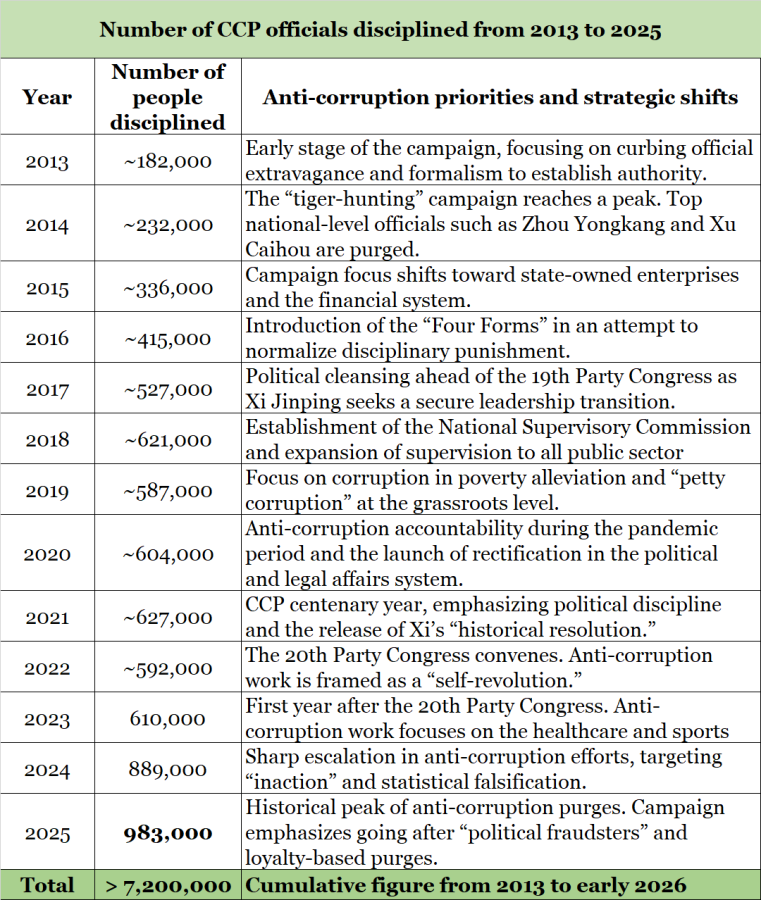
iii) The table above shows more than 7.2 million people were cumulatively disciplined between 2012 to early 2026. This indicates a structural, two-way crisis of trust between Xi Jinping and the CCP bureaucracy.
First, Xi’s anti-corruption actions and rhetoric reveal that the top leadership has deep doubts about the loyalty and implementation capacity of the bureaucracy under adverse conditions. For example, local governments, in an effort to maintain appearances, often falsify economic data (such as inflating investment figures or concealing debt). This makes it difficult for the central authorities to obtain truthful information for decision-making, leading to fundamental distrust of local reporting. Ironically, this situation is partly caused by Beijing’s own policy of imposing impossible “triple demands” (environmental protection, growth, and security) on local governments in implementing economic work. As a result, local officials commonly resort to “selective implementation” or “formalistic responses,” with policy implementation stuck at the propaganda and rhetorical level without any meaningful progress.
Second, the phenomena of “lying flat” and “inaction” among CCP bureaucrats partly reflect their doubts about the effectiveness of central policies and changed reward incentives. The political promotion model from the Jiang-Hu era — career advancement by inflating GDP figures — has been replaced in the Xi era by the vague notion of having a “correct view of political achievements.” Officials learn that striving for economic growth carries high risks (especially debt accumulation), while not striving invites accountability. This disincentivizes them from properly implementing Beijing’s orders over fears that they the more they strive, the more they will be penalized (多做多錯). Meanwhile, many localities lack the foundations to develop high-tech industries, and centrally imposed initiatives such as the “unified national market,” regional economic integration, and “new quality productive forces” appear unrealistic at the grassroots level. This disconnect between Beijing’s “top-level design” and “grassroots reality” in the localities effectively alienates officials from the center, fostering a mindset of “you say what you want; I’ll do my own thing” (你講你的,我做我的).
The proportion of disciplined officials among those holding key leadership positions (deputy section chief level and above) between 2012 and 2026 is as high as 20 percent. Such a high-risk political environment fundamentally alters bureaucrats’ expected payoff models. When the probability of “something going wrong” reaches statistical significance, the CCP bureaucracy exhibits two typical stress responses: inaction combined with mere “performances of loyalty,” and forming cliques and attaching oneself to senior officials in search of political protection. Given the traditional responses of the officialdom to heightening political risk, Xi’s “self-revolution” will likely fail to resolve the CCP’s bureaucratic problems and even exacerbate their severity.
Based on estimates derived from staffing quotas at various levels, the number of officials with real decision-making power (deputy section chief level and above) is statistically about 900,000 to 1 million. Taking into account natural turnover during Xi’s 14 years in power (retirements, departures, deaths), the total number of people who have held such positions is about 1.5 times the estimated figure. That is, from 2012 to 2026, there were roughly 1.5 million officials in key positions (deputy section chief level and above), of whom about 300,000 were disciplined — a ratio as high as 20 percent.
All in all, the CCP is showing signs of systemic deadlock. Xi likely has a deep distrust of the bureaucracy, viewing it as inherently corrupt, lethargic, and disloyal. Therefore, he believes he must rely on external supervisory forces (disciplinary commissions and inspection teams) to forcibly rein in the bureaucratic machine and carry out constant purges to ensure that it functions per the central authorities’ demands. Meanwhile, the bulk of the bureaucracy likely believes that the implicit past contract between themselves and the political center — “loyalty in exchange for protection” and “performance in exchange for promotion” — has been breached in favor of an arrangement where they do not have a win scenario. Notably, loyalty no longer guarantees safety (purges are becoming indiscriminate), and performance no longer guarantees advancement (political criteria come first). As a result, many bureaucrats appear to have adopted a “minimum-effort” strategy as the rational “solution” to ensuring their political survival and progression.
4. Of the four senior officials who appeared to be absent from the special seminar for principal leading cadres at the provincial and ministerial level, there is only clearer evidence that Ma Xingrui has run afoul of the Xi leadership. The other three — Zhang Youxia, Liu Zhenli, and Shi Taifeng — could have missed the meeting due to mundane reasons such as health problems or important scheduled duties. Going forward, whether these officials are absent from upcoming Politburo or other important meetings will be an important indicator to watch to determine their political security.




