
1 PRC and Russia openly challenge the US-led global order during Putin’s China trip
Putin visits China
May 16 to May 17
Russian president Vladimir Putin traveled to China in his first overseas trip since being re-elected for the fifth time in March. PRC and Russian official statements said that Putin was visiting China at the invitation of Xi Jinping.
Xi greeted Putin with much pomp and pageantry. The two met on a red carpet outside the Great Hall of the People in Beijing, and the welcoming ceremony included a 21-gun salute on Tiananmen Square, a marching band, an honor guard, and children waving the flags of the PRC and Russia.
In the afternoon on May 16, Putin laid a wreath at the Monument to People’s Heroes in Beijing before meeting with PRC premier Li Qiang and State Council secretary-general Wu Zhenglong. Xi and Putin then attended the opening ceremony of the “China-Russia Years of Culture” event and a special concert celebrating the 75th anniversary of China-Russia diplomatic ties. Xi and Putin also held a small-scale meeting in the evening, according to state mouthpiece Xinhua.
On May 17, Putin traveled to Harbin in northeastern China with PRC leaders to lay a wreath for Soviet soldiers before attending a China-Russia Expo.
The Russian delegation accompanying Putin in China included:
- Russian foreign minister Sergey Lavrov.
- Russian defense minister Andrei Belousov.
- Russian Federation Security Council secretary Sergei Shoigu.
- Russian economic minister Maksim Reshetnikov.
- Russian finance minister Anton Siluanov.
- Russian central bank governor Elvira Nabiullina.
- Russia first deputy prime minister Denis Manturov.
- Russian deputy head of the presidential administration Maxim Oreshkin.
- Russian presidential aide Yuri Ushakov.
- Russian Federal Service for Military Technical Cooperation chief Dmitry Shugayev.
- Sberbank CEO Herman Gref.
- VTB Bank CEO Andrey Kostin.
- Rosneft CEO Igor Sechin.
Joint statement
Xi Jinping and Putin issued a joint statement on “deepening the China-Russia comprehensive strategic partnership of coordination for a new era.”
The statement, running over 12,000 characters and divided into 10 sections, contained the following noteworthy content:
- Current China-Russia relations transcend the military and political alliance model of the Cold War era and are characterized by non-alignment, non-confrontation, and not targeting third parties. Faced with a turbulent and changing world order, China-Russia relations have withstood the test of international upheavals, demonstrated stability and resilience, and are now at the best level in history.
- The development of the China-Russia comprehensive strategic partnership for a new era is not a temporary measure nor is influenced by specific incidents, but possesses strong internal momentum and intrinsic value.
- Both sides resolutely safeguard their legitimate rights and interests, and oppose any attempts to obstruct the normal development of relations between the two countries, interfere in the internal affairs of either country, or restrict the economic, technological, and international space of the two countries.
- Russia reiterated its adherence to the One China principle, opposes any form of “Taiwan independence,” and firmly supports China’s measures to safeguard national sovereignty and territorial integrity, and achieve national reunification. China supports Russia in maintaining its national security and stability, development and prosperity, sovereignty and territorial integrity, and opposes external forces interfering in Russia’s internal affairs.
- Both sides pointed out that the world is undergoing rapid changes, with the status and strength of emerging countries and regions in the “Global South” continuously increasing, and the acceleration of a multipolar world becoming more obvious. These objective factors are hastening the redistribution of development potential, resources, and opportunities in favor of emerging markets and developing countries. Countries that cling to hegemonism and power politics are attempting to go against this trend and replace and undermine the universally recognized international order based on international law with a “rules-based order.”
- As an independent force in the process of establishing a multipolar world, China and Russia will fully explore the potential of their bilateral relationship to promote the realization of an equal and orderly multipolar world and the democratization of international relations, as well as gather their strength to build a just and reasonable multipolar world.
- Both sides will continue to firmly defend the results of the victory of the Second World War and the post-war world order enshrined in the United Nations Charter, and oppose the negation, distortion, and falsification of the history of the Second World War. Both sides also emphasized the necessity of strongly condemning the glorification or attempted revival of Nazism and militarism.
- Both sides will maintain close high-level exchanges, exchanges between legislative leaders, and interactions between government, local, and civil organizations.
- On the basis of high-level strategic mutual trust, both sides will steadily carry out defense cooperation, expand the scale of joint training exercises, regularly organize joint maritime and air patrols, strengthen coordination and cooperation under bilateral and multilateral frameworks, and continuously improve the ability and level of jointly responding to risks and challenges.
- Both sides will carry out cooperation in law enforcement and security, and strengthen cooperation in combating terrorism, separatism, extremism, and transnational organized crime.
- Both sides condemn attempts to confiscate foreign assets and property, and emphasize that affected countries have the right to take countermeasures in accordance with international law.
- Both sides are willing to continue deepening cooperation in various views, including bilateral trade, the China-Russia Expo, investment, energy, civil nuclear energy, local currency settlement, financial intelligence, industry and innovation, information and communications technology, aerospace, agriculture, transportation logistics and ports, customs, intellectual property, competition policy, industry, infrastructure, housing and urban development, the China-Russia Arctic route, local and border cooperation, environmental protection, the integration of the Belt and Road Initiative with the Eurasian Economic Union, comprehensive cooperation in the Eurasian region, and trilateral cooperation among China, Russia, and Mongolia.
- Both sides actively seek to expand cultural cooperation, including cooperation in education, scientific, and technological exchanges, cultural exchanges, the film industry, modern medical technology, biotechnology, sports exchanges, tourism, archives, civil exchanges, exchanges between experts and think tanks, and youth cooperation.
- Both sides reaffirm their commitment to building a more just and stable multipolar international order.
- Both sides will strengthen cooperation within various organizational frameworks, including the Shanghai Cooperation Organization, BRICS, UNESCO, the G20, the Asia-Pacific Economic Cooperation, and the Global Development Initiative.
- China and Russia expressed concern over the international security situation:
- Both sides emphasized the idea that nuclear wars cannot be won and must not be fought.
- Both sides reiterated their serious concern over the United States’ attempts to undermine strategic stability to maintain its absolute military advantage, including:
- Constructing a global missile defense system and deploying missile defense systems around the world and in space;
- Enhancing its capability to conduct military operations with high-precision non-nuclear weapons;
- Developing “decapitation” strike capabilities;
- Strengthening NATO’s “nuclear sharing” arrangements in Europe and providing “extended deterrence” to certain allies;
- Building infrastructure in Australia, a party to the South Pacific Nuclear Free Zone Treaty, that could support U.S. and British nuclear force operations;
- Engaging in nuclear submarine cooperation between the U.S., the UK, and Australia;
- Implementing plans to deploy land-based intermediate- and short-range missiles in the Asia-Pacific and Europe, and providing such missiles to its allies.
- Both sides expressed serious concern over the joint exercises conducted by the United States targeting China and Russia.
- Both sides demand that the United States refrain from engaging in any biological military activities that threaten the security of other countries and relevant regions, both domestically and internationally.
- Both sides oppose attempts by certain countries to use outer space for armed confrontation.
- Both sides expressed deep concern over the politicization of the Organization for the Prohibition of Chemical Weapons.
- Both sides attach great importance to the issue of artificial intelligence.
- China and Russia oppose setting trade barriers under the pretext of addressing climate change and linking climate issues with threats to international peace and security. Both sides expressed serious concern over Japan’s discharge of contaminated water from the Fukushima nuclear accident into the ocean.
- Russia welcomes China’s willingness to play a constructive role in resolving the Ukraine crisis through political and diplomatic means. Both sides believe that to steadily resolve the Ukraine crisis, it is necessary to eliminate the root causes of the crisis, adhere to the principle of indivisible security, and take into account the legitimate security interests and concerns of all countries.
- China and Russia believe that no country should seek its own security at the expense of the security of other countries.
- Both sides call on relevant countries and organizations to stop adopting confrontational policies and interfering in the internal affairs of other countries.
- Both sides oppose the United States establishing bloc structures in the Asia-Pacific region, Northeast Asia, and the Middle East, and interfering in the internal affairs of regional countries.
- Both sides will strengthen cooperation and coordination on ASEAN affairs, African affairs, Latin America and Caribbean affairs, and Arctic affairs.
Chinese bank suspends international settlement business
May 9
Hunchun Rural Commercial Bank, which mainly provides financial services for the China-Russia trade, announced the suspension of international settlement-related business operations, including the temporary halt of remittance services, due to “system upgrades.” The bank is located in Hunchun, a county-level city in China’s Jilin Province that borders Russia and North Korea.
***
Hunchun Rural Commercial Bank’s suspension of international settlement-related business operations could be an effort by the bank to avoid being targeted by U.S. sanctions.
Backdrop
1. In an interview with Xinhua just before his China trip, Vladimir Putin said that he had “fond memories” of Xi Jinping’s visit to Russia in March 2023 after his re-election as PRC leader following the 20th CCP National Congress. Also, the “unprecedented level of strategic partnership” between both countries determined Putin’s choice to visit China after his own re-election.
***
The PRC authorities appeared to deliberately keep their distance during Putin’s fifth inauguration ceremony. The PRC foreign ministry congratulated Putin but did not appear to send a representative to the ceremony. Meanwhile, Xi happened to be visiting Europe. The PRC media also reported on Putin’s inauguration in a low-key manner.
2. The Russian military recently opened up a new front in the northeastern part of Ukraine while continuing to advance in the east and south, leading to a retreat of Ukrainian troops.
3. The U.S. and its European allies have been warning the PRC against supporting Russia’s war effort, and in particular, sending dual-use items that helped Russia retool and resupply its defense industrial base. At a press conference in Beijing on April 26, U.S. Secretary of State Antony Blinken said, “Beijing cannot achieve better relations with Europe while supporting the greatest threat to European security since the end of the Cold War. As we’ve told China for some time, ensuring transatlantic security is a core U.S. interest. In our discussions today, I made clear that if China does not address this problem, we will.”
Our take
1. Xi Jinping’s reception of Vladimir Putin in Beijing and the content of the China-Russia joint statement on deepening “comprehensive strategic partnership of coordination for a new era” indicate that the PRC and Russia are set on defying the U.S.-led “rules-based international order” and double down on mutual support in the face of recent pressure from the U.S. and its European allies.
Here are some of our takeaways on the joint statement:
i) Clear signs that the PRC and Russia are strengthening bilateral relations despite warnings from the U.S. and the EU include the claim that China-Russia relations are at the “best level in history,” the claim that the development of the comprehensive strategic partnership is not a “temporary measure” or influenced by “specific incidents” but “possesses strong internal momentum and intrinsic value,” and the call to “oppose any attempts to obstruct the normal development of relations between the two countries, interfere in the internal affairs of either country, or restrict the economic, technological, and international space of the two countries.”
ii) The joint statement explicitly names the United States as an actor responsible for the “destabilization” of the international security situation, and indirectly accuses the latter of engaging in “hegemonism and power politics.” Previously, the CCP rarely accused the U.S. in such a blunt fashion, preferring instead to use vague language when criticizing Washington.
Meanwhile, the PRC and Russia sold themselves as “responsible global stakeholders” who are interested in building an “equal and orderly multipolar world” and the “democratization of international relations.” Such language, however, is highly deceptive and does not mean what it seems at first glance. Qu Qingshan, dean of the Central Party History and Documentation Research Institute, brought up concepts such as “democratization of international relations,” “multipolarization,” and “economic globalization” in a lengthy piece published in July 2022 promoting Xi’s “Two Establishes.” We explained at the time that Qu is making the argument that CCP-dominated “multipolarism” is due to replace U.S. “hegemonism,” and that the Party “never abandoned the “Cold War mentality,” does not trust the U.S. and the West to engage with the PRC in good faith even if the latter becomes more pro-China, believes in the ‘inevitability’ of ‘the East is rising, the West is in decline,’ and is preparing to resolve the ‘main contradiction’ of ‘great changes in the world unseen in a century’ squarely in its favor.”
The PRC and Russia also reveal in the joint statement their intention to overturn the current international order by “strengthening cooperation within various organizational frameworks,” as well as their cooperation and coordination on various regional affairs.
iii) The PRC and Russia attempted indirectly to find legitimacy for Russia’s aggression against Ukraine by calling for “firmly defend(ing) the results of the victory of the Second World War and the post-war world order” and “strongly condemning the glorification or attempted revival of Nazism and militarism.” This is a nod at Russia’s excuse that it is invading Ukraine to neutralize Nazi elements active in the country and a tacit accusation that the U.S. is undermining the post-war world order by siding with the Ukrainian far right.
iv) The joint declaration and the composition of the Russian delegation indicate that both sides are looking to deepen economic, energy, and military cooperation going forward.
With the PRC’s implicit backing, Russia would likely be emboldened to press on with its offensives and achieve its military objectives in Ukraine even if it means engaging in a potential military conflict with NATO. Meanwhile, the PRC and Russia’s agreement to carry out defense cooperation and expand military exercises suggests that both sides are preparing to face potential military challenges from the U.S. and its allies in multiple theaters, including the Indo-Pacific region and particularly in the Taiwan Strait and the South China Sea.
v) The PRC and Russia’s repeated warnings about avoiding nuclear warfare read like a veiled threat to the U.S. and its allies that they should not be pushed to the brink unless Washington and NATO want a military conflict with nuclear-armed China and Russia.
2. There are several possible reasons why the CCP is strengthening its partnership with Russia at the risk of courting greater tensions with the United States and worsening the regime’s current crises.
First, Beijing could believe that it is presently advantageous to deepen its cooperation with Russia and indirectly back Putin’s war in Ukraine. Russia has a number of things going for it in the conflict, including superiority in manpower and ammunition. By contrast, the U.S. and its European allies are struggling to fund and arm Ukraine. Also, Beijing could believe that the U.S. and its European allies may become more inclined to negotiate if Russia occupies only the Russian-speaking parts of eastern Ukraine and limits its westward advancement. Beijing could too be betting on a change in administration after the U.S. presidential election in November and the growing lack of appetite for war in the American public to prevent an escalation of geopolitical tensions and conflict. Finally, Beijing could believe that the U.S. and the EU face even worse financial and economic crises than the PRC, and it is worth weathering the storm since “the East is rising, and the West is in decline.”
Second, Beijing could believe that conflict with the U.S. and its allies is unavoidable. Hence, the CCP regime is willing to do whatever it can to shore up its current partnerships and alliances to amplify every advantage it can get and prevent being isolated when conflict arrives, even if it risks heightening tensions in the interim. While the CCP always views the U.S. as its number one threat, it has long held the latter to be acting mostly in good faith and unwilling to deeply fracture the bilateral relationship. The Biden administration’s tough measures against China after the Xi-Biden summit in San Francisco, however, have likely convinced the Xi leadership that the U.S. is now mostly untrustworthy and views the PRC as an enemy to be defeated. As such, it is better for the PRC to deepen cooperation with Russia and mutually strengthen their self-sufficiency; Russia can provide energy and food to China, and China can use its manufacturing sector to support Russia.
Third, Beijing could be looking to exploit global chaos to establish its “multipolar world order” and advance its domination agenda. The PRC’s call for peace and stability would be attractive to countries who fear that global conflict could break out if the U.S. and its allies continue to pursue their foreign policy agenda in Ukraine and elsewhere. Beijing could also seek to garner sympathy from countries by portraying itself as the victim of U.S. “hegemonism and power politics,” while at the same time duplicitously casting itself as the “savior” of developing countries (who do not wish to see a worsening of global instability) and a “responsible stakeholder” and defender of the post-war world order.
2 Beijing rolls out more policies in bid to rescue worsening property sector
April economic data
May 17
The PRC National Bureau of Statistics released the following economic data for April and the first four months of the year:
Retail sales
- Total retail sales of consumer goods in April increased by 2.3 percent year-on-year to reach 3.5699 trillion yuan. Retail sales excluding automobiles grew 3.2 percent to reach 3.2196 trillion yuan.
- Total retail sales of consumer goods during the January to April period increased by 4.1 percent year-on-year to reach 15.6026 yuan. Retail sales excluding automobiles increased by 4.3 percent to reach 14.1396.
- Automobile category: Sales of automobiles in April decreased by 5.6 percent year-on-year to reach 350.3 billion yuan, and increased 1.4 percent during the January to April period to reach 1.4630 trillion yuan.
- Retail sales of goods by units above designated size: Sales of such goods increased by 0.9 percent year-on-year in April to reach 1.2541 trillion yuan, and increased 4 percent during the January to April period to reach 5.4236 trillion yuan.
Fixed asset investment
- National fixed asset investment (excluding rural households) during the January to April period increased by 4.2 percent year-on-year and decreased by 0.03 percent month-on-month to reach 14.3401 trillion yuan (calculated on a comparable basis).
- Private investments increased by 0.3 percent from a year ago.
- Investments by foreign-invested enterprises decreased by 15.2 percent from the previous year.
Real estate
- National real estate development investment during the January to April period decreased by 9.8 percent to reach 3.0928 trillion yuan (calculated on a comparable basis). Residential investment decreased by 10.5 percent to 2.3392 trillion yuan.
- Area of new housing under construction during the January to April period decreased by 24.6 percent year-on-year to 235.1 million square meters. Area of new residential housing under construction decreased by 25.6 percent to 170.06 million square meters.
- Sales area of new commercial housing during the January to April period decreased by 20.2 percent year-on-year to 292.52 million square meters. Sales area of new residential housing decreased by 23.8 percent to 245.07 million square meters.
- Sales of new commercial housing during the January to April period decreased by 28.3 percent year-on-year to 2.8067 trillion yuan, while the average price per square meter decreased by 9.2 percent year-on-year to 9,595 yuan. Sales of new residential commercial housing decreased by 31.1 percent to 2.4453 trillion yuan, while the average price per square meter decreased by 8.7 percent to 9,978 yuan.
- The price of new homes fell by 0.6 percent month-on-month in April according to Reuters calculations based on official data, a larger decline compared to down 0.3 percent in March and the fastest pace since November 2014. Official data also shows that housing prices have fallen for ten consecutive months.
Prices of commercial residential buildings in 70 key cities
New home prices in 64 of 70 large and medium-sized cities in April were lower than the previous month, and lower in 63 cities than the same period in 2023. Meanwhile, second-hand home prices were lower in 69 cities compared to a month ago, with only Kunming showing a slight increase, and all 70 cities recorded a lower price than the same period last year.
Prices of new commercial residential buildings:
- First-tier cities saw prices decrease by 2.5 percent from a year ago and 0.6 percent from a month ago in April, compared to decreases of 2.4 percent and 0.1 percent respectively in March.
- Second-tier cities saw prices decrease by 2.9 percent from a year ago and 0.5 percent from a month ago in April, compared to decreases of 2 percent and 0.3 percent respectively in March.
- Third-tier cities saw prices decrease by 4.2 percent from a year ago and 0.6 percent from a month ago in April, compared to decreases of 3.6 percent and 0.4 percent respectively in March.
Prices of second-hand residential buildings:
- First-tier cities saw prices decrease by 8.5 percent from a year ago and 1.1 percent from a month ago in April, compared to decreases of 7.3 percent and 0.7 percent respectively in March.
- Second-tier cities saw prices decrease by 6.8 percent from a year ago and 0.9 percent from a month ago in April, compared to decreases of 5.9 percent and 0.5 percent respectively in March.
- Third-tier cities saw prices decrease by 6.6 percent from a year ago and 0.9 percent from a month ago in April, compared to decreases of 5.7 percent and 0.5 percent respectively in March.
Latest property policies
May 17
1. The PRC authorities held a nationwide video conference on ensuring the delivery of housing.
According to a speech by PRC vice premier He Lifeng:
- Efforts should be focused on categorically addressing unfinished building projects.
- Relevant local governments should consider reclaiming or purchasing unused residential land that has been sold to assist financially troubled real estate companies.
- In cities with high inventories of commercial housing, local governments may consider purchasing some commercial housing at reasonable prices for use as affordable housing.
- Continue to prevent and defuse the debt risks of real estate companies and solidify advance the “three major projects” (i.e. planning and building affordable housing, renovating urban villages, and constructing emergency public facilities for “normal and emergency uses.”)
2. The People’s Bank of China announced that it would lower the interest rate on individual housing provident fund loans by 0.25 percentage points starting from May 18. The central bank also removed the nationwide lower limit on interest rates for commercial individual housing loans for first and second-time homebuyers.
3. The PBoC and the National Financial Regulatory Administration jointly issued a notice on adjusting the minimum down payment ratio for first-home and second-home loans to not less than 15 percent and 25 percent respectively. The previous minimum ratios set by the PBoC at the end of August 2023 were 20 percent and 30 percent respectively.
4. Tao Ling, the deputy governor of the PBoC, said at a press conference that the central bank will establish a 300 billion yuan relending facility (interest rate of 1.75 percent for 1 year, renewable up to four times) to support government-subsidized housing projects. Local state-owned enterprises can take out loans via the facility to purchase completed but unsold commercial housing at reasonable prices to use as affordable housing for sale or rent. The loan recipients are the 21 national banks, with the central bank providing loans covering 60 percent of the loan principal and potentially generating 500 billion yuan in bank loans.
Tao added that the SOEs and their affiliated groups who acquire loans must not be involved in local government implicit debt and cannot be local government financing vehicles. Further, the borrowing entities should meet the credit requirements and credit space of banks and promptly distribute or lease the acquired properties after purchase.
Another notable property developer defaults
May 14
Agile Group Holdings noted in a filing to the Hong Kong stock exchange that it was unable to service the coupon on a $483 million bond (interest rate of 6.05 percent) maturing in 2025 within the grace period that ended on May 13 and fulfill all payment obligations due to liquidity pressure.
Agile’s aggregate presales fell 68 percent from a year ago in the first four months of 2024 to 6.55 billion yuan. The company previously said on WeChat in February that many of its projects in Chongqing, Guangzhou, and Kunming had been included in the “whitelists” of local governments, and that it had delivered over 72,000 homes in 120 projects across 60 cities in 2023.
Agile was once known alongside Country Garden, Evergrande, R&F Properties, and Hopson Development as the “Five Tigers of South China.”
Our take
1. The official economic data for April and the first four months of the year suggests that the Chinese economy is still seeing sustained deterioration and China’s real estate sector woes are becoming increasingly severe. This aligns with our earlier observation that China has been seeing negative growth this year instead of the “comparable caliber”-tweaked positive figures being rolled out by CCP authorities.
Consumption in China remains weak despite the CCP’s various monetary easing and stimulus policies. This is most notable in the growth rate of retail sales of goods by units above designated size increasing by less than a percent in April, and the sale of automobiles decreasing by 5.6 percent during the same period even though the auto sector appeared to show decent growth momentum. Should present trends persist, the economic situation in China is likely much worse than what many observers and experts are saying.
A comparison of the CCP’s own data for national fixed asset investment (see Table 1), which reflects the level of economic activity, indicates that it should be declined by 2.8 percent in absolute terms instead of increased by 4.2 percent during the January to April period. If so, this would correspond to the significant drop in credit and social financing in China in April.
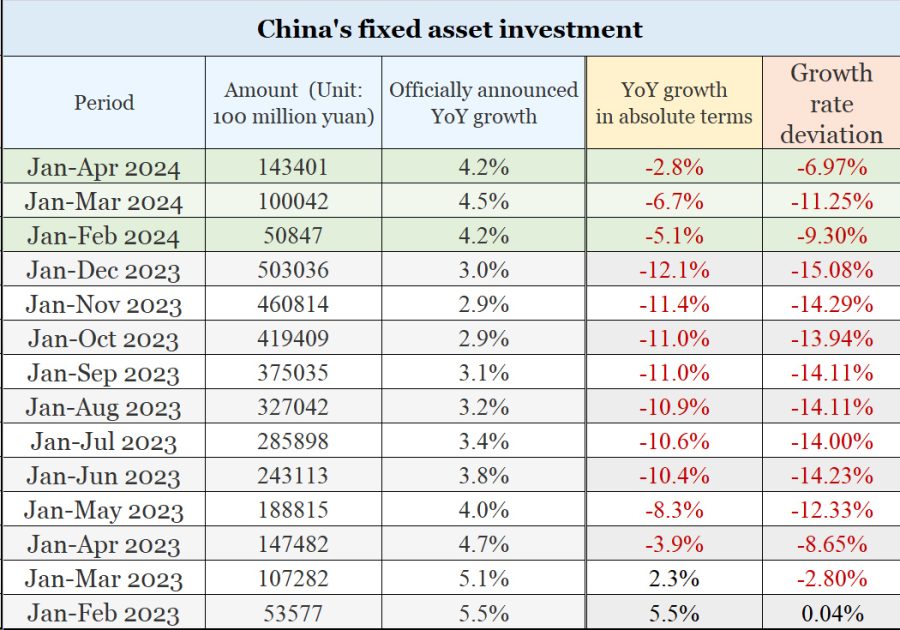
Table 1 (Source: National Bureau of Statistics)
A closer look at the official economic data released by the CCP authorities for April and the first four months of 2024 shows that China’s exports, consumption, and investment are weak, and that the Chinese economy is still in a deflationary state.
2. Declining real estate prices in April indicates that China’s real estate crisis is worsening. This will negatively affect the country’s financial system and cut into local government fiscal revenues.
Falling home prices will reinforce existing property buying trends. Potential homebuyers will become more inclined to wait for prices to bottom out before making purchases. Also, second-hand homeowners who are concerned about further price declines could rush to cash out of their property while it still has value, thus creating a vicious cycle that negatively impacts property prices. The trend of falling home prices will lead to fewer bank mortgages, the devaluation of banks’ real estate collateral, and a rise in bad debts and financial risks.
Additionally, local governments will reduce land sales as property prices plummet. Already, the Office of the Ministry of National Resources issued a notice on May 8 requiring local governments to suspend the sale of new commercial residential land if the local commercial housing decommissioning cycle exceeds 36 months.
3. The recent wave of so-called “historic” real estate policies by the CCP authorities are undoubtedly intended to reverse the growing property sector malaise and prevent the triggering of financial risks. However, the effectiveness of the policies may be limited.
The CCP authorities could be attempting to stabilize house prices by acquiring some of the inventory through SOEs for use as affordable housing and providing liquidity to troubled property developers through relending to help them finish projects. However, most local governments and local SOEs are heavily indebted and would likely struggle to raise funds to make property acquisitions. There may also not be many SOEs with a good enough credit rating to meet the financing conditions for reloans.
Beijing would need to spend much more than it has currently slated for the current policies to work. Tianfeng Securities estimated that the CCP authorities would have to spend at least 7 trillion yuan if it hopes to help property companies clear inventory within 18 months. However, the central government has only approved the issuance of 1 trillion yuan worth of ultra-long bonds. Meanwhile, a real estate analyst told state-run mainland media National Business Daily that the 300 billion yuan relending facility “can only help to digest 30 to 50 million square meters of housing. In the current market, that is akin to trying to extinguish a fire in the Greater Khingan Range with a bucket of water.”
The central government appears to believe that lowering the threshold for home purchases (mortgage interest rates and down payment ratios) will translate to more home sales. However, the worsening of the Chinese economy appears to be the main reason for declining home sales, with residents becoming less inclined to spend in the face of income reduction and unemployment. Chinese residents are also becoming reluctant to increase their leverage by investing in property given falling real estate prices. For instance, the reduction of the down payment ratio from 20 percent to 15 percent increases the leverage ratio of home buyers from five times to seven times. Should home prices fall by more than 15 percent in the near future, property will become a negative asset and banks will demand additional collateral from home buyers. Banks would also see an increase in bad debts.
We believe that a potentially significant factor contributing to the shortage of housing demand in China could be a massive reduction in population during the pandemic years and even after. Overseas Chinese language media continue to report that the pandemic in China remains severe despite the claims by the CCP authorities, with residents reporting that there are more cases of fever, pneumonia, and cancer thus far in 2024 than in previous years, and that hospitals and funeral homes are often overcrowded. Assuming the reports are correct, then China did not beat the pandemic and pandemic-related deaths are continuing to accrue.




