
1 US tightens tech restrictions on China
Washington recently continued clamping down on the PRC’s access to American technology while signaling bigger moves in the future.
Jan. 27
1. Japan and the Netherlands joined the U.S. in restricting exports of advanced semiconductor technology and machinery to China, according to several news reports (see here and here). The countries did not publicly announce the move due to “sensitivity,” and actual implementation could take months as they finalize legal arrangements.
While details of the agreement are sparse, media outlets say that the Netherlands will expand restrictions on ASML Holding NV to prevent it from selling to China some of its deep ultraviolet lithography machines used to manufacture advanced chips. Japan will also impose similar limits on Nikon Corp.
2. Rep. Michael McCaul (R-TX), the House Foreign Affairs Chair, told Politico that he learned from conversations that the Biden administration is considering a total ban on U.S. investments in certain high-tech areas of China’s economy.
The administration “is talking about a theory where they would stop capital flows into sectors of the economy like AI, quantum, cyber, 5G, and, of course, advanced semiconductors — all those things. They actually want to say, right, you can’t invest in any [Chinese] company that does AI. You can’t invest in any company that does cyber” or other similar sectors, McCaul said.
3. The House Foreign Affairs Committee announced plans in February to vote on a bill to ban the Chinese-owned social media app TikTok in the United States
Jan. 30
1. Financial Times reported that the Biden administration had notified some U.S. companies that it would no longer issue licenses to allow them to export American technology to Huawei. Previously, the U.S. government had granted export licenses to some companies like Intel and Qualcomm after the Trump administration added Huawei to the “entity list” in 2019.
Bloomberg also reported that the Biden administration is looking to ban all U.S. suppliers from selling to Huawei. A person familiar with matters told The Wall Street Journal that an idea the administration is considering is prohibiting exports to other companies and intermediaries who then supply Huawei.
2. Rep. Cathy McMorris Rodgers (R-WA) announced that TikTok CEO Shou Zi Chew will appear to testify before the U.S. Energy and Commerce Committee on March 23.
The backdrop
The Biden administration’s tech curbs on China come amid impending escalation in the Russia-Ukraine conflict and the international community’s growing wariness towards a possible PRC invasion of Taiwan.
Our take
Several short and long-term factors appear to be behind Washington’s latest efforts to halt the PRC’s access to advanced technology.
The U.S. began restricting exports of American technology and manufacturing equipment to China during the Trump administration as Washington and the world gained greater awareness of and focused their attention on the CCP threat. The Biden administration has since continued and strengthened the Trump administration’s tech sanctions on China. As long as Washington views Beijing as a revisionist power that intends to subvert and replace the rules-based international order, future administrations will likely maintain and tighten technology restrictions with regard to China while rebuilding America’s semiconductor and key technologies manufacturing capacity.
Washington’s guarding of American technology also appears to be an attempt to both hoard and safeguard the supply of strategic resources. The chip crunch during the pandemic and growing geopolitical tensions have seen semiconductors become as vital to modern economies as oil. Intel CEO Pat Gelsinger made such a comparison in an interview with The Wall Street Journal in October 2022, “As I’ve said, where the oil reserves are located has defined geopolitics for the last five decades. Where the chip factories are for the next five decades is more important because everything hinges on where our technology is.”
Finally, it cannot be ruled out that Washington’s tech curbs on China are partly influenced by more immediate developments. As we analyzed in the previous newsletter, the Biden administration seems to be pressuring the PRC into distancing itself from Russia and aligning itself with the international community on the Russia-Ukraine war. The administration could also have assessed that Xi Jinping is under tremendous pressure owing to recent domestic setbacks (post-“zero-COVID” health crisis, rapidly worsening economy, growing political and social instability, etc.), and have decided to lean more strongly on China to get the Xi leadership to make important concessions.
What’s next
The Biden administration could roll out more measures to tighten the screws on the PRC ahead of Secretary of State Antony Blinken’s trip to China in early February. This could compel the Xi leadership to further obscure “wolf warrior” diplomacy and appear more “accommodative” of Washington’s demands.
Whether Beijing actually gives up ground on key issues (Ukraine, Taiwan, climate, etc.) instead of paying lip service as it “delays and waits for change” remains to be seen. Regardless, Xi Jinping will face increased political risks if he responds too meekly in the face of mounting U.S. pressure.
2 Sichuan health authorities allow unmarried people to legally have children
On Jan. 30, mainland media reported that the Sichuan health commission had made revisions on Jan. 12 to its birth registration measures (四川省生育登記服務管理辦法) issued in 2019.
The revisions, which would come into effect from Feb. 15 and will be valid for the next five years, essentially allowed married couples and unmarried individuals who want to have children to register with the government. The revisions also do not impose any ceiling on the number of children that people can register for. Previously, the Sichuan health commission had only permitted married couples who want to have up to two children to register with them.
Mainland media explained that the “fertility registrations” as listed in the revisions are not the same as household registrations (hukou). Also, the revised measures are not meant to encourage unmarried people to have children but to safeguard the rights and interests of people who have children out of wedlock, including allowing them access to some maternal and childcare health services after registering with the authorities.
The backdrop
The CCP authorities had earlier acknowledged China’s demographic decline after years of hiding the fact. On Jan. 17, the National Bureau of Statistics announced that China’s population had declined by 850,000 to less than 1.42 billion people in 2022.
As for Sichuan, the province had a registered population of 90.945 million people and a permanent population of 83.72 million people at the end of 2021. Sichuan has the fifth largest population of provinces in China.
Data in the PRC’s Seventh National Population Census published in 2021 suggests that Sichuan’s demographic dividend is decreasing. Compared with the previous census in 2010, the proportion of children and labor-age population in Sichuan decreased by 0.87 percent and 4.54 percent respectively. Concurrently, the proportion of those ages 60 and above was 21.71 percent (up 5.41 percent) of the Sichuan population, while those ages 65 and above comprise 16.93 percent of the population (up 5.98 percent). This means that Sichuan has an aged society (proportion of those 65 and above at 14 to 20 percent), according to the World Health Organization’s definition.
Our take
1. The Sichuan authorities are looking to alleviate their local population crisis by permitting unmarried individuals to register children with the government. Sichuan has some of the poorest areas in China and has long suffered from “labor drain” as the province’s youth travel to other places for work.
Sichuan’s aging population will also impact the nationwide labor shortage problem and see China’s manufacturing capacity shrink.
2. Mainland media picked up on the Sichuan authorities’ move to allow unmarried people to legally have children only after the central authorities acknowledged a population decline. It is possible that local officials recently decided to call attention to what they had done some weeks back because they no longer had to be concerned with being “politically incorrect” with China’s population crisis now out in the open.
3. In today’s China, economic factors are the main reason why the Chinese people are unwilling to get married and have children despite the end of the “one-child” policy and the CCP’s introduction of pro-natalist policies. For instance, the cost of raising a child in China is far higher than in the U.S. and Japan (485,000 yuan on average to raise a child to the age of 18; more than 1 million yuan in Shanghai and 969,000 yuan in Beijing), and people are increasingly struggling to make ends meet as the Chinese economy rapidly deteriorates.
As such, the Sichuan authorities’ effort to promote births through allowing unmarried people to legally have children will likely do almost nothing to boost fertility. Instead, the move will further erode cultural mores and create even more social problems that worsen the demographic crisis. For instance, unmarried people without the means will still opt not to have children, while the Party elite and the wealthy will have more “license” to engage in extramarital affairs and surrogacy without consequences while leaving the burden to the unwed mothers.
We noted in our 2023 China outlook: “China’s population crisis will become more obvious. The CCP will resort to authoritarian means to reverse this trend, but those measures will be ‘too little, too late’ and will likely result in more social problems.” What the Sichuan authorities have done puts our prediction on track for verification.
Why it matters
The CCP cannot “delay and wait for change” or fulfill its “the East is rising, the West is in decline” mantra if it cannot fix its demographic crisis. On the current trajectory, decoupling between the PRC and the U.S., as well as between the PRC and the world at large, will accelerate as China’s “demographic dividend” runs out. The CCP regime will also find itself more vulnerable to sanctions as its “economic shield” crumbles.
3 Many public security, procuratorate, and judicial leading cadres reshuffled at local Two Sessions
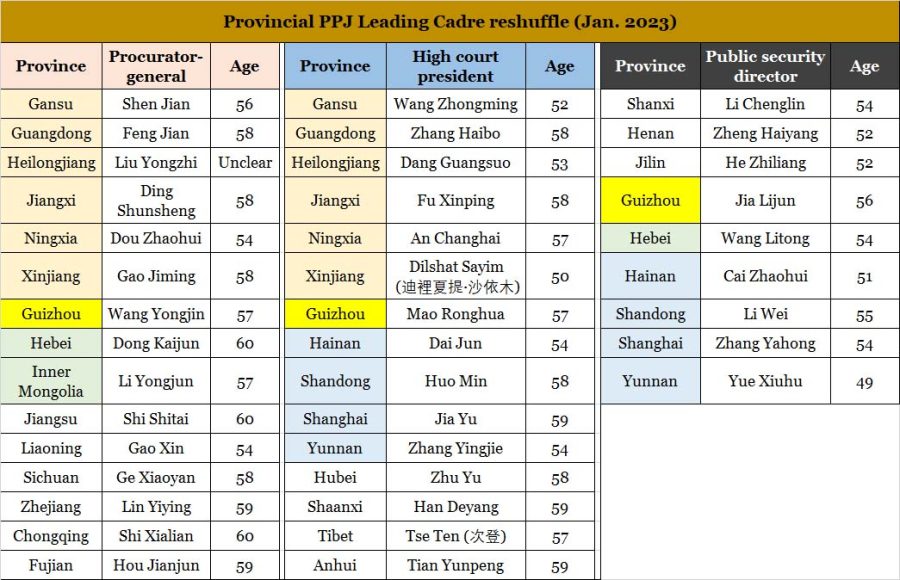
All 31 provinces in China concluded their local Two Sessions between Jan. 14 to Jan. 19. During the meeting, the new leadership team of local governments were “elected” to office, including leading cadres of provincial high courts, procuratorates, and public security bureaus.
Reshuffle details
The presidents of high courts in 15 provinces were reshuffled, including Heilongjiang, Shanghai, Anhui, Jiangxi, Shandong, Hunan, Guangdong, Hainan, Guizhou, Yunnan, Tibet, Shaanxi, Gansu, Ningxia, and Xinjiang.
The procurator-generals of procuratorates in 15 provinces were replaced, including Hebei, Inner Mongolia, Liaoning, Heilongjiang, Jiangsu, Zhejiang, Fujian, Jiangxi, Guangdong, Chongqing, Sichuan, Guizhou, Gansu, Ningxia, and Xinjiang.
The directors of public security bureaus in nine provinces were changed, including Hebei, Shanxi, Jilin, Shanghai, Shandong, Henan, Hainan, Guizhou, and Yunnan.
Seven provinces reshuffled both the heads of their high court and procuratorate, including Jiangxi, Guizhou, Gansu, Guangdong, Ningxia, Heilongjiang, and Xinjiang. Guizhou also replaced its public security director.
Why it matters
The Jiang Zemin faction has long held sway over the political and legal affairs apparatus, a crucial tool for “maintaining stability” and protecting the CCP’s power in the regime. As such, Xi Jinping has been attempting to “rectify” the political and legal affairs apparatus since taking office and bring it to heel.
The latest round of provincial public security, procuratorate, and judicial (PPJ) leading cadre personnel adjustments offer clues to how much control Xi actually has over the regime.
Our take
1. The PPJ reshuffles at provincial Two Sessions indicate that Xi Jinping is not at ease with the officials in the political and legal affairs apparatus. Many PLAC officials who are eligible to hold leadership positions more or less have some associations with the Jiang faction. Meanwhile, Xi also does not have an abundance of cronies or trusted officials available to fill up the key provincial PLAC slots.
Public security directors
Yang Dong (age 60), the public security director of Ningxia Province, and Qin Yi (59), the public security director of Jiangxi Province, have both reached retirement age and are slated to step down. The appointment of Sun Hongshan, the former Shanxi public security director, as vice governor of Jiangxi means that Sun will likely be confirmed as the new Jiangxi public security director. It is yet unclear who will replace Yang Dong as Ningxia public security head.
Separately, the public security directors of Sichuan and Tibet are both 57 years old and have served in their post for nearly five years. This suggests that both directors are likely to be replaced later this year.
Of the nine public security directors who were newly appointed so far in January 2023, four are career police officers or have experience working in political and legal affairs, four others did not previously serve in the political and legal affairs apparatus, and there is little publicly available information about the remaining one (the Hainan public security director). Yunnan public security director Yue Xiuhu, the youngest of the nine (age 50), is concurrently serving as director of the Yunnan Provincial Development and Reform Commission.
Three of the nine new public security directors were transferred to the provinces from the Ministry of Public Security (MPS) either recently or previously. They are:
- Jia Lijun, deputy Party secretary, political commissar, and secretary of the disciplinary committee of the MPS’s intelligence command center, was appointed Guizhou public security director.
- Zhang Yahong, former Party secretary and director of the MPS’s intelligence command center, was transferred to Shanghai to serve as deputy public security director in November 2021, and was promoted to director at the provincial Two Sessions.
- Zheng Haiyang, director of the MPS’s railway bureau and former director of the Beijing Municipal Public Security Bureau’s political department, was appointed Henan public security director.
The three aforementioned officials are former subordinates of Xi ally and public security minister Wang Xiaohong. The number of former Wang subordinates serving as provincial public security heads has now increased from five before the 20th Party Congress to eight.
Of the 31 provincial public security chiefs, 28 are under 58 years old, and 18 of the 28 are younger than 56. Another eight were born in the 70s. Younger officials rose through the ranks much later during the Jiang faction’s era of dominance (1997 to 2012), and are more likely to have weaker patron-client relations with Jiang faction officials.
High court presidents
The high court presidents of new provincial governments tend to be older than the public security directors. For instance, four of the 31 current high court presidents have reached the retirement age of 60 while 13 are between 58 to 59. Meanwhile, five high court presidents are under 55 years old and two were born in the 70s. The Xi leadership has less leeway to appoint younger officials or those from outside the judicial profession to serve as high court presidents due to the legal knowledge and experience requirements.
Presently, seven of the 31 high court presidents (Zhejiang, Sichuan, Jiangsu, Henan, Inner Mongolia, Guangxi, and Jilin) have served for five years or nearly five years at their posts. With the exception of Yang Zongren (age 56) in Inner Mongolia, the other six are close to or have reached retirement age. These seven high court presidents could be reshuffled later this year.
Procurator-generals
The current crop of provincial procurator-generals are even older than the provincial high court presidents. Six of the 31 procurator-generals are 60, nine are approaching retirement age (58 to 59), and only four are younger than 55. Of the 15 personnel reshuffled this round, nine are over 58 and three have reached retirement age.
2. All the recent PPJ personnel reshuffles were either inter-provincial or inter-departmental transfers. For instance, the high court presidents of seven provinces (Shanghai, Anhui, Jiangxi, Shandong, Hunan, Heilongjiang, and Xinjiang) were either previously officials at the Supreme People’s Procuratorate or procuratorial officials from other provinces. Meanwhile, the procurator-general of five provinces (Jiangsu, Hebei, Fujian, Sichuan, and Liaoning) were appointed from among the high court presidents of other provinces.
Such personnel arrangements call attention to Xi Jinping’s problem of having insufficient trusted officials to install in key positions. To tackle corruption and factional struggle issues, Xi has resorted to inter-provincial and inter-departmental swaps as a way to weaken or prevent local power networks from forming or being abused to undermine his rule. Moving leading cadres away from their base of operations (調虎離山) also facilitates the Xi leadership’s investigations into them or their associates, if investigations are warranted.
What’s next
The Xi leadership could strengthen the “rectification” of the political and legal affairs apparatus after key posts in the central government have been officially filled at the upcoming Two Sessions in March.
4 Qiushi stresses ‘self-revolution’ again after the Lunar New Year
Qiushi, the CCP Central Committee ideological journal, published an article on Feb. 1 titled, “Comprehensively Strictly Govern the Party and Explore a Successful Path to Escape Historical Cycles By Relying on the Party’s ‘Self-revolution’” (全面從嚴治黨探索出依靠黨的自我革命跳出歷史週期率的成功路徑). The article was adapted from Xi Jinping’s speech at the sixth plenum of the 19th Central Commission for Discipline Inspection on Jan. 18, 2022.
In the article, Xi first touted his contributions to the CCP’s fight against corruption. Xi noted that since he took office, “some unhealthy trends that have not been stopped for many years have been stopped, many chronic diseases that have not been resolved for a long time have been resolved, serious hidden dangers in the Party, the country, and the military have been eliminated, and the laxity and softness in Party management have been fundamentally reversed.”
Xi then stressed the importance of the anti-corruption campaign in preserving the regime. He again brought up the “cycle” conversation (of why dynasties rise and fall) and noted that “self-revolution,” his “answer” to the escaping historic cycles, “concerns the Party’s survival or death, and concerns the success or failure of our socialist system.”
Xi further put forth several requirements on how to “strictly govern the Party” and achieve the requirements of “self-revolution.”
The backdrop
The Qiushi article comes amid mounting internal and external crises for the Xi leadership, including a post-“zero-COVID” health crisis, a very high COVID death toll, the CCP’s acknowledgment of China’s demographic crisis, and growing pressure from the U.S. and the international community over the PRC’s stance on Taiwan and Ukraine.
Our take
The publication of the Qiushi piece immediately after the Lunar New Year holiday is likely meant to serve as a stern warning from Xi Jinping to the Party elite and others who have suffered from Beijing’s policy failures and are becoming increasingly dissatisfied with the Xi leadership. Xi would be hoping to intimidate his factional foes and other “anti-Xi” elements by signaling through the Qiushi article that the anti-corruption campaign and “self-revolution” rectification effort will come for them should they attempt to undermine his rule and the regime. The indirect criticism of Xi’s predecessors in the piece also serves to put on notice the remnant Jiang faction and underscores Xi’s determination to purge lingering political enemies.
Concurrently, the Qiushi article signals to the CCP elite and members that they should set aside their discontentment with the Xi leadership and instead unite around Xi Jinping to preserve the regime. Xi would be hoping that the Party comes to a “consensus” in backing his leadership, otherwise he would have no choice but to eliminate “hidden dangers” in the name of “self-revolution.”




